Howard is right about the "D" cells wired up parallel and then wrapped in a big wad of tape.
When coming to CL Stunt I had been using--in RC Pattern and CL Combat--sticks of sub-C nicads, six cells total, mainly as I had, and still have, hundreds of the things. Series/parallel wiring to give 2.4 volts at the pack. Fairly long leads, wire-wound resistor home-made and inserted in one line, tapped just past the point where a Fox plug would flash-bulb into oblivion. (The best use ever for Fox plugs, in my opinion.)
I actually chuckled to myself when asking PW what batteries were in the wad of plastic electrical tape. "Dry cells!! That boy ain't as smart as I have been lead to believe..."
Shortly thereafter, actually *very shortly* thereafter, and with a different matter entirely, I came to see the error of my assumption.
Dry cells are much preferred today, I'm not even sure I can find those old nicad-based packs from yesteryear. Dry cells deliver plenty of power for our Stunt engines and plugs, they are exceedingly reliable over an entire season of heavy use, back-ups can be kept in the tool box or purchased at any convenience store.
Best of all, **they need not be charged, nor do they inexplicably work one minute only to "fall off the knee" of discharge cycle and not working the next flight**.
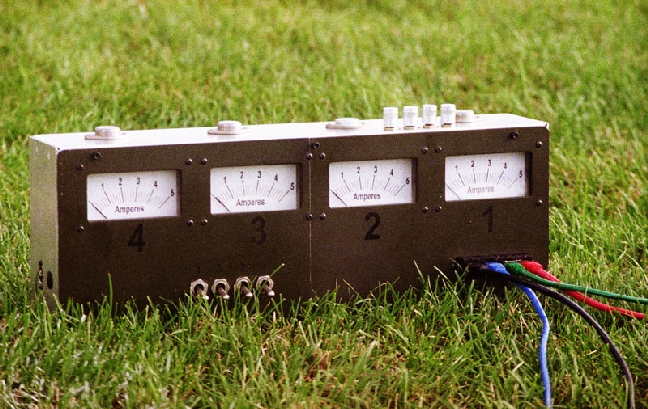
The Gary Letsinger-built flight box I use contains four "D" cells, driving though 0-5 ammeter.
How y'all can stand those silly single-nicad glow battery units, *and* not having a meter of some sort to indicate continuity, flooded engine, dry engine, I will never know...
But I do know that plain, old-fashioned "D" cells handle my every need when it comes to CL Stunt models of any kind.