Is there a rule of thumb in determining line drag between solids and stranded? If you were flying on 70ft. solids (.014) and decided to change to stranded (.018), what length stranded would equate to the solids? I'm definitely in the cable camp, but occassionally feel the need for solids for a percieved gain in performance (heavy airplane). Thanks, dale g
solid vs cable-drag
Stuka Stunt Main Forum · 34 of 34 known posts recovered
Dale:
I can't give you any math, just something from my own experience. In the early 1990s I had a few Tigre 60 powered ships, all of which I converted to OS 40VF piped set ups.
At first I continued to fly 'em on the 67' of .018" cable. Eventually I put 'em on 70' of .015" cable, expecting the lap time to slow down.
Much to my surprise, the lap time speeded up. I then did the math and realized the model was dragging a lot less metal around the circle with the longer thinner lines.
It would probably be even more exaggerated with .014 solids.
I currently fly a smallish (630 sq in) ship on .014 solids. I tried going to .018 and a hard point handle, but nothing beats the performance of the solids, They were quite popular here in the northeast in the late 80s and early 90s. Sure, they require more care, but I feel are well worth it.
That's my .02
RC
Drag goes linearly with line diameter. The drag of a cable the same size of a solid line may be very slightly lower than solid lines due to the effects of turbulation.
However, the weight of the lines goes as the square of the diameter!
So, for example going from a .049 engine to a .061 engine you get a 20% increase in power, but you have to go from .008 to .012 cable lines and there is a 50% drag increase, plus, roughly a 100% weight penalty.
The lesson of the above, is that if you fly a .061, use .008 solid lines. IF you can find them 
LeagueCityRalph · Aug 11, 2004 10:31 PM
#5 source
Hi Larry,
I bought a 1000' spool (or maybe it was 1#; still, a lot) of pre-straightened .008 stainless wire about three months before AMA proclaimed that the Mouse-Race lines ought to be .010 instead.
I bought a 1000' spool (or maybe it was 1#; still, a lot) of pre-straightened .008 stainless wire about three months before AMA proclaimed that the Mouse-Race lines ought to be .010 instead.
Want some? How much? I certainly can't use solids in Houston, except for about 3 days per year . . .
Larry, I think you made a misstatement. Crosssection area of the lines is pi x radius x radius, not pi x diameter x diameter. Interestingly enough, it appears to make no difference in figuring the weight ratio. .012 is 2.25 times as heavy as .008 either way you figure it.  Life is good!
Life is good!Jim
>Is there a rule of thumb in determining line drag between
>solids and stranded? If you were flying on 70ft. solids
>(.014) and decided to change to stranded (.018), what length
>stranded would equate to the solids? I'm definitely in the
>cable camp, but occassionally feel the need for solids for a
>percieved gain in performance (heavy airplane). Thanks, dale
>g
>solids and stranded? If you were flying on 70ft. solids
>(.014) and decided to change to stranded (.018), what length
>stranded would equate to the solids? I'm definitely in the
>cable camp, but occassionally feel the need for solids for a
>percieved gain in performance (heavy airplane). Thanks, dale
>g
Ron B.
F4Fguy
Probably the most comprehensive study of this was "Wild Bill" Netzband's series of articles in American Modeler. They are in the July/August and September/October 1966,and December 1967 issues.I'm sure there's some drag coefficient difference between solids and cable,but basically,the drag varies directly with line diameter,and directly with line length.The articles give both the equations and nomograms for determining drag,line rake,etc.,for varying speed,model weight,line length,and line diameter.
Ron B.
I've got the old magazines so I'll dig 'em up. Meantime, I'm going to chop the stranded 018s a foot shorter than the solid 014s. I've had some line sticking experiences with solids in the past and maybe I just need to keep them cleaner. Thanks, everyone.
How long has it been since line elasticity's been brought up on the BBS? What a hot topic it was, in the past.. I think it was Brett who made the case for using .018s instead of .015s because they were less elastic, never mind the extra drag. Phil Granderson then came up with using British tinned wire, which stretched very little.
Brett Buck · Aug 12, 2004 12:16 AM
#7 source
>How long has it been since line elasticity's been brought up
>on the BBS? What a hot topic it was, in the past.. I think
>it was Brett who made the case for using .018s instead of
>.015s because they were less elastic, never mind the extra
>drag. Phil Granderson then came up with using British tinned
>wire, which stretched very little.
>on the BBS? What a hot topic it was, in the past.. I think
>it was Brett who made the case for using .018s instead of
>.015s because they were less elastic, never mind the extra
>drag. Phil Granderson then came up with using British tinned
>wire, which stretched very little.
Nothing much to mention. .018 are still a lot less compliant than .015, data transmitted, not much more to talk about. Control system compliance is still vitally important, but everybody knows the pros and cons.
Brett
Igor Burger · Aug 12, 2004 07:08 AM
#8 source
There was already something written in past. As far as I remember, the conclusion was, that the drag does not vary too much with surface quality. The reason is, that RE number is in segment where the drag coefficient is invariant to the RE number. That picture down shows relation between drag and RE number for cylindric body. It shows that drag coefficient goes down with growing RE till RE=~100 then it is almost constant till re=~10 000, then it does funny things at critical RE and continues straight again (no shownt) in higer REs.
We are with our lines under 1000 If I calculate well.
That is for 7 strand lines but what about my russian 4 strand? ...  ... I even do not know what is the exact diameter
igor
Has anyone done a Reynolds number calc on lines, .015, .018 or otherwise. Does Reynolds number change at the leadout/mid point/ at the handle?
Brett Buck · Aug 12, 2004 02:55 PM
#12 source
>Has anyone done a Reynolds number calc on lines, .015, .018
>or otherwise. Does Reynolds number change at the leadout/mid
>point/ at the handle?
>or otherwise. Does Reynolds number change at the leadout/mid
>point/ at the handle?
Certainly. Read Pete Soule's paper on line drag!
Brett
I must have misplaced my copy in the garage. Where might I find a copy of Peter Soule's line drag article.
Iskandar Taib · Aug 13, 2004 06:27 AM
#20 source
Igor, is there a cheap source for the Russian wire in bulk (several thousand feet)?
Nothing Russian is cheap anymore. We use combat 4 strand lines, I have enough for 2 sets, no more. I hope at EC next year they bring more stuff ... if I do not forget ...
BTW they are typically available as 30m pieces for combat guys. So it needs two combat lines for one stunt set.
Iskandar Taib · Aug 16, 2004 10:10 PM
#29 source
If it's the Russian combat wire, then it's .015-.016 inch in diameter. Viktor Yuvenko said he'd sell me large spools of it, but it wasn't much cheaper than buying cut sets. Might be worth it for Stunt flying, though.
Might be worth it to the Combat fliers to try to find someone to make the stuff in the U.S. - one company I contacted did have three strand .015 galvanized wire. On the other hand, the Russian wire sells for $3 a set, so it's not prohibitively expensive.
When slowrat went from 018 cable to 018 solids back in '79 or '80, we all thought that the plane speed would be slower, ... but it wasn't ...
As it turned out, the 018 soilds were .018 inch in diameter....
The 018 cable turned out to be 0.0188 inch diameter. Botton line ... don't believe the number on the package. The bronze colored cable actually measured about right. Remember though that AMA allows for a +/- .0005 inch dispersion.
As it turned out, the 018 soilds were .018 inch in diameter....
The 018 cable turned out to be 0.0188 inch diameter. Botton line ... don't believe the number on the package. The bronze colored cable actually measured about right. Remember though that AMA allows for a +/- .0005 inch dispersion.
I think that 016 soild would actually be more correct for the new larger displacement engines legal next year. After 3 or 4 loops I'm not sure that the 018 soilds are going to slide over each other very well.
Brett Buck · Aug 12, 2004 12:42 PM
#10 source
>When slowrat went from 018 cable to 018 solids back in '79
>or '80, we all thought that the plane speed would be slower,
>... but it wasn't ...
>As it turned out, the 018 soilds were .018 inch in
>diameter....
>The 018 cable turned out to be 0.0188 inch diameter. Botton
>line ... don't believe the number on the package. The
>bronze colored cable actually measured about right.
>Remember though that AMA allows for a +/- .0005 inch
>dispersion.
>
>or '80, we all thought that the plane speed would be slower,
>... but it wasn't ...
>As it turned out, the 018 soilds were .018 inch in
>diameter....
>The 018 cable turned out to be 0.0188 inch diameter. Botton
>line ... don't believe the number on the package. The
>bronze colored cable actually measured about right.
>Remember though that AMA allows for a +/- .0005 inch
>dispersion.
>
Indeed, beware. I got several reels of Sullivan lines a few years back, and idly went about making the end fittings. On a whim, I decided, "well, might as well check the diameter, too". On one set, both lines were .0174. On the other set, the one line was .0181, and the other .0175. SO check ahead of time, before you make the ends up.
Brett
I have almost 8000 feet of the brown stuff left over from my combat days. 1000 feet per roll, and 8 rolls. one has some sets of lines from it. Before pulling and stretching, they measure from 0.0174 up to 0.0178. none even to 0.018 or above. after several pulls and usages they usually lose about 0.0003 inch or so. Seastrand was the brand.
Bigiron
Well, the proof is in the pudding, so to speak. Flew today in dry, cool air with 018 cables and the old ship was a real drag. Almost 6 second lap time at the usual 10.2K rpm. Got to 5.8 with 10,5K where the motor didn't sound happy. Out came the solids, 10.2K ran 5.6 lap times, where I like it to be. The cables were 5 inches shorter. Until I build that light-weight ship, I better stay with the solids. Thanks to all, dale g
Brett Buck · Aug 12, 2004 10:09 PM
#17 source
>Well, the proof is in the pudding, so to speak. Flew today
>in dry, cool air with 018 cables and the old ship was a real
>drag. Almost 6 second lap time at the usual 10.2K rpm. Got
>to 5.8 with 10,5K where the motor didn't sound happy. Out
>came the solids, 10.2K ran 5.6 lap times, where I like it to
>be. The cables were 5 inches shorter. Until I build that
>light-weight ship, I better stay with the solids.
>in dry, cool air with 018 cables and the old ship was a real
>drag. Almost 6 second lap time at the usual 10.2K rpm. Got
>to 5.8 with 10,5K where the motor didn't sound happy. Out
>came the solids, 10.2K ran 5.6 lap times, where I like it to
>be. The cables were 5 inches shorter. Until I build that
>light-weight ship, I better stay with the solids.
Huh? It would make less difference on a heavy plane than a light plane, I would think.
What I would probably do is go into LINEII, put in the parameters for your airplane and fiddle with the weight until you get the current line sweep. Then switch to .018, and fiddle the length until you get the same line sweep. Then make up lines that length, and go see.
Of course, it's going to fly differently, but I have recently tried the inverse experiment (cables to solids) and it didn't make a huge difference. Some, but not a show stopper.
Brett
I'm going out and try this again this morning with Bob. I certainly prefer the "silkiness" of Tom Morris's 018 cables, but the plane seems to labor dragging them around in comparison to the solids-most notable in the square eight verticle lines. All I want is the continuous/steady state manuever speed your plane, Bill's, Bob H's and Dave's demonstrated at he Final 5. Paul's was a little fast for my reaction times, I feel. Thanks, dale g
>Well, the proof is in the pudding, so to speak. Flew today
>in dry, cool air with 018 cables and the old ship was a real
>drag. Almost 6 second lap time at the usual 10.2K rpm. Got
>to 5.8 with 10,5K where the motor didn't sound happy. Out
>came the solids, 10.2K ran 5.6 lap times, where I like it to
>be. The cables were 5 inches shorter. Until I build that
>light-weight ship, I better stay with the solids. Thanks to
>all, dale g
>in dry, cool air with 018 cables and the old ship was a real
>drag. Almost 6 second lap time at the usual 10.2K rpm. Got
>to 5.8 with 10,5K where the motor didn't sound happy. Out
>came the solids, 10.2K ran 5.6 lap times, where I like it to
>be. The cables were 5 inches shorter. Until I build that
>light-weight ship, I better stay with the solids. Thanks to
>all, dale g
I am curious as to what airplane/engine combination you are using. I wouldn't think that lap times would be nearly that dramatic unless there simply wasn't sufficient power coming out of the engine package.
Leonard,
He flies an Impact on a PA65 turning a 13" Phelps prop.
Iskandar Taib · Aug 13, 2004 06:09 AM
#18 source
Is everyone measuring the diameter correctly?
http://www.thecableconnection.com/wireropeassemblies/spec2.htm
Left is correct, right is not.
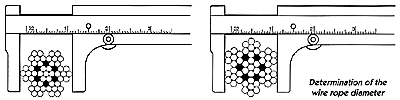
The brown stuff is, I think, from Sevenstrand Corp (and mostly sold to Combat fliers via Riley Wooten). It gets repackaged for sale under various other names, but if you compare test strengths given by Sevenstrand and those given by other manufacturers, the Sevenstrand wire seems quite a bit stronger. Whether it actually is or isn't I've no idea, I've never actually done any destructive testing. The European carbon steel brown wire is quite a bit stronger (or at least, it saws through a lot less easily) than the American stainless.
I only use solids, I feel they offer a better feel over the Cable.
However, care is needed BEYOND reproach. Clean them 4 times before and after everyflight. Dont use rainex.
Ive also been told, by a few medical people, that "isopropyl alchol" is only a disinfectant, and offers poor cleaning properties for removing grease, grim, wax residue, or exhaust gas"
If you intend to put the solids into your skin, it will disinfect it sufficiently, but will not remove fully these other items, as its not designed to.
Ive personally been using solids since 1998 and in all those years I still find regular "carburettor Cleaner" for car engines to be the best gear around. Its soul purpose is to remove grease, grim, exhaust buildup ect ect off metal parts QUICKLY, and offer smooth free motion.
Ive used 5 different brands from the Us and Australia, and found most of them work the same way, my advice to anyone out there using solids, Give this stuff a go, see for yourself if its better/worse than what you are currently using. Im not saying USE IT!!!! im saying TRY IT!
"Clean lines maketh the pattern"
However, one thing was strange about my visit to the US for the US NATS, Out here we dont often fly over tarmac and I had been used to cleaning them a few times before my flight then leave the lines resting on the ground, however after 2 flights I noticed i was getting a LARGE amount of line bind, I later realised the lines were clean and upon leaving them on the tarmac for 5 - 10 mins they picked up all the grease off the ground, so Its best to re-clean them before your flight, but thats just sensible practice in itself.
PJ
Igor Burger · Aug 13, 2004 09:55 AM
#25 source
>>>"isopropyl alchol" is only a disinfectant<<<
It is alcohol as any other. So it DOES clean as others do. It clean something and something not. It IS dedicated for cleaning - for example it is typical cleaner for electrotechnic stuff. But the real problem why he told you it is only for disinfection is that the bottle you can get in shop contains too much water and thus it does not solve gerease very well. That is like if you add water to the fuel, it will immediately separate oil from alcohol. I got a bottle ir Muncie for cleanig. It was 90% alcohol and it still worked well. We used it for cleaning models. Methyl works well too, but huts hands. But we here use "petrol for cleaning". It is available in our shops. I did not see it in US shops, may be the petrol for burning will work as well, I do not know.
Iskandar Taib · Aug 16, 2004 10:18 PM
#30 source
>>>>"isopropyl alchol" is only a disinfectant<<<
>
>It is alcohol as any other. So it DOES clean as others do.
>It clean something and something not. It IS dedicated for
>cleaning - for example it is typical cleaner for
>electrotechnic stuff. But the real problem why he told you
>it is only for disinfection is that the bottle you can get
>in shop contains too much water and thus it does not solve
>gerease very well. That is like if you add water to the
>fuel, it will immediately separate oil from alcohol. I got a
>bottle ir Muncie for cleanig. It was 90% alcohol and it
>still worked well. We used it for cleaning models. Methyl
>works well too, but huts hands. But we here use "petrol for
>cleaning". It is available in our shops. I did not see it in
>US shops, may be the petrol for burning will work as well, I
>do not know.
>
>It is alcohol as any other. So it DOES clean as others do.
>It clean something and something not. It IS dedicated for
>cleaning - for example it is typical cleaner for
>electrotechnic stuff. But the real problem why he told you
>it is only for disinfection is that the bottle you can get
>in shop contains too much water and thus it does not solve
>gerease very well. That is like if you add water to the
>fuel, it will immediately separate oil from alcohol. I got a
>bottle ir Muncie for cleanig. It was 90% alcohol and it
>still worked well. We used it for cleaning models. Methyl
>works well too, but huts hands. But we here use "petrol for
>cleaning". It is available in our shops. I did not see it in
>US shops, may be the petrol for burning will work as well, I
>do not know.
I used to keep bottles of isopropyl alcohol around to clean the last bits of oil off a model that needed repairs. A cleaner like Windex takes off almost all the oil, but it leaves just enough that repair tape won't stick. The IPA took that off.
Around here I can't find IPA in drugstores. I have to use denatured (methylated) alcohol (which is available in any hardware store). It's got methanol in it, so it's best to avoid skin contact (some is OK, I suppose - glow fuel is mostly methanol, after all).
I suspect "petrol for cleaning" is probably something like turpentine or paint thinner. I wouldn't use gasoline, even Coleman fuel, for cleaning planes - too volatile, for one, and the stuff from the pump contains all sorts of nasties in it (no more tetraethyl lead, thankfully, though).
Igor Burger · Aug 17, 2004 02:40 AM
#31 source
IPA is no magic. Methyl alcohol is danger, Ethyl is expensive for taxes, denatured Ethyl (by gasoline) contains oils, denatured (by Methyl) is danger and irritating skin, so only propyl alcohol could be sold clean and that's the reason why it is used for cleaning instead of methylA or ethylA.
Igor Burger · Aug 13, 2004 09:42 AM
#24 source
Yes that exactly is problem of 4 strand lines, they apears thinner under stronder force. So they are 0,44mm at soft touch but micrometric screw says 0,4mm.
>>>The European carbon steel brown wire is quite a bit stronger (or at least, it saws through a lot less easily) than the American stainless.<<<
Yes they are stronger (till failure) and they are also harder, they do not elongate as much as stainless. When I swithed from our brown unvisible lines to much thicker stainless, I did not feel less flexibility, it was almost same or even worse in extreme (in wind with heavy model), but they were FAR heavier due to diameter - 0,46mm seven strand instead of 0,44 four strand. Unfortunately those brown gets rosty after every rain, so it needs to change them often.
*snip*
for example it is typical
cleaner for electrotechnic stuff. But the real problem why he told you it is only for disinfection is that the bottle you can get in shop contains too much
water and thus it does not solve gerease very well.
for example it is typical
cleaner for electrotechnic stuff. But the real problem why he told you it is only for disinfection is that the bottle you can get in shop contains too much
water and thus it does not solve gerease very well.
Lets see I have the bottle in front of me now :
"Isopropyl Alcohol BP"
Contains : Isopropy; Alcohol 99.5 % v/v
2 of my relatives work in the neurological ward of a major hospital and this is what i was given. I was told this by them, and I tried a good 1/2 bottle of this stuff in an attempt to get them to work.
YES IT DOES work im not saying i didnt Im saying I find my gear works better, thats all, based on my testing over the last 6 of so years.
Is 99.5% a high amount? I failed maths.
In the Pacific NW, acetone is most common agent used in cleaning lines, be they cables or solid. The PW Influence, no doubt; but the stuff works, is easy to get, is cheap. And serves well in other sorts of cleaning activities at the field.
Dan
And the beat goes on......Flew ten flights this AM, Bouncing bottoms, losing shapes, etc, etc. The cables do slow things down, and require more tip weight and the Impcat's already heavy (72 oz). PA 65 is developing lots of power (werwage/phelps 2 blade). Just have to put in more practise and not blame all the problems on the turb coming across the RR tracks. Bob asked what happened to the nice 5 ft' bottoms he saw me do at the Nats? What's different? Well, I changed handles upon returning home so tomorrow going back to the line/handle combination used at the Nats. So if it's not broken too badly, just leave well enough alone.....'til I get a lighter plane! Regards to all, dale g