Stuka Stunt Control Line Forum
Archive, 2000–2021 · recovered from the Internet Archive
Forums › Stuka Stunt Main Forum

Yet another Prop Question

Stuka Stunt Main Forum · 17 of 17 known posts recovered

peabody · Aug 15, 2004 05:17 PM

#0 source
Learning about the pitch gauge hasn't made me any smarter...I apparently went too far with a 13 X 4 Bolly 3 blade and pitched it to somewhere between 3.5 and 3.75, which seems to make the airplane less than happy. A 13 X 4 3 blade seems to make both the plane and me smile....
Trying a "pro stunt" take off today shortened and splintered my 13 X 4...so I stuck a 12 X 3.5 3 blade "red" Eather on there....I grabbed this when Winfred gave up on his GMA/Jett .51. The Eather, with a significant undercamber, seems to run the same as the longer, more pitched Bolly...is this possible? The plane makes a differnet noise from outside the circle ..... lots of prop noise, but seems to me to work the same.


See Ya

Peabody

Brett Buck · Aug 15, 2004 05:41 PM

#1 source
>Learning about the pitch gauge hasn't made me any
>smarter...I apparently went too far with a 13 X 4 Bolly 3
>blade and pitched it to somewhere between 3.5 and 3.75,
>which seems to make the airplane less than happy. A 13 X 4
>3 blade seems to make both the plane and me smile....
>Trying a "pro stunt" take off today shortened and splintered
>my 13 X 4...so I stuck a 12 X 3.5 3 blade "red" Eather on
>there....I grabbed this when Winfred gave up on his GMA/Jett
>.51. The Eather, with a significant undercamber, seems to
>run the same as the longer, more pitched Bolly...is this
>possible?

In the absence of magic trolls, incantations, or hallucinations on your part. etc, I would guess it has to be that way...

The difference in the airfoil is quite extreme and has extraordinary effects on the way the prop runs. The undercamber add to the effective pitch, and also to the load. So you get maybe close to the same load on the engine as the larger prop, and maybe similar thrust/speed characteristics, so it runs 'the same'.

Of course, you might find with more observation that it's really not as "the same" as you might think. I've done some experiments trying to take different props and adjust one to match the other, and I never really got them truly identical. Specifically, I wound up with a lot more pitch on the Bolly, and a lot more wash-in, than the Eather UCT, to get the same results. Which matches the underlying theory fairly well. But you really can't match everything - the Bolly of similar overall load is *much* larger in diameter. That may be either good, or bad, depending on the rest of the system.

Brett

peabody · Aug 15, 2004 06:20 PM

#2 source
Thanks Brett...I kind of thought that the huge undercamber would be the basis for my perceived feeling that the runs were similar....it also explains why I I've never had much luck with undercambered props on, say, the Randy modified Magnums that I am fond of....I generally use a 10 1/2 X 4 1/2 APC but have tried various undercamebred pieces pitched to 2.5....still too much "tug"...I should probably lop some off of the end?
Thanks again.

See Ya

Peabody

godzilla · Aug 15, 2004 07:20 PM

#3 source
LAST EDITED ON Aug-15-04 AT 07:21 PM (CDT)
 
...so I stuck a 12 X 3.5 3 blade "red" Eather on
>there....I grabbed this when Winfred gave up on his GMA/Jett
>.51. The Eather, with a significant undercamber, seems to
>run the same as the longer, more pitched Bolly...is this
>possible?

If you decide you do not like it, send said Eather (do not trim) to

Bradley Walker
1506 woodoak
Richardson, TX 75082

I have the 3.75 UCT red and that is all I have been flying of late.

A 3.5? That is pretty flat. I have found the 3.75" to work well even on my many repaired Mr. Hyde both with the Saito and the RO Jett (so far, I have about 6 flights on it). This is a very overlooked propellor, as there seems to be a lot of misconseptions about its capabilites due to its size. Not so! Bigger props, even bigger Eathers do not compare.

I have tons of propellors to trade. One good flatback is the 13", it can be trimmed to a much smaller diameter and still perform well while not overloading the engine.

The City Smasher

David Fitzgerald · Aug 16, 2004 05:29 PM

#4 source
"This is a very overlooked propellor,"

I don't think so. We on the left coast have use this prop since about 1997 with great sucess...

David Fitzgerald

Jim Pollock · Aug 17, 2004 11:51 PM

#5 source
Hi Dave,

Glad to see you back posting here. I was using one at Muncie too. However, it still didn't make my plane fly as well as yours did!
Boo - Hoo!

Jim Pollock

godzilla · Aug 18, 2004 02:27 PM

#6 source
>"This is a very overlooked propellor,"
>
>I don't think so. We on the left coast have use this prop
>since about 1997 with great sucess...

Well, yes. I meant overlooked in Texas for sure.


The City Smasher

peabody · Aug 18, 2004 02:44 PM

#7 source
Okay, I am using this for about 3/4 gallon of fuel. When I screwed it on, I did not tach nor adjust the engine, just flew it.
Am I hallucinating or is there a "touch" less line tension is some places, most notably the turn to down vertical on the squares? Didn't Winfred used to preach that bigger props meant more line tension? Of course, that was when he had his lines exiting at the hingeline. I like the prop, but have questions.

Thanks


See Ya

Peabody

hihflyinguy · Aug 18, 2004 05:22 PM

#8 source
LAST EDITED ON Aug-18-04 AT 05:26 PM (CDT)
 
David or Godzilla, I'm from Colorado and never heard of UCT props. Could you be so kind as to tell me and probably other guys that maby be interested, where one would get UCT props?
Appreciate it, Jerry

Gary Tultz · Aug 18, 2004 10:29 PM

#9 source
UCT refers to undercambered airfoil on the blades as opposed to flat bottomed airfoil. They are speaking of a prop made by Brian Eather in Australia. Other UCT props are made by Bill Lee (I hope still) and Gerry Phelps. A great series of flatback props is made by another Aussie,Chris Bollinhagen-Bolly Props.

Gary T

Dick Fowler · Aug 19, 2004 05:56 PM

#12 source
Huh...... Kmart Sucks! Right Raymond?

Gary Tultz · Aug 19, 2004 06:58 PM

#13 source
Definatly,Definatly

Gary T

Bandolero · Aug 20, 2004 03:42 AM

#15 source
LAST EDITED ON Aug-20-04 AT 03:42 AM (CDT)
 
>A great series of flatback props is made by another Aussie,Chris Bollinhagen-Bolly Props.

No, it's Les Bollenhagen. Nickname - Bolly.

Bandolero

Igor Burger · Aug 19, 2004 04:36 PM

#10 source

does it answer all?

Leonard Neumann · Aug 19, 2004 05:14 PM

#11 source

>
>does it answer all?

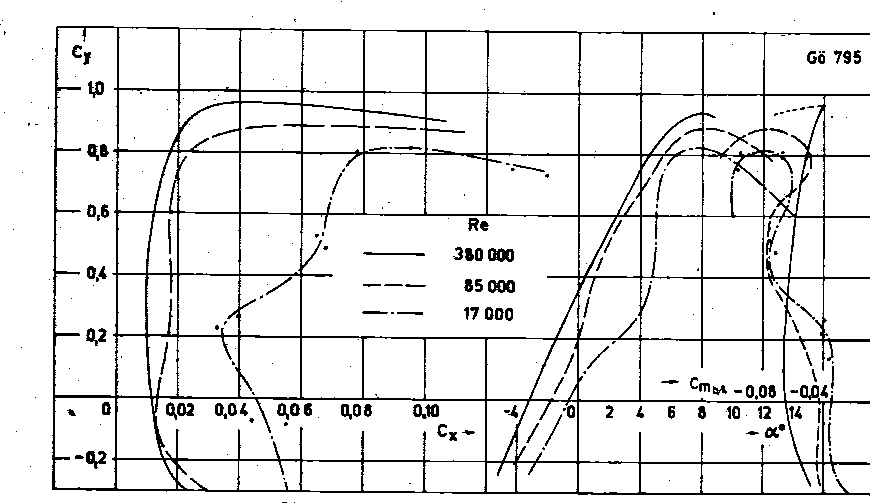
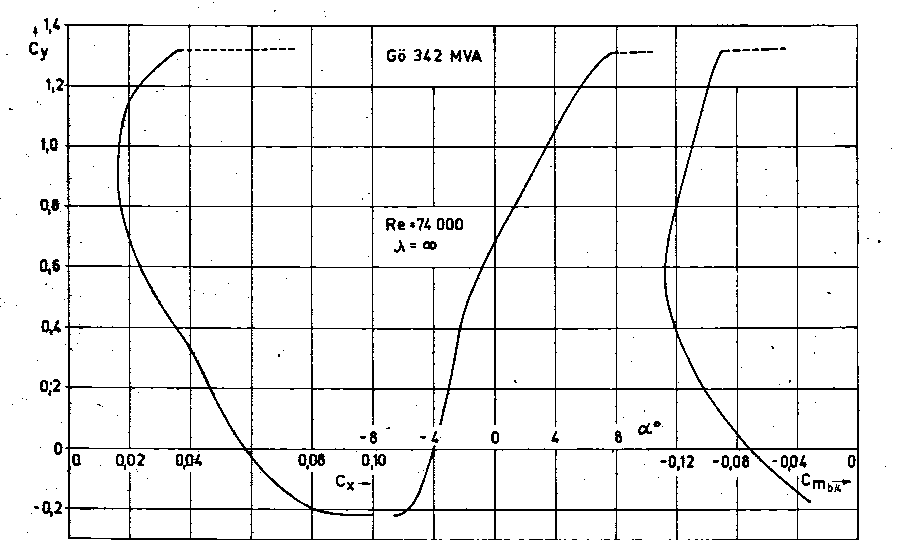
Uh....no. They are pretty lines and curves, but, there are some guys on this forum who don't understand this. So...

Let's pretend that I haven't the faintest idea what all these lines and curves mean (Humor me. Pretend I that I am one of those who don't have the faintest idea what they mean.) Could you maybe give just a little hint so that these other guys reading this forum might know what these charts are saying?

Leonard Neumann

Igor Burger · Aug 19, 2004 07:28 PM

#14 source
:-) ... everything was written by Brett in post #1 alreday, but OK:

1/ The alpha/lift polar on both airfoils shows zero lift (that is little under point where we fly level flight at minimal model drag = lap times). It is 1 or 2 degrees lower at UCT airfoil than flat. It means that if UCT airfoil is at -4 degrees AoA producing no lift, then flat blade needs only -3 or even more (-2) deg AoA. If you recalculate that difference to tip of blade it makes huge difference of "effective pitch". Means that UCT prop will be at the same size/pitch/rpm quicker.

2/ The lift/drag polar shows what the prop does at load. While that flat airfoil has almost vertical polar from lift -0.2 to 0.8 (means the airfoil drag does not change with change of lift), the UCT airfoil has negative response. The drag on UCT is similar to that flat prop at full load 0.8 but it grows as prop makes less and less lift - the airfoil drag is 3x higher at zero lift than at full load. It means that if flat prop after load loses rpm because of tip induced drag, the UCT prop can keep its rpm or even accelerate under the load.


BTW: cx is drag coefficient, and cy is lift coefficient

captcurt · Aug 20, 2004 07:21 AM

#16 source
OH sure...now I get it!

Thanks Igor

It was great to visit with you in the PAMPA Products booth at the WC.

Curt