Stuka Stunt Control Line Forum
Archive, 2000–2021 · recovered from the Internet Archive
Forums › Stuka Stunt Main Forum

Bladder Fuel Tank

Stuka Stunt Main Forum · 42 of 42 known posts recovered

Gary Weaver · Oct 08, 2004 12:02 AM

#0 source
LAST EDITED ON Oct-08-04 AT 09:04 AM (CDT)
 
I have been asked to post some pictures of a bladder fuel tank and explain how it works. There may be others interested in this too.

I start with 1/4" diameter aluminum rod. Put the rod in the lathe and turn a tiny grove about .020 deep 1/8" wide 1/16" from the end. Cut off a piece about 1/4" long and push it into the end of 1/4" gum rubber surgerical tubing that I bought at Home Depot for 39 cents a foot. Wrap 2 or 3 turns of soft #20 copper wire around the hose and twist it tight into the groove of the aluminum plug. This will plug up one end of the 1/4" hose. Turn a groove in another piece of aluminum rod. Also turn down a small section about .150" diameter about 1/4" long with a tiny groove in it too. Drill a 1/16" hole through the center of the aluminum piece. Cut off this piece of aluminum will it should be about 1/2" long. Cut the 1/4" hose off so the piece is 3" long. Slide the aluminum piece into the 1/4" tubing and twist some copper wire around it too like you did before. Put the fuel line hose on the small part of the aluminum. Insert the bladder fuel tank into the wing of the airplane through a 1/2" diameter hole. Run the fuel line to a filter then to a shut off clamp, then to the needle valve. Fill the bladder with fuel using a surgical syrange then slide the fuel hose into the clamp to hold the fuel in. Screw the needle valve in all the way then screw it out 1/2 turn. Release the fuel line hose from the clamp just long enough for some fuel to flow into the engine then clamp it back again. When the engine starts slide the fuel line out of the clamp. Adjust the needle valve and your ready to fly. Screw the needle in and out over and over a few times until you find the place where the engine is right on the border line of 2 cycle and 4 cycle slightly closer to 4 cycle. Pinch the fuel line with your finger to shut for fuel for a split second and you should hear the engine speed up for a split second. If you hear the engine speed up for a split second then the needle is set. Once the airplane is in the air it will lean out a little but not too much the engine will run 2 cycle all the time. The blatter works great on all the OS engines I have tried. It works on the McCoy 35 engine but will not work on any of the Fox engines that have the needle valve with those 2 tiny flat places on the tip of the needle. If you file those 2 tiny flat things off it will allow the needle to screw in more and then it will work. The engine will run perfect and NEVER miss a stroke no matter how sharp your airplane turns, no matter how many inside loops or outside loops you do. You can do 40 figure 8's in a row and the engine will continue to run perfect all the time. When your about to run out of fuel the engine will give you a 2 lap warning. The engine will speed up to WIDE OPEN lean out and the engine will scream for the last 2 laps. 75 mph laps turn into about 85 mph laps on the last 2 laps.

Gary Weaver
tomB · Oct 08, 2004 09:55 AM

#1 source
Nice post, Gary.

Baby Binky's still work pretty good, too - and you only have to seal one end. Half a beer can works to hold it, along with a balsa plug on one end. A pair of hemostats on the fuel line to start is very useful. Your fingers will get depressed after awhile, and the high pressure will shoot the fuel through the lines anyway.

The Fox engines' needle valves you mention are the Fox 35's - they were never built for pressure. A good Fox Combat Special on pressure will take a Voodoo over 110 mph - easy. A Nemesis will go a little faster. Winders, Spectrums, and Toothpicks even faster, but they got really heavy with wing reinforcement. The high aspect ratio wings would snap after a few flights. I used to use straight spruce for leading edges, spars, and plywood bracing in the trailing edge - they'd still snap after awhile. I think the Monoboom broke the record at 135 mph, but I never had the pleasure.

They will slow down in repetitive turns (loops and eights), but not the engines. Howard Rush always recommended to set the stabilator travel at a point where the plane would not slow down. That way, when things got busy, you didn't have to worry about your plane falling off the lines. I think the big foam jobs don't do this as much, but they're slow compared to the older stuff. My experience was that 9-7 props gave the fastest speed, but 8-8's would turn better.

Engines like the Magnum 36 and Thunder Tiger 36 would go even faster, I'm sure. The nice thing about bladder pressure is venturi's aren't needed. Simply remove the RC carb, bolt in your favorite needle valve assembly, and away you go.

Fun, fun, fun.

Tom B

Sparky12366 · Oct 08, 2004 10:05 AM

#2 source
>Nice post, Gary.
>
>Baby Binky's still work pretty good, too - and you only have
>to seal one end. Half a beer can works to hold it, along
>with a balsa plug on one end. A pair of hemostats on the
>fuel line to start is very useful. Your fingers will get
>depressed after awhile, and the high pressure will shoot the
>fuel through the lines anyway.
>
>The Fox engines' needle valves you mention are the Fox 35's
>- they were never built for pressure. A good Fox Combat
>Special on pressure will take a Voodoo over 110 mph - easy.
>A Nemesis will go a little faster. Winders, Spectrums, and
>Toothpicks even faster, but they got really heavy with wing
>reinforcement. The high aspect ratio wings would snap after
>a few flights. I used to use straight spruce for leading
>edges, spars, and plywood bracing in the trailing edge -
>they'd still snap after awhile. I think the Monoboom broke
>the record at 135 mph, but I never had the pleasure.
>
>They will slow down in repetitive turns (loops and
>eights), but not the engines. Howard Rush always
>recommended to set the stabilator travel at a point where
>the plane would not slow down. That way, when things got
>busy, you didn't have to worry about your plane falling off
>the lines. I think the big foam jobs don't do this as much,
>but they're slow compared to the older stuff. My experience
>was that 9-7 props gave the fastest speed, but 8-8's would
>turn better.
>
>Engines like the Magnum 36 and Thunder Tiger 36 would go
>even faster, I'm sure. The nice thing about bladder
>pressure is venturi's aren't needed. Simply remove the RC
>carb, bolt in your favorite needle valve assembly, and away
>you go.
>
>Fun, fun, fun.

Go to your local Office Depot and buy Pen Bladders. They work great!

Robert Storick
AMA 12366
Saint Louis,MO.

preston · Oct 08, 2004 02:16 PM

#3 source
Iskandar wrote up a nice explanation, back when.
Here's an illustrated copy of his article.

http://www.clcombat.info/bladder.html

Preston

DW · Oct 08, 2004 03:15 PM

#4 source
Hi Robert
That's a great idea! One of those why didn't I think of that, how does the presure compare to histar or pacifier less I would expect am I right?
Dwayne

Sparky12366 · Oct 08, 2004 03:20 PM

#5 source
>Hi Robert
>That's a great idea! One of those why didn't I think of
>that, how does the presure compare to histar or pacifier
>less I would expect am I right?
>Dwayne


SAME! Thats what I use to use in combat ships in the 70tys.

Robert Storick
AMA 12366
Saint Louis,MO.

JetJock · Oct 10, 2004 10:16 PM

#33 source
Did you say that Office Depot has pen bladders? You mean the old black ones? I've been looking for a source for those for eons...

Sparky12366 · Oct 10, 2004 10:18 PM

#34 source
>Did you say that Office Depot has pen bladders? You mean the
>old black ones? I've been looking for a source for those for
>eons...

Try Office Depot or you local Art Store.

Robert Storick
AMA 12366
Saint Louis,MO.

Gary Weaver · Oct 08, 2004 05:54 PM

#6 source
>The Fox engines' needle valves you mention are the Fox 35's
>- they were never built for pressure. A good Fox Combat
>Special on pressure will take a Voodoo over 110 mph - easy.

I have never had a Fox 36X over 75 mph. I have not experemented much with them either. I put an OS Max 40 LA on an airplane once with a 10x7 prop and a tubed pipe it flew 95 mph. I found out real quick I don't like flying that fast but it was fun for one flight. I think I will do some experements and see if I can get a Fox 36X up to 100 mph.

Gary Weaver

Sparky12366 · Oct 08, 2004 06:54 PM

#7 source
>>The Fox engines' needle valves you mention are the Fox 35's
>>- they were never built for pressure. A good Fox Combat
>>Special on pressure will take a Voodoo over 110 mph - easy.
>
>I have never had a Fox 36X over 75 mph. I have not
>experemented much with them either. I put an OS Max 40 LA
>on an airplane once with a 10x7 prop and a tubed pipe it
>flew 95 mph. I found out real quick I don't like flying
>that fast but it was fun for one flight. I think I will do
>some experements and see if I can get a Fox 36X up to 100
>mph.
>
>Gary Weaver


36XBB will go over 100 mph. Pressure and a 8x8 or a 8X9 prop and a wing.

Robert Storick
AMA 12366
Saint Louis,MO.

tomB · Oct 08, 2004 07:45 PM

#8 source
9x7 will work, too. I know the higher pitches on 8x8's should result in more speed theoretically, but for me, it was one of those situations where the real world didn't match theory (happens a lot).

The fastest laps I ever got - with Fox's: 36XBB, Mark II, IV, etc. was a 9x7 speed or pylon prop cut down to 8.5. On pressure with medium 10% nitro, 2 second laps and less are standard. My calcs show that's at least 125 mph.

Sparky - I think you were approaching 2 second laps with that Supertiger Ringmaster at NAS Memphis.

Tom B

Sparky12366 · Oct 08, 2004 07:59 PM

#9 source
>9x7 will work, too. I know the higher pitches on 8x8's
>should result in more speed theoretically, but for me, it
>was one of those situations where the real world didn't
>match theory (happens a lot).
>
>The fastest laps I ever got - with Fox's: 36XBB, Mark II,
>IV, etc. was a 9x7 speed or pylon prop cut down to 8.5. On
>pressure with medium 10% nitro, 2 second laps and less are
>standard. My calcs show that's at least 125 mph.
>
>Sparky - I think you were approaching 2 second laps with
>that Supertiger Ringmaster at NAS Memphis.


Ringmaster used a BINKY and a 8X8 Tornado prop.

Robert Storick
AMA 12366
Saint Louis,MO.

tomB · Oct 08, 2004 08:06 PM

#10 source
BTW - crankshaft timing and venturi have a lot to do with it. You could probably open up those OS LA crankshafts by 20-30 degrees. Stock LA's have to idle and draw fuel. Combat engines don't worry about either. Advancing and lengthening the timing on the crankshaft port, and opening up the venturi (or removing it!) will increase rpm's a bunch. The venturi opening optimizes at that point where the engine is so rich on the ground it's about to die.

Keep in mind, though, the engines won't be much use for anything else if you do these things.

Differences between 110, 120, and 130 mph are very slight. A couple of feet higher laps, or a slow thumb on the stopwatch can make a 10 mph difference. As I posted earlier, the high aspect planes were the fastest (the Monoboom was advertised at 135 mph) - Toothpicks were 10-20 mph faster than a Nemesis or Voodoo. My Toothpick with a 36XBB was faster than a Nemesis with a Combat Special Mk IV.

Tom B

tomB · Oct 08, 2004 08:14 PM

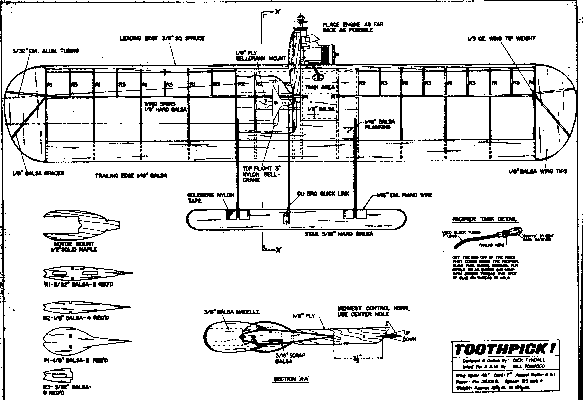
#11 source
From Barry Baxter's site - http://www.controllineplans.com

Toothpick:

Tom B

Sparky12366 · Oct 08, 2004 08:18 PM

#12 source
>From Barry Baxter's site - http://www.controllineplans.com
>
>Toothpick:

Looks like a WINDER whats diffrent?

Robert Storick
AMA 12366
Saint Louis,MO.

Howard Rush · Oct 08, 2004 08:25 PM

#13 source
It didn't fold its wings in maneuvers.

Sparky12366 · Oct 08, 2004 08:44 PM

#14 source
>It didn't fold its wings in maneuvers.

If you had a Winder fold it wasn't built right.

Robert Storick
AMA 12366
Saint Louis,MO.

Howard Rush · Oct 09, 2004 11:05 AM

#18 source
Were you there when Jim Finley folded three of them at Buder Park? It was most entertaining.

tomB · Oct 09, 2004 11:23 AM

#21 source
Toothpicks would fold eventually, too. The original design included a 3/8 spruce leading edge. I changed the spars to spruce, too, and also started laminating plywood in the trailing edge center section. They held up pretty good then.

Unfortunately, they couldn't turn as well as your Nemesis after that, and I started building them instead. I liked Tyndall's engine mount the best, though - and continued using them for every combat plane I built.

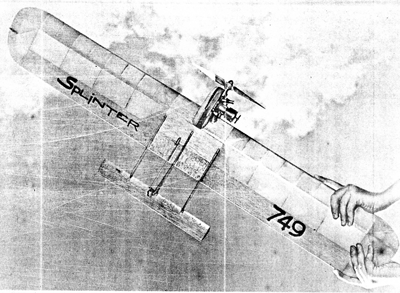
All of the high aspect ratio combat planes had their origin with Bill Netzband's Splinter and his article in AAM - 1967:

Tom B

Howard Rush · Oct 09, 2004 11:50 AM

#22 source
Or P.T.Granders*n's Tyrantula, which got 2nd in Sr. (I think) at the 1967 Nats. (We have been cautioned not to mention PT's name searchably in connection to combat, as he is now a respected stunt flyer and government contractor.)

JetJock · Oct 10, 2004 10:25 PM

#36 source
The Tyrantula Two was one of the best flyers of the period, IMHO.

tomB · Oct 10, 2004 10:39 PM

#37 source
Great thread!

I never had the pleasure of flying the Tyrantula, but it looks great!

Howard and everyone - has there been talk of a Vintage Combat movement? Current attempts are to slow down the speed, but they may be doomed to failure eventually - like Slow Rat and Slow Combat.

Maybe we could have a cut-off year, take points away for crashes or mid-airs, no-kill, with emphasis on the validity of the combat model.

Just a thought.

Another one from Barry's site (I think I have order going to him soon.), Tyrantula:

Tom B

JetJock · Oct 10, 2004 10:21 PM

#35 source
A 3/32" plywood LE doubler in the center section of a Winder solved all probs and cost very little in weight.

Minnesotamodeler · Oct 09, 2004 08:20 AM

#15 source
>>The Fox engines' needle valves you mention are the Fox 35's
>>- they were never built for pressure. A good Fox Combat
>>Special on pressure will take a Voodoo over 110 mph - easy.
>
>I have never had a Fox 36X over 75 mph.


I don't know how you keep a Fox .36X as slow as 75! I flew the .35X and .36X in competition 40 years ago...The oldest, most beat up .36X anyone could come up with would break 100. So would the .35X, just before it blew. I had an older Blackhead that broke 110...just before it blew. (Anyone see a pattern here?)
--Ray

DW · Oct 09, 2004 10:25 AM

#16 source
I agree a Fox .36X on a bladder with 25% nitro and a 8x7 or 8x8 will most definitely top 100 mph. I'm 45 and I still remember when I was 12 I saw a voodoo with a 36X and man it was fast!
Dwayne

OKCFLYER · Oct 09, 2004 10:49 AM

#17 source
Try a Nelson 36 combat engine and get some REAL speed or the newer foriegn engines but the Nelson was by far my favorite didnt have to retime like a Fox MK 6 or MK 4 or do any of the other refinements a Fox needed,just had to break it in properly and fly, always got a first hit start, if one wanted to fly slow combat just make a suitable venturi and seal it in with high temp silicone.
Nelson was far faster than a Fox as well which is why Fox quit making them cos' everyone went to Nelsons that wanted to be truly competitive.

tomB · Oct 09, 2004 11:10 AM

#19 source
I agree that the Nelson was superior, unlike the Supertiger, which Fox had great success competing against. As far as "blown," the Fox would fail, but most of the time I sent them back to Duke with a letter, and got brand new engines (or more) in return. The new ones they sent back would have the problem fixed.

If you bought Foxes for a long time, you would realize it was only the later models that had problems - they were trying to compete with imports flooding the market, and a combat event that was dying along with control line in general. A 36XBB lasted as long or longer than a Fox 35. That's probably why so many of us still have them around. The later versions stayed around, too - they just became the current Fox 40.

Before the Internet, it was awfully tough for some of us to buy one of the "cottage industry" engines. I had a tough enough time just trying to buy a Supertiger.

Question: From what I can remember, the Nelson bares a resemblence to PA stunt engines - is he the one producing them for Randy Smith?

Tom B

Pat Mackenzie · Oct 09, 2004 11:17 AM

#20 source

>
>Question: From what I can remember, the Nelson bares a
>resemblence to PA stunt engines - is he the one producing
>them for Randy Smith?
Yes.
Pat MacKenzie

Minnesotamodeler · Oct 09, 2004 04:14 PM

#23 source
LAST EDITED ON Oct-09-04 AT 04:15 PM (CDT)
 
>Try a Nelson 36 combat engine and get some REAL speed or the
>newer foriegn engines but the Nelson was by far my favorite
>didnt have to retime like a Fox MK 6 or MK 4 or do any of
>the other refinements a Fox needed,just had to break it in
>properly and fly, always got a first hit start, if one
>wanted to fly slow combat just make a suitable venturi and
>seal it in with high temp silicone.
> Nelson was far faster than a Fox as well which is why Fox
>quit making them cos' everyone went to Nelsons that wanted
>to be truly competitive.


No question, Nelsons are THE combat engine today, from what I read. I just am not sure I want to go 130. Actually I am sure and I don't. My old Fox Rocket is plenty for me at this stage in my life. We weren't really discussing modern competition, but how you couldn't hold a .36X down to 75 mph. No argument about the Nelsons.
--Ray
(edit to remove one "Ray".)

ferocious · Oct 09, 2004 08:28 PM

#24 source
a stock 36X with the standard .277 restrictor and 5% fuel will probably run around 75 mph. It takes a wide open venturi, quite a bit of timing changes to the sleeve and crank, head adjustment, and 30-40% nitro to get a small(330sq.in.) plane over 100 mph consistently.

Phil C

tomB · Oct 09, 2004 08:57 PM

#25 source
not sure I agree with that - especially the part about crank and sleeve re-timing ...

If you ran one on suction (with the restrictor you mention), and then 5% fuel, which almost implies choking the engine with the high castor in Superfuel, and you propped it with a low pitch, maybe.

Tom B

Minnesotamodeler · Oct 09, 2004 09:55 PM

#26 source
>a stock 36X with the standard .277 restrictor and 5% fuel
>will probably run around 75 mph. It takes a wide open
>venturi, quite a bit of timing changes to the sleeve and
>crank, head adjustment, and 30-40% nitro to get a
>small(330sq.in.) plane over 100 mph consistently.

I never reworked an engine, or had one reworked for me. Always ran 'em stock out of the box. Wide open venturi, yes, and pressurized fuel system. 9x7, 9x6, or 8x8 prop. Fuel anywhere from 20% to 50% nitro, depending on conditions. Speeds were consistently around 105 or so. This with Fox .35X, .36X, Rocket; Supertigre G21, Johnson CS. Planes from 280 sq. in. to 360. (Smaller ones closer to 110 mph; larger ones closer to 100.) Had a lot of buddies with reworked engines, maybe 2-3 mph faster. I never thought it was worthwhile.
--Ray

hothandle · Oct 10, 2004 09:30 PM

#31 source

A 36XBB or 36X, on a Guided Muscle (Pete Asjes, 1953 design 300 Squares, flapped profile, from Kansas City), with stock venturi, and superfuel and a 9/7 prop was turning 69-70mph. Replacing it with a ST G21-35 74-75mph. was trying to get close to 75mph for speed limit combat in Ok. City.

Hothandle

preston · Oct 10, 2004 12:30 AM

#27 source
>No question, Nelsons are THE combat engine today, from what
>I read. I just am not sure I want to go 130.

I don't think anyone really does.
They just use considerably larger planes than in the old days.
Holds the speed to a managable level, and the planes turn better.

Preston

Gary Weaver · Oct 10, 2004 09:59 AM

#28 source
>Try a Nelson 36 combat engine and get some REAL speed or the
>newer foriegn engines but the Nelson was by far my favorite
>didnt have to retime like a Fox MK 6 or MK 4 or do any of
>the other refinements a Fox needed,just had to break it in
>properly and fly, always got a first hit start, if one
>wanted to fly slow combat just make a suitable venturi and
>seal it in with high temp silicone.
> Nelson was far faster than a Fox as well which is why Fox
>quit making them cos' everyone went to Nelsons that wanted
>to be truly competitive.

How may RPM's will the Nelson 36 turn?

What size prop does it need?

What fuel does it need?

Gary Weaver

ama21835 · Oct 10, 2004 02:21 PM

#29 source
Paul Smith

After using Fox 36 Mark III, IV, V and VI for many years I bought one Nelson. I an say this about that.

Speed: the Nelson is 10-15 MPH faster than the fastest Fox. Or you can carry an extra 100-150 squares of wing area.

RPM: All you want.

Fuel: 10 %, why waste money on overkill.

Problem: The Nelson has so much speed, RPM, horsepower, and G-force that it will tear apart a good airplane designed for a good Fox Mark VI. I know this for a fact. I had one good flight on a Fox-plane convered to Nelosn. After that it was too limped-up to fly again. With Nelsons, you need to take strength up to a higher level.

Props; another case where strength is the issue.

tomB · Oct 10, 2004 06:23 PM

#30 source
Sounds nice, and similar to the rest of the paradigm peaks reached with the latest and greatest combat engine. I never had the pleasure back in the old days.

Who, where, and how much to get one?

Tom B

hothandle · Oct 10, 2004 09:44 PM

#32 source
Before the Fox MK2/3, and other schnerle's, etc, when we all were running Fox 36X's or Super Tiger G21-35's,35C's or Johnsons, a combat contest around Tulsa/OKC area would have 20-30 contestants. Now you can't even find a Fast Combat Contest, they are all Speed limit, 75-80 mph.Even the speed limit contests have less than a dozen fliers. I personally think that the Schnerle's killed combat because they got so expensive and so fasst they were hard to keep up with.

A Sneeker or Nemesis and a stock ST G21-35 or Fox 36XBB with a 9/7 prop and MIssle Mist could hit about 105, which was about all I could take care of. A Nelson or Fox MK VI would do over 120, too fast for me to try and control.

In the heyday of the G21, speeds were 95-110, which about all most people could control.


Hothandle

ama21835 · Oct 13, 2004 10:26 AM

#40 source
>Sounds nice, and similar to the rest of the paradigm peaks
>reached with the latest and greatest combat engine. I never
>had the pleasure back in the old days.
>
>Who, where, and how much to get one?

Paul Smith

You can get Nelson engines, and repair work on Nelson engines, only from Henry Nelson. 724-538-5282, 121 Pebble Creek, Zelienople, PA 16063.


Henry still flys combat and services all his previous engines. He just rebuilt a .15 for me in only about three weeks.

I have seven 15's and one 36. They are a real joy to fly, even though none my planes fit the current rules.

Originally (1984-1990 ) I was paying $175/$275 for the 15/36. I expect Nenry has gone up some, but not as much as an 8-ounce jar of epoxy paint. ( from $4 up to $19).


preston · Oct 13, 2004 12:41 PM

#41 source
Look here for some better pictures: http://www.clcombat.info/nelsons.html

Preston

Iskandar Taib · Oct 10, 2004 11:59 PM

#38 source
LAST EDITED ON Oct-10-04 AT 11:59 PM (CDT)
 
>Problem: The Nelson has so much speed, RPM, horsepower, and
>G-force that it will tear apart a good airplane designed for
>a good Fox Mark VI. I know this for a fact. I had one good
>flight on a Fox-plane convered to Nelosn. After that it was
>too limped-up to fly again. With Nelsons, you need to take
>strength up to a higher level.

I dunno about this. People are still flying Allenplanes and Arrowplanes with Nelsons, and those date back to when the Mark VI was the most numerous engine being used. I don't think they're doing anything more to them than is called for in the instructions. The Mark VII would run just a little slower than the best Nelsons. The Mark VI was slower, but not that much slower. Maybe 5-7 mph. The Mark VI wasn't really all that much faster than a Mark IV either, especially after you had stuff done to the Mark IV.

>Props; another case where strength is the issue.

People often still use wood (which can take the RPM), but other props that work are the Bolly Clubman 9.5 x 6 cut down, the Master Airscrew Scimitar 8x6 (they make a special Combat version with a solid hub that lets you ream it out for a Nelson) and the APC 7.8x6 Combat prop. The safest props to use, though, from a prop integrity point of view, would be the imported carbon/fiberglass props from GRS or Mejzlik, and they don't cost much more than the APC.

A Nelson will turn one of the above props in the 24K range.

Iskandar Taib · Oct 11, 2004 12:21 AM

#39 source
>Iskandar wrote up a nice explanation, back when.
>Here's an illustrated copy of his article.
>
>http://www.clcombat.info/bladder.html
>
>Preston

A couple addenda to my old article.

I still use 1/8" aluminum pop rivets for the fuel tubing end connection. The longer the better. Cheap, no need to machine anything. Just knock out the "stake" in the middle and use them for blowgun darts or something of the sort. I use aircraft rivets for the plug end, but it really isn't necessary. Fired .22 shell casings work just as well (can't get them here, though). I tried Phil's BB gun pellet idea, the skirt of the pellet collapsed, so I probably didn't do it right.

Those tubes you see on my bandsaw were from a different article - I made those using lexan tubes they sell at lighting contractors. They're used over fluorescent light tubes for protection. Get the smaller 1.25" diameter ones. Make the ends out of balsa or ply, glue them in with polyurethane glue after roughening up the insides of the tubes slightly with sandpaper. A thin coating of PU glue on the inside of the balsa will keep fuel from soaking into it.

For fuel tubing, for the last few years, I've been using latex tubing - same material as the bladder tubing, just a lot smaller in size. The size that works is 1/16" i.d. x 1/8" o.d., though 1/16" i.d. x 5/32" o.d. works better. Very easy to squeeze shut, but it does rot over time. I generally throw the whole bladder away when the fuel tubing starts to rot, or if an aneurysm forms.

I use nylon cable ties (don't use the polypropylene ones - they don't work for this purpose) to put the things together, but there's a knack to it. You have to get them really snug. Use a pair of pliers to get them tight - roll the pliers against the tie. Make sure the bladder tubing doesn't get bunched up where the ratchet is - if it does, it'll leak right there.

Iskandar