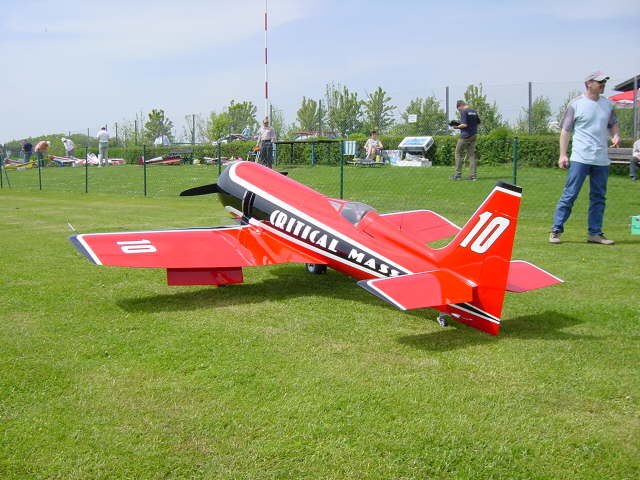
Your Mustang is a beauty for sure,..but what's happening with the "Critical Mass" Sea Fury build. I've got a sort of related mpg file to pass along if you need to be inspired to finish it. The file is 2.7mg of a r/c model.
Tony
Stuka Stunt Main Forum · 13 of 13 known posts recovered
Tony
Poor 'ole Crit has been sitting on its nose in the dinning room (don't ask how I get away with that) for more than a year and a half now. I set it aside for a couple of reasons. First, some friends prevailed on me to update Snaggletooth to create a modern competitive stunt ship. Second, Critical Mass was coming out a bit heavy as projected by adding up estimated weights, still to be added, compared to the Sea Fury, which has the same wing (excepting the cuffs). I had hoped to bring Critical Mass in at 70 ozs for its 690 sq ins wing, but it is looking more like 75 ozs. The Sea Fury was competitive, when I had an extraordinary ST 60, at 73 ozs. When handling the Critical Mass, it feels light as a feather but it is a big airplane.
Anyway, I lost confidence that it would surely be competitive in the corners of the "modern" pattern. I set it aside, giving it a lower priority than other more interesting projects, and so it sat. My interest picked up some when the Saito 82 became available to upgrade from the Saito 72. Interest ebbed again when the 82 appeared to have excessive vibration. Even then, I doubted that more power would have completely solved the problem. I still worried about wing loading.
December last, I found a way to add unbelievable stiffness to stunt flaps with the use of carbon torque tubes for the flap leading edges. This made a set of the stiffest flaps I ever built, and, in practice, overpowered Snaggletoth's elevators requiring taping of the elevators to increase their effectiveness. Now, there appears light at the end of the tunnel. I can get more lift out of the Critical Mass flaps.
Now that I have a positive way to increase lift, I began to consider again the question of increased power which would also moderate the weight problem, though not cure it, by itself. I wondered if it was possible to somehow "shoe horn" a Saito 91 into the dedicated Saito 72 mounts. Windy was coming to Texas for a visit which would include an overnight stay with me. I called him and asked, if his 91 wasn't presently installed, would he bring it so that I could get some measurements? In anticipation of Windy's visit, I had Kyle run me off a set of Critical Mass forward bulkheads and jig pockets. I built up a Critical Mass nose section "mock up" to visualize and experiment on, to explore possible ways to get the 91 in without compromising strength.
Windy left me the Saito 91. I had a friend build up a special set of mounting plates to adapt the mount to fit Windy's Saito. That worked, I could get the 91 in. The specification data sheet listed the 91 as weighing 50 grams more than the 72's 470 grams. No problem, I expected to need some noseweight anyway. When I weighed the 91 it weighed only 495 grams, 25 less than specified. With the 91 weighing only one ounce more than the 72, things began to look up. I called Windy to find out what he did with the other 25 grams. Windy said the engine was completely stock but perhaps it predated a later, heavier version of the 91. Windy also said the .91 was extremely "friendly" and exceptionally smooth and vibration free. He also said to keep and enjoy the very 91 he flew to a NATs 5th place. Thanks again, Windy.
At present, the Saito 91 and the "mock up" are at Dirk Tollenaar's for a custom CL stunt manifold. He makes the Ultra Hobby manifolds and used to engineer for me on 727's.
Considering my Snaggletooth experience with the rigid flaps, I am also widening the Critical Mass's elevators 1/8" and will build a very tight stab/elevator joint. With rigid flaps, much more power, and modified elevators, I am once again optimistic that I can make Critical Mass an unrestricted, competitive stunt ship. Snaggletooth has cleared the workshop. Critical Mass's flaps are on the bench. Maybe this time I will get it finished. Considering that I won't be running the Saito .91 throttled as Windy operated it, Critical Mass should be one terrifying machine, a worthy successor to its progenitor, the Sea Fury.
There is also an unfinished Millennium 2 in my dining room. It is an updated version of the Millennium, correcting its faults. The original Millennium was a lovely flying airplane with a nice square corner, but lacked enough triangle corner, due to the use of a 3" bellcrank. There was also a bit of unnecesssary weight in the removable wing. The new Millennium 2 is building noticeably lighter. It is currently planned for a Ro-Jett 77 but, as I become expert at "shoe horning", it could wind up with a newly legal Ro-Jett .92. More power! More power!
Al
P.S. Thanks for mentioning the RC Critical Mass. I don't have much respect for typical RC structure or outlines, but I might be interested in "Critical Mass" logos.
Al
Tony
Still, I'm hopeful and actually back to work on it.
Al
I mean, you need to finish this plane just on principal. It is just too cool to sit there naked.
WWWARBIRD
Now, what about that Sea Hornet that is in the picture???
Bill <><
When the character of a man is not clear to you, look at his friends.
Japanese Proverb
"At present, the Saito 91 and the "mock up" are at Dirk Tollenaar's for a custom CL stunt manifold. He makes the Ultra Hobby manifolds and used to engineer for me on 727's."
Every once in a while I remember a scene or situation that involves you, and for some reason this quote triggered one. Maybe it being so far back in time now when both you and dad were 72 capt.
At the 69 Nats, you, dad, Whitely and maybe Tom Lay and some other guys were going to the bar. I couldn't go, so since the group left from your room I stayed and watched TV. But since the real draw wasn't the TV, but the Bearcat, I picked it up and put it on the bed. There I stared at it for 10 minutes or so, until you can barging into the room, way ahead of schedule, looking for something. I was so shocked and scared that you would have gotten upset that I moved it, I could scarcely move. Your reaction was to remark something like, "You really like that thing..." and left! I was a happy kid, sat there all night looking at that Bearcat.
Hope all is well,
Chris McMillin
[photo not recovered: 8.jpg]

This is the r/c bird I mention above,..its a big one. Here's a link to some vid footage. Just hunt around a bit and you'll find it. http://www.a-team-modellbau.de/
Tony
Typically, this is how my designs begin. I start with a photo, then, stretch it a little and slim it a little, to adapt it to stunt moments. I then calculate tail volume and figure out the mechanicals. I also compare the proposed design to other airplanes I have experience with. Since the real Critical Mass is a modified Sea Fury, it was logical to consider modifying my NATs and Walker winning Sea Fury. My two Sea Furys had removable wings and a bunch of noseweight. I could save some weight by eliminating the removable wing and using a heavier, and more powerful, modern engine to replace the Sea Fury's noseweight. Aerodynamics were reconsidered in the light of my having more experience in designing. I decided to use similar, but not exact, moments and areas. The Critical Mass has a longer fuselage than my Sea Furys, but the extra length is mostly visual, not structural, overhang. This overhang is the result of moving the vertical fin and rudder back. The location of the stab and its relationship to the wing is basically unchanged. Cross sections of the fuselages are about the same size.
Next, I may make a small cardboard version to visualize how appropriately the wing and tail surfaces fit the appearance of the real airplane while preserving the moments and areas of a competition stunt ship. On the photo, you may be able to see how I enlarged the vertical fin and rudder to improve appearance. If at this point, it looks like my semi-scale version will build into a competitive airplane, I begin to consider how to build it with the lines and weight that are my goals. Then, I may consider the construction of a mockup, built "half fuselage", on a 3/4" MDF or particle board base. The mockup is mostly pinned and taped together with a few small glue joints to facilitate easy disassembly. Disassembled parts may be modified or used as templates. This step is to further visualize the shapes of the bulkheads and to solve obvious structural problems before beginning construction. My semi-scale airplanes don't simply begin with a clean sheet of paper. The process isn't difficult, but it is time consuming. It sorta depends on whether you think the result will justify the effort.
Builders don't understand why I consider it necessary to buy a 15 to 20 video set to attempt construction of my airplanes. There is no way that all of the templates and techniques could be incorporated into plans. Those who simply buy laser parts from Kyle wind up with no plans and a pile of parts which they can't identify. Even with plans, which I don't sell individually, many of the parts would still be unidentifiable from the plans. I am not anxious to have people build my airplanes. My airplanes are very complex and time consuming to build with the only techniques I think will result in a sufficiently light, competitive airplane. By the time my design is "improved", construction "simplified" and engine "substituted" the builder is almost always disappointed with the performance of the "lashed up" result. This leads to the opinion that my airplanes must not fly as well as advertised, competition history not withstanding. I've learned, the hard way, that few builders have the will and determination to spend the time, money and effort necessary to duplicate my airplanes and obtain the same performance capability.
Al
That funny car windshield, A-26 cowled version of Blind Mans Bluff/Critical Mass has a way different shape than the current plastic windshield/canopy, DC-7 cowled version. I think that the R/C guy built his model to approximate the original versions shape. It is still wrong, but they tried.
I was a helper on the Blind Mans Bluff build up when I lived in Phoenix in 86 to 88, and Larry Burton had a vision to what the airplane was to look like. He liked the Travel Air Mystery Ship looks, and designed the forward fuse and paint scheme to capture the feeling of that classic racer.
If only they had picked ME to fly it instead of that girl!
Chris...
Its a really neat looking airplane though. It should make a gorgeous Stunt ship. Feel free to come and admire it when finished.
Your friend,
Al