Stuka Stunt Control Line Forum
Archive, 2000–2021 · recovered from the Internet Archive
Forums › Stuka Stunt Main Forum

AERO .35

Stuka Stunt Main Forum · 20 of 20 known posts recovered

Jeff W · Dec 05, 2004 09:58 PM

#0 source

Does any one remember an engine built a few years ago with a horizontal cylinder called the AERO.35 (I think)? My ex-brother in law had one but he never ran it. Bet it's worth a bit today!

I don't quite recall the mechanics of how it converted the horizontal piston motion to shaft rotation but it sure looked appealing. Anyone out there ever run one?

Jeff W

Garf · Dec 05, 2004 10:32 PM

#1 source
This one?

I think it used an S shaped rod and the crankpin was at 45*. to the crank axis.

SAVE ALL THE PIECES-Phil Brown

Jeff W · Dec 05, 2004 11:37 PM

#2 source
Phil:

That's the beast. Do you own it or have you seen one run?

Jeff

V12 · Dec 07, 2004 10:50 AM

#15 source
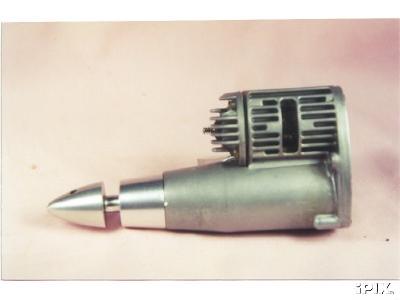
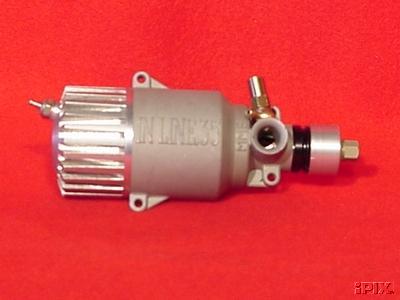
While it wasn't really a hot performer, it was a fascinating piece of engineering. I took mine apart to share some details - hope Leonard doesn't mind me taking up all the space.
As pointed out, the "S" shaped connecting rod is steel and the front pivots in the angled bushing in an aluminum crank. The rear of the rod pivots in a fixed ball joint and subtends a conical path. The wrist pin forms a joint with two degrees of freedom, pivoting and sliding.
Confused yet? Rather than more verbage, I'll suggest looking at the pictures. I'll eventually put it back together and run it.
Bob.

tbeard · Dec 08, 2004 05:21 PM

#18 source
Could you show a picture of the rear of the crank?

tomB · Dec 06, 2004 06:03 AM

#3 source
I remember reading about it, but I thought it had evolved into the current RCV engine -

http://www.rcvengines.com/model_home_page_full.htm

Maybe they're not connected, but the RCV has horizontal cylinders, too. In addition, they're in-line with the crankshaft.

Tom B

gcb · Dec 06, 2004 06:29 AM

#4 source
"A few years ago?" ... That beastie was out in the late 1950's!

I THINK the RCV is a whole different technology.

From what I remember reading about them (in their day), they were a little down on power compared to some other engines of the day. More for CL scale, not so good for stunt. Don't remember anything about the throttled version.

George

tomB · Dec 06, 2004 07:11 AM

#5 source
>"A few years ago?" ... That beastie was out in the late
>1950's!
>
> I THINK the RCV is a whole different technology.
>
OK, so my memory is a little off. What's new? There was another engine technology advertised for a long time in Model Aviation and elsewhere - it dealt with an inline, horizontal cylinder. If that's not RCV, then maybe there's still another type.

Tom B

ferocious · Dec 06, 2004 08:05 AM

#6 source
LAST EDITED ON Dec-06-04 AT 08:06 AM (CST)
 
Some Russian scale modelers have used an axial piston motor. Small diameter to fit into turboprop nacelles. It used a conventional crankshaft and gears to transfer power to the prop shaft that ran forward alongside the cylinder. They have been for sale in limited quantities over the years.

the Aero 35 uses an L- shaped crankarm. One end fits in an angled hole in the ALUMINUM crank shaft and moves around in a cone. The other end moves in a straight line along the piston axis, running in a little slipper block that allows some movement(instead of a wrist pin in a conventional motor). The crank moved on a ball joint on the corner. Not real obvious, but it works. I believe they had some problems with the cranks breaking and the ball socket wearing prematurely. Take a look in Dave Gierke's engine book.

Phil C

Garf · Dec 06, 2004 12:08 PM

#7 source
LAST EDITED ON Dec-06-04 AT 12:12 PM (CST)
 
The PROFI uses a type of wobble plate design. I have an AVI file of one revolution. There are at least 2 other engines like this out there, one is 1.03cid.

SAVE ALL THE PIECES-Phil Brown

kdheath · Dec 06, 2004 12:17 PM

#8 source
LAST EDITED ON Dec-07-04 AT 11:51 AM (CST)
 
Yep, here is Chinn's MAN 1964 review and the accompanying ad. I hope it is readable. Some quotes: "completely unorthodox", "In i.c..design, American engineers do not usually go out of their way to be different", "rectangular venturi intake", "throttle..version..available", "handles and runs just the same as a conventional motor", rpms-8400 on a 12-5 Power-Prop, 9900 on a 10-5 Tornado, 10,200 on an 11-3, 12,200 on a 9-4 Tornado, 14,200 on an 8-5 PP. Peak torque 42 oz-in at 8-9000 rpm. Peak bhp .42 at 11,500 rpm. "Deserves attention", "starts eadily and runs smoothly."

The company principles are listed as "president August N. Savage and his associate John Piston..." Hmmm. Curious coincidental last name....

Bob's photos show the conrod arrangement very well. Interesting piece of work. Anyone ever run one?
Bigiron13 · Dec 06, 2004 02:13 PM

#12 source
There was one sold on E-Bay somewhere around a year ago. Seems like it went in the neighborhood of $800 or so. Too rich for my blood.

Bigiron

Bigiron13

Garf · Dec 06, 2004 12:17 PM

#9 source
The MMB 1.03.

[photo not recovered: MMB1.03a.jpg]

SAVE ALL THE PIECES-Phil Brown

Garf · Dec 06, 2004 12:22 PM

#10 source

SAVE ALL THE PIECES-Phil Brown

kdheath · Dec 06, 2004 12:48 PM

#11 source
One difference here is that the Profi's P/C assembly is inline with the crankshaft, where the Aero 35's piston is parallel with the shaft. The Profi has a gear box resembling an automobile differential, IIRC, vs the "bent" conrod of the Aero.

Garf · Dec 07, 2004 09:12 AM

#13 source
One more. Hiness 60.

[photo not recovered: hiness60b.jpg]

SAVE ALL THE PIECES-Phil Brown

Garf · Dec 07, 2004 09:18 AM

#14 source
LAST EDITED ON Dec-07-04 AT 09:21 AM (CST)
 
Hiness 60.

[photo not recovered: hiness60b.jpg]

SAVE ALL THE PIECES-Phil Brown

Garf · Dec 08, 2004 10:52 AM

#16 source
LAST EDITED ON Dec-08-04 AT 10:55 AM (CST)
 
I plan to post some pics of some unusual engines, glow, diesel, and spark ignition on my forum on the Hangar Flying site.

RCV 60

[photo not recovered: rcv60c.jpg]

SAVE ALL THE PIECES-Phil Brown

Dr Spark · Dec 08, 2004 04:33 PM

#17 source
I once owned an AERO 35 engine, which was reported to be brand new. I put it on the test bench and ran it for about 30 minutes. It wasn't very powerful, and after my tests, it seemed to be worn out! I think I either traded it for something or gave it away. Dumb me!

I think that the idea of transferring power via a cam plate wasn't a good idea. It couldn't last very long.

The British RCV motors have the right idea. They use ball bearings and gears to transfer power to the prop shaft.

Floyd

Jeff W · Dec 09, 2004 09:48 PM

#19 source
Thanks to all for the input. I almost understand how it works now. Sure is an interesting piece of memorabilia. I still picture two of them in a P-38, but it won't happen.

Think I'll see if I can talk my ex brother in law out of that one he has, then sell it. It'd be the only good I ever got from him!

Jeff