Stuka Stunt Control Line Forum
Archive, 2000–2021 · recovered from the Internet Archive
Forums › Stuka Stunt Main Forum

Speed, weight, thrust & drag

Stuka Stunt Main Forum · 27 of 27 known posts recovered

Adrian · Dec 11, 2004 08:23 AM

#0 source
Could someone help my thinking, pls.....

The basic question is....Is the speed of an airplane materially affected by its weight? If so, is it significant or not, and is it quantifiable in any way?

I seem to remember (but could be mistaken!) reading that the speed of an aircraft was unaffected by its weight. My thought process was that for two mythical identical planes, but one heavier than the other, with identical engines and thrust that the thrust and drag would find equilibrium and the speeds would be identical. But then the heavier aircraft would need to generate more lift to match the extra weight and so wouldn't it alter its flying attitude (more AoA?)
to generate said lift. Would this not create extra drag and thus slow the heavier aircraft down?

Some definitive help required please.......

Adrian

Leonard Neumann · Dec 11, 2004 08:30 AM

#1 source
Simple response: More lift equals more drag. More drag means less speed.

True speed planes are so over powered that there may be very minor changes in speed with some additional weight, but at the same time their wing area is limited, also. Everything is a compromise. Too small of an area for the weight and the angle of attack will need to be greatly increased. But larger wing area also produces more drag. So less weight means less needed wing area or lesser angle of attack and so more speed. You can't get away from it.

Leonard Neumann

Old_Harley Man · Dec 11, 2004 08:36 AM

#2 source
LAST EDITED ON Dec-11-04 AT 08:42 AM (CST)
 
There is a long answer and a short answer....Both are "YES"....More lift is required. Two ways to increase lift...AoA and airspeed (non symetrical airfoil). Double AoA = double the lift...Double airspeed of a non symetrical airfoil and lift is quadrupled....both = more drag, less speed for same thrust...and on and on and on.....

Tnx, Mike, the "Old Harley Man" [email protected]

"As a young man I started with nothing and still have most of it"

Iskandar Taib · Dec 13, 2004 03:17 AM

#8 source
>There is a long answer and a short answer....Both are
>"YES"....More lift is required. Two ways to increase
>lift...AoA and airspeed (non symetrical airfoil). Double AoA
>= double the lift...Double airspeed of a non symetrical
>airfoil and lift is quadrupled....both = more drag, less
>speed for same thrust...and on and on and on.....

Just nitpicking here, but the same is also true for symmetrical airfoils. Increase the airspeed with a symmetrical airfoil while keeping the sama AOA, and you increase lift.

R Bush · Dec 11, 2004 11:18 AM

#3 source
Hi Adrian,

A highly recommended book is "Model Aircraft Aerodynamics", by Martin Simon.
The type of drag that comes with producing lift is called induced drag or vortex drag. It seems to me that you understand the effect correctly-- but then, I'm no Martin Simon.
In stunt flying,it is not just weight that affects lift and drag. The induced drag varies widely during an aerobatic flight due to the many changes in speed, direction, angle of attack, and the airfoil shapes (Both the horizontal tail and the flapped wing are variable airfoils.)

Cheers,
Randy

Ted Fancher · Dec 11, 2004 11:58 AM

#4 source
>Hi Adrian,
>
>A highly recommended book is "Model Aircraft Aerodynamics",
>by Martin Simon.
>The type of drag that comes with producing lift is called
>induced drag or vortex drag. It seems to me that you
>understand the effect correctly-- but then, I'm no Martin
>Simon.
>In stunt flying,it is not just weight that affects lift and
>drag. The induced drag varies widely during an aerobatic
>flight due to the many changes in speed, direction, angle of
>attack, and the airfoil shapes (Both the horizontal tail and
>the flapped wing are variable airfoils.)
>
>Cheers,
>Randy

Lots of really good answers, Adrian.

Like everything else in flight, you pretty much can't change anything aerodynamic without having a greater of lesser degree of effect on everything else.

The simple answer is that increased weight requires increased lift. The production of more lift results in more drag (induced as Randy stated). Drag slows the airplane for a given amount of thrust available.

Shoot, if you make the thing heavy enough it won't even move! Not Germand, but cute!!

Merry Christmas

Ted

Igor Burger · Dec 12, 2004 02:48 AM

#5 source
Almost all is already written above, but anyway few notes:

- Mentioned induced drag makes role at LOW speed not at high speed. It is when wing works at high lift coefficient. So it will not change max speed too much.

- If we speak about stunt models, then induced drag plays role in tight corners – means at high lift coefficient – as was already mentioned. That is why we can fly heavier models with stronger engines. But it seems to me from center of circle that the weight rather limits radius then speed. It is because if I see slowing down, I automatically adjust radius and I try to keep model in motion. (yes this is rather mental then aerodynamic question )

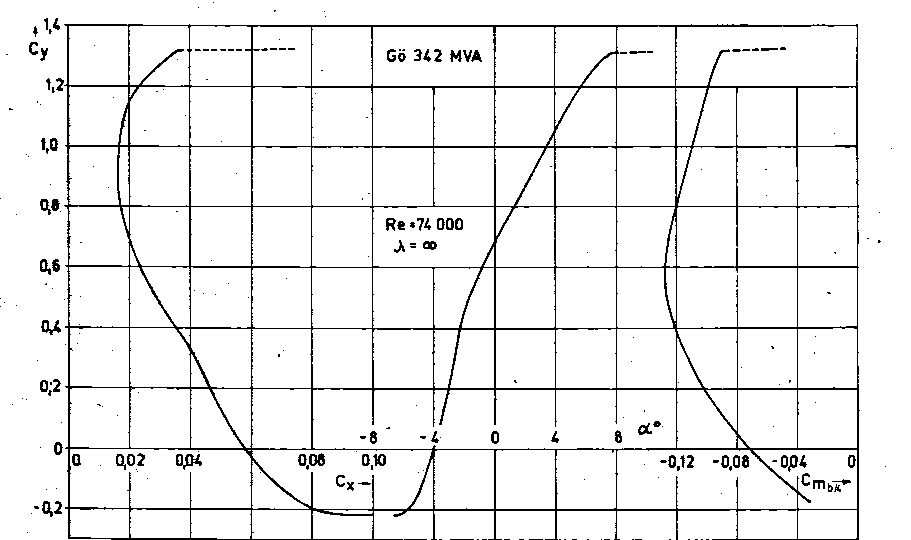
- It could be in some cases just opposite. Heavier model can have higher speed. Aerodynamically clean vehicle making lot of lift can fly at too low lift coefficient to keep at efficient flight. Example is glider with high aspect ratio (and thus minimized induced drag). In that case most important criterium is airfoil drag and that depends on airfoil shape. It can easily happen that airfoil at low lift makes higher drag then the same airfoil at little higher lift. The result is, that the glider needs ballast weight to be able to fly quickly or it needs to modify airfoil by flaps. Picture below shows extreme example of polar getting strong drag at very low lift (that is what we effectively use on props against overrewing unloaded). You can see that drag at lift cl=0 is 3x higher then at lift cl=1.

And how to enumerate? It is easy if you know speed, weight and airfoil you can calculate lift coefficient. Then you can look to polar and to see what is drag coefficient. It will give you airfoil drag. If you know also aspect ratio and planform, you can calculate from known lift coefficient also induced drag. Induced drag plus airfoil drag will give you complete drag.


kenwstr · Dec 12, 2004 07:32 PM

#6 source
Hi

It's a complex question where you need to define the application well.

For example in a glider, thrust is a proportion of weight so is not a constant. Look at the basic lift and velocity formulae.

L = 1/2 . p . V^2 . S . Cl

L = lift force
p = density of air
V = velocity
S = wing area
Cl = lift coefficient

For level or small angles of glide we can consider that L = the weight of the plane. Now rewrite the make Velocity the subject.

V = ( 2 . L /( p . S . Cl ) )^(1/2)

With L on the top line of the division, we see that for a given plane at a given trim (Cl), the heavier plane will fly faster. And this is the reason for ballast in a glider.

In powered flight (level at max power), we see something different.
If at 1st we assume the same speed, then the wing of the lighter plane is at a lower Cl and generaly a lower Cl means a lower drag coefficient which allows the lighter plane to fly faster resulting in even lower Cl etc. However we need to consider the trim the airfoil is designed for. A symetrical section will offer min form drag coefficient (Cdf) at zero lift. Any deviation in incidence + - will increase Cdf.

If our plane is designed for speed, we need to minimise drag when trimmed for max speed (some positive Cl value). To do this, we bend the airfoil around a curved camber line specifically designed for min drag at that Cl. This new asymetric section will produce less drag than the symetric one at this Cl. But here is the rub, you don't get something for nothing. As camber increases so does the min Cdf of the section. This means that even when optimising the section for the Cl of the plane, the heavier plane will be slower.

However if we take a heavy plane with a high cambered section that is optimised for this weight, then reducing the weight while keeping the same section will result in a CL value below that of min Cdf. Therefore the lighter plane will have a higher Cdf. If the increase in Cdf is greater than the reduction in induced drag coefficient (Cdi), total drag is increased and the lighter plan will be slower.

However most CL planes have a symetrical wing (zero camber) so the lower the CL, the lower Cdf and Cdi so the faster it flies.

Confused yet? Get Martins book, his diagrahms add a little something!


Regards,
Ken

Igor Burger · Dec 13, 2004 02:01 AM

#7 source
>>>However most CL planes have a symetrical wing (zero camber) so the lower the CL, the lower Cdf and Cdi so the faster it flies.<<<

My model has flaps

ama21835 · Dec 13, 2004 05:59 AM

#9 source
LAST EDITED ON Dec-13-04 AT 06:00 AM (CST)
 
In theory, weight should reduce speed, but only slightly.

In reality, in the world of Control Line, a heavier model might actually go faster.

Assume we are comparing the same design, built to different weights. A very light model will be flimsey and will not give the engine a solid mounting. A heavier model (within reason), will give the motor "something solid to sit on".

In rat racing, pan-rats generally out-ran "quickie-rats", despite the weight penalty.

Ultra-light combat models often went slower than stout machines.

Iskandar Taib · Dec 13, 2004 09:39 PM

#11 source
Heh heh heh..

The Texans started using nose gussets on their Slow Combat planes, ostensibly to make the nose stronger in a crash. When people complained about them, they made them into "tank platforms". Turns out the real idea was to stiffen the noses to reduce vibration. That was one of the Texas speed secrets.

As told to me by Jim Mears.

kenwstr · Dec 13, 2004 07:33 PM

#10 source
Yes of course Igor, flaps do have a camber effect.
However if we are talking level flight which I was, the flap deflection is very small. This is one of the reasons I stated that the application needs to be well defined in any such descussion.

I believe I supported your conclusions though from a slightly different tack. Even with the application of flaps set to give the effect of optimum camber, min Cdf tends to increases with camber and flap deflection. Therefore the lighter loaded plane will be faster.


Regards,
Ken

R Bush · Dec 14, 2004 12:57 AM

#12 source
Adrian,
Keeping in mind the primary effects of total weight described above, I'd like to offer some specific situations in which judicious addition of weight might achieve a net speed increase in powered level flight:

1. Stiffen the structure to increase efficiency of engine and prop and to reduce vibration of airframe. (mentioned above)
2. Add nose or tail weight to fine tune pitch trim. A forward CG requires greater lift from wing and tail plane -->(causing) greater induced drag. An extreme aft CG will reduce stability --> wandering path and more control inputs --> increased drag. Test by stopwatch.
3. (Specifically for tethered flight) Fine tune yaw to maximize speed. As yaw is affected by the interrelationship of fore-and-aft balance, leadout position, and aerodynamic forces, adding weight to trim the yaw might yield a net speed increase. Test by stopwatch.

Of course, if one can do this trimming without adding to the total weight, the net speed increase should be greater.

Cheers,
Randy

Igor Burger · Dec 14, 2004 02:39 AM

#13 source
Yes Ken, but my point was what happens in corners. Because if you speak about our c/l stunt applications, they are often flapped and they fly at constant speed. So the speed limitation is important in point where we do not have enough power, means in corners - and in corner we have flaps so it really can make sense ... however in that point it makes lot of lift, so here comes also induced drag, but in any case, it looks there is what to optimize.

Ion Muniz · Dec 14, 2004 04:05 AM

#14 source
LAST EDITED ON Dec-14-04 AT 04:07 AM (CST)
 
Does wheight affect a plane's speed?

Lemme put it in a simplified, no-nonsense way:

1-Lifting wheight demands ponies from the engine.

2-Making the wheight go fast (in this case, the plane) also demands ponies from the engine. The faster you want it to go the more ponies you'll need

3-The more ponies the engine has to deliver to keep the wheight airborne less ponies are left for making the wheight go fast (and the number of ponies is not ∞).

SO:

WHEIGHT AFFECTS SPEED IN A NEGATIVE WAY.

Ion (was I clear enough?) Muniz

P.S. - NOW, a question: If you release two identical planes, (exept for the wheight)with the same engine , prop and fuel and engine settings from a altitude of 10 miles, both pointing nose down, which one will get to the ground faster? The lighter of the heavier one?

Igor Burger · Dec 14, 2004 04:17 AM

#15 source
>>>WHEIGHT AFFECTS SPEED IN A NEGATIVE WAY.<<<
That was the orriginal question ... typically yes, but there are exceptions.

Dick Fowler · Dec 14, 2004 05:44 AM

#17 source
LAST EDITED ON Dec-14-04 AT 05:48 AM (CST)
 
>P.S. - NOW, a question: If you release two identical planes,
>(exept for the wheight)with the same engine , prop and fuel
>and engine settings from a altitude of 10 miles, both
>pointing nose down, which one will get to the ground faster?
>The lighter of the heavier one?

What to expect from we "Stuka Stunters"

It depends...Did you start the engines?

Maybe they aren't trimmed the same....how do you know they will stay nose down?

If they are Fox engines be sure to use plenty of castor at least XX%

That's bull.... I've run my Foxes on Missle Mist for years with no problems.

What did you use to get them to 10 miles?

What was the launch RPM? I always launch my Belchfire 40 at 10152.57 RPM... with a 10.975 X 3.9888888 pitch APC

What tach did you use to set the engines? I don't use a tach...them's for sissy stunters.

Dummy....don't spend your money on an expensive tach. The cheap ones work just as well.

Hey... you said they were identical...why does on weight more than the other?

I bet you used dope and not car paint. Back in 50's we used aerogloss metallic and it always came out heavy.

You should have tried Hobby poxy...much better.

Who built the models ? Remember you won't get appearance points but you can fly it.

Were you wearing a thong when you launched?

What color? Red is sexier! I got facts to prove it.

Well, it depends.......

L3 · Dec 14, 2004 07:27 AM

#18 source
Dick, you deserve 10 "Attaboys" for that reply.
Larry Lundy

Serge Krauss · Dec 14, 2004 11:51 AM

#20 source
Ion-

>P.S. - NOW, a question: If you release two identical planes, (exept for the wheight)with the
>same engine , prop and fuel and engine settings from a altitude of 10 miles, both pointing nose
>down, which one will get to the ground faster? The lighter of the heavier one?

Well, now that Dick has made it unnecessary for some SSWF folks to do our normal thing - pretty good, Dick! - your answer is that the heavier one will reach the ground first, because it will reach a higher terminal velocity. That's the speed where the aerodynamic drag (proportional to V^2) is equal in magnitude to the weight of the model, which is the force driving it downward. The identical prop/engine combinations may tend toward equalizing speeds, but there will be less prop slippage on the plane being pulled downward with the most force, and it should rev higher with that help. I don't think that a pipe can fully block this effect. On the other hand, do you think these engines will even run at that altitude if tuned for lower? Oh, oh...

SK

Serge Krauss

ama21835 · Dec 14, 2004 05:26 AM

#16 source
LAST EDITED ON Dec-14-04 AT 07:09 AM (CST)
 
>Could someone help my thinking, pls.....
>
>The basic question is....Is the speed of an airplane
>materially affected by its weight? If so, is it significant
>or not, and is it quantifiable in any way?

Let me assume that you have some sort of engine power control ( throttle, needle value, use a smaller engine ).

A heavy plane ( of the same design ) must fly faster, to support its weight. A light plane can be made to fly slower.

I flew KC-135's in the USAF. We took off at 256,000 pounds and landed at 115,000 pounds. This is for real. The heavy plane needs to fly faster.

The original takeoff was done at almost 200 knots. When we did touch-and-goes at the end of the flight, it was about 135 knots.

Quantifiable, heck yes, we had a whole notebook full of charts.

Adrian · Dec 14, 2004 10:14 AM

#19 source
OK fellas – really good info to ponder.
Now this is why I asked, but I need to confess this time it wasn’t about stunt (sorry!).
A very well known TR guy in the UK reduced the weight of his team racer by nearly 30%. There was certainly an decrease in the time to complete 80 laps – but quite small (4%) – and the implication was that much of this decrease was to do with the quicker deceleration and acceleration in and out of pit stops. In other words, perhaps a tad faster, but not much. I also wondered whether the line drag consumes such a percentage of the available thrust that the combined drag of model + lines results in the model’s speed becoming asymptotic to some notional value, beyond which it is difficult or impossible to go given a particular size of engine - a possibility maybe??
I have built identical stunt models with different weights and the speeds of these seem not to vary a good deal – no more than one might expect from ‘normal adjustment’.
Your posts have been helpful as ever
Thank you, tight lines and Season’s Greetings from the UK
Adrian

Serge Krauss · Dec 14, 2004 12:51 PM

#21 source
LAST EDITED ON Dec-14-04 AT 12:55 PM (CST)
 
>implication was that much of this decrease was to do with the quicker deceleration and
>acceleration in and out of pit stops.

That's probably it. For your team racer, don't forget the effect of line tension. The upward component of tension restraining a model flying slightly below handle level will reduce the wing lift needed. I don't know what your team racer's weight might be, but from Goran Olsson's spreadsheet (and English units - sorry!), suppose a 12.5-oz model flies at 131 mph 52.9 ft. from the center. The centripetal acceleration (V^2/R) would be about 21.8 g's, corresponding to a force of about 17 lb. The angle of declination of the lines to support the model without any wing lift at all would be arc tan (1/21.8) = 2.6 degrees below horizontal. Except for passing, it doesn't appear that those all-wing team racers need wings at all; centripetal force, dependent on mass and speed, "flies" them to a significant extent. Edit: Of course, when they're higher...

>I also wondered whether the line drag consumes such a percentage of the available thrust that
>the combined drag of model + lines results in the model’s speed becoming asymptotic to some
>notional value, beyond which it is difficult or impossible to go given a particular size of engine - a
>possibility maybe??

Line drag is a high percentage of the thrust. For a given engine, model drag is probably not greatly significant, given the similarity in model designs. So whatever thrust advantages you might attain, however small, seem most likely to make the only significant speed differences. FWIW.


SK

Serge Krauss

ama21835 · Dec 14, 2004 08:41 PM

#22 source
Your theory about going faster at very low altitude has been around at least 45 years that I know of. The FAI believed it might work and has a miminum height that prevents it's use. In reality, going very fast below shoulder level is risky bidness at best, let alone three-up.

OK. Line drag is more than airplane drag, but everybody uses the same lines. So if you want to win, work on airplane drag.

For a few months, "line groupers" were the rage. They were gizmos to make the lines "slipstream" each other and cut frontal area. Speed and TR models went much faster,,,,,, for about three months until AMA & FAI outlawed 'em. I rememeber the one-and-only Nats where they were legal. Guys were making 'em round the clock. Some FAI-types had just got back from Europe with the idea.

Serge Krauss · Dec 15, 2004 07:24 AM

#24 source
>So if you want to win, work on airplane drag.

Out of curiosity - is there really anywhere to go with this after so many years of refinement? 'still seems that the best engine tuners would have the advantage.

I was impressed with how much faster the R/C-pylon guys can go with less power and larger planes, but without having to drag the lines of the CL speed planes.

SK


Serge Krauss

Dave Simons · Dec 14, 2004 09:29 PM

#23 source
Adrian,
Over the last couple of years I've been working to reduce the weight of my TR models - Vintage A and F2C. I've had some pretty spectacular improvements - F2C times from 3.40 to under 3.20, that I've put down to the airframe weight reduction. I'm now a firm believer in "light is right". A 330g F2C is heaps faster, in a race, than a 420g model.

I think that the advantage is particularly found in a practical sense, in actual races. The team have to learn to exploit a lighter model to the full.

For example: A light model accelerates & decelerates faster. The pilot & pitman have to learn to shut off (talking F2C here)much closer to the pitman, the pitman can catch much "harder" without fear of injury or breaking the wing (less inertia). Takeoffs are safer, as the model reaches a safe speed faster.

And the big one: A lighter model doesn't load the motor so much when overtaking (or being blocked), & that means it can be run much closer to the edge, without "going over" - diesel speak. The benefit to airspeed and range are substantial.

TR context here only, obviously.

Do you know Duncan Bainbridge?

Adrian · Dec 15, 2004 08:57 AM

#25 source
Hi Dave - thanks for that. I know Duncan - infact bought a racing engine and plane from him recently. Will e-mail you in the next day or so.

Thank you Serge and ama21835 - all very useful stuff. I'm beginning to build up a picture of what the main parameters are and the way they interact
Thanks
Adrian

jehold66203 · Dec 15, 2004 09:10 AM

#26 source
To make things real simple as to the question as I read it: Both airplanes with Identical power, prop, fuel, lines and airplane should fly the same speed. It jjust takes longer for the heavy plane to get to that speed. Also takes longer to slow down. -DOC