Stuka Stunt Control Line Forum
Archive, 2000–2021 · recovered from the Internet Archive
Forums › Stuka Stunt Main Forum

Explaining Aerodynamics??

Stuka Stunt Main Forum · 55 of 55 known posts recovered

Sunnybreeze · Oct 12, 2006 08:49 AM

Explaining Aerodynamics??#0 source
Guys,
I need all you smart flyers out there to help me out! My 6th grade son's teacher wants me to come to his class and talk about Aerodynamics and then put on a C/L demo after. One question I want to be clear on is I understand why a standard Asymmetrical wing creates lift with the air over the wing going faster than the lower thus creating lift. On stunt planes with Symmetrical wings what truly creates the lift? Is it the slight deflection of the elevator and flap creating lift or some kind of air wedge created by the wing shape. Could someone PLEASE explain this in 6th grader terms or direct me to a web site which will explain it.

As always thanks a million

Steve Everett

Mild Bill · Oct 12, 2006 08:56 AM

RE: Explaining Aerodynamics??#1 source
Hmmm, just a wild thought that many will laugh at. Consider the extreme case of a symetrical airfoil, the flat plate section. No curve over the top at all - but it DOES produce lift. Maybe it just slides along like a surfboard, deflecting air downward, thus producing lift. Eh???
Iconoclast

Jim Thomerson · Oct 12, 2006 09:41 AM

RE: Explaining Aerodynamics??#2 source
To produce lift a symmetrical airfol has to fly at a bit of positive incidence. Usually this is not apparent with a stunt airplane flying around upright; however, if you watch one flying inverted, particularly if the bottom of the fuselage is parallel to the thrust line, it is obviously flying a little nose-high.

Brett Buck · Oct 12, 2006 10:17 AM

RE: Explaining Aerodynamics??#3 source
> Hmmm, just a wild thought that many will laugh at.
>Consider the extreme case of a symetrical airfoil, the flat
>plate section. No curve over the top at all - but it DOES
>produce lift. Maybe it just slides along like a surfboard,
>deflecting air downward, thus producing lift. Eh???


It's not a surfboard, but, deflecting/redirecting the air is EXACTLY what creates the lift. The air also gets dragged along the path of flight ("slowed down" , although that depends on your frame or reference) and that's what creates drag.

Brett

Iskandar Taib · Oct 13, 2006 01:12 AM

RE: Explaining Aerodynamics??#16 source
The usual "asymmetrical wing" explanation you find in kids books is wrong.

Ron King · Oct 12, 2006 11:00 AM

RE: Explaining Aerodynamics??#4 source
LAST EDITED ON Oct-12-06 AT 11:02 AM (CST)
 
For a symmetrical wing to create lift it must have a postive Angle of Attack. The AOA can be very small (like 1/10ths of a degree), but it's there. At zero AOA, the air molecules are evenly deflected top and bottom.

The AOA must create enough lift to overcome the weight of the machine.

In level unaccellerated flight, Lift = Weight and Thrust = Drag.

EDIT - typos

Ron King

"The greatest attribute is tenacity. Do not be surprised when tenacity overcomes talent." - one of my college professors

BLACK HAWK MODELS · Oct 12, 2006 12:13 PM

RE: Explaining Aerodynamics??#5 source
BLACK HAWK

OK! For 6th graders;
Ask how many have ridden in a car with their hand out of the window. As the car moves forward air passes over and under their hand much like a wing in flight. Tilting the hand up slightly gives a Positive angle of attack which creats lift and makes the hand want to rise. A down ward tilt of the hand creats negitive angle of attack and lowers the hand. They can get a piece of cardboard and shape into different types of airfoils (under camber, flat bottom, symetreial) and experment at home just as the Wright Brothers did.
The Tail, propeller, ailerons and flaps all use this basic theroy to operate. Up elevator creats more life over the elevator and so on.

I hate to answer anything simply on this site because it is like a dinner bell to the wolves.
Larry

Brett Buck · Oct 12, 2006 12:57 PM

RE: Explaining Aerodynamics??#6 source
>BLACK HAWK
>
>OK! For 6th graders;
> Ask how many have ridden in a car with their hand
>out of the window. As the car moves forward air passes over
>and under their hand much like a wing in flight. Tilting the
>hand up slightly gives a Positive angle of attack which
>creats lift and makes the hand want to rise. A down ward
>tilt of the hand creats negitive angle of attack and lowers
>the hand. They can get a piece of cardboard and shape into
>different types of airfoils (under camber, flat bottom,
>symetreial) and experment at home just as the Wright
>Brothers did.
> The Tail, propeller, ailerons and flaps all use
>this basic theroy to operate. Up elevator creats more life
>over the elevator and so on.


That seems to be as good an explanation as any. Most textbooks go into "bernoulli" effects, which, while incomplete, bordering on simply wrong, is also hard to understand.

>
>I hate to answer anything simply on this site because it is
>like a dinner bell to the wolves.

Debate and discussion of posts is a feature, not a bug. That's why they call it a discussion forum, not a "declaration forum".

Brett

Dick Fowler · Oct 12, 2006 01:13 PM

RE: Explaining Aerodynamics??#7 source
Great idea! Why not bring a small table fan along and have a show and tell to demonstrate the concept.

Serge Krauss · Oct 12, 2006 03:40 PM

RE: Explaining Aerodynamics??#11 source
LAST EDITED ON Oct-12-06 AT 03:41 PM (CST)
 
I think that this can be done, but have to caution that the effects are usually not so nicely laid out, due to the lack of flow straighteners (turbulence!) and fan power, when/if you try to straighten the flow. With great faith (ha!), I spent a lot of time once producing a nice balsa model with ailerons and elevator operated by bellcranks and threads to be pulled for control. Unfortunately, I couldn't get sufficient linear flow for the thing to work. I should have stuck to simpler fan effects. The kids had been really enjoying the airplane stuff up to that point too...

SK

Serge Krauss

BillLee20018 · Oct 12, 2006 01:22 PM

RE: Explaining Aerodynamics??#8 source
>BLACK HAWK
>
>OK! For 6th graders;
> Ask how many have ridden in a car with their hand
>out of the window. As the car moves forward air passes over
>and under their hand much like a wing in flight. Tilting the
>hand up slightly gives a Positive angle of attack which
>creats lift and makes the hand want to rise. A down ward
>tilt of the hand creats negitive angle of attack and lowers
>the hand. They can get a piece of cardboard and shape into
>different types of airfoils (under camber, flat bottom,
>symetreial) and experment at home just as the Wright
>Brothers did.
> The Tail, propeller, ailerons and flaps all use
>this basic theroy to operate. Up elevator creats more life
>over the elevator and so on.
>
>I hate to answer anything simply on this site because it is
>like a dinner bell to the wolves.
>Larry

In this day of politically correct parenting, I suspect the answer to your first question will be "None!". Most 6th graders have never ridden in a car without being strapped in until they can't wiggle so that when their parents have that horrendous crash, they can blame somebody else for their injuries.

Bill Lee

Ron King · Oct 12, 2006 02:32 PM

RE: Explaining Aerodynamics??#9 source
> The Tail, propeller, ailerons and flaps all use
>this basic theroy to operate. Up elevator creats more life
>over the elevator and so on.
>

Ooops, Larry. Up elevator drives the tail down, but I think we understand what you are trying to say.

For those who really want to learn about this, I suggest they read Part One of Wolfgang Langewiesche's seminal book, "Stick and Rudder". First published in 1944, it should be in every pilot's library. Part One gives a detailed look at how wings really fly.

Cheers,

Ron King

"The greatest attribute is tenacity. Do not be surprised when tenacity overcomes talent." - one of my college professors

BLACK HAWK MODELS · Oct 12, 2006 05:32 PM

RE: Explaining Aerodynamics??#12 source
BLACK HAWK

You are right I type faster than I think, that is sad.
Larry

Ted Fancher · Oct 13, 2006 12:55 AM

RE: Explaining Aerodynamics??#15 source
>BLACK HAWK
>
>You are right I type faster than I think, that is sad.
>Larry

Shucks! Ron beat me to it.

Ted

Ted Fancher · Oct 13, 2006 12:53 AM

RE: Explaining Aerodynamics??#14 source
>BLACK HAWK
>
Up elevator creats more life
>over the elevator and so on.

Well, actually, no it doesn't. Up elevator cambers the stab/elevator (or horizontal stabilizer) in a direction that creates lift (lower pressure) under the elevator, not over it.


>
>I hate to answer anything simply on this site because it is
>like a dinner bell to the wolves.
>Larry

Hoooowwwwllll!

What's for dinner?

Dick Fowler · Oct 13, 2006 07:18 AM

RE: Explaining Aerodynamics??#18 source
>>BLACK HAWK
>>
> Up elevator creats more life
>>over the elevator and so on.
>
>Well, actually, no it doesn't. Up elevator cambers the
>stab/elevator (or horizontal stabilizer) in a direction
>that creates lift (lower pressure) under the elevator, not
>over it.

This is where Bernoulli falls apart. (BELCH!)

>
>
>
>>
>>I hate to answer anything simply on this site because it is
>>like a dinner bell to the wolves.
>>Larry
>
>Hoooowwwwllll!
>
>What's for dinner?

Larry F · Oct 14, 2006 11:12 AM

RE: Explaining Aerodynamics??#30 source
Serge's hint (1) is maybe the best for both sixth graders and adults.

>1) Blow over the top of a small (4" x 6"?) light piece of paper held >just below the lips and drooping from its own weight. The air >underneath will exert more pressure from below than the fast moving >air blowing across the top. The paper rises. This requires some >technique though.

I have shown this simple experiment to my kids and grandkids. They were uniformly amazed that the paper rose! The result is counter intuitive, as higher velocity air seems obviously to have higher pressure than static air, which it does not. That small differences in velocity of air can produce lift is a sweet and simple demo.

Printer paper (8.5 X 11) is more readily available than Serge's 4 X 6, and works easily. I can't see that the demo requires any special technique, as I have never seen anyone fail on the first trial.

If you wish to address AOA, simply twist your fingers near your lips and change the AOA. Again, the results are obvious.

Larry Fulwider
Bernoulli is alive and well, and lives in a log cabin in Indiana

EbonBetta · Oct 14, 2006 01:13 PM

RE: Explaining Aerodynamics??#33 source
Bernoulli's principle is doing just what it should be doing.
creating lift...under the stab/elevator...to increase the angle of attack of the wing....which changes the vector of thrust and the wings lift.

Serge Krauss · Oct 12, 2006 03:28 PM

RE: Explaining Aerodynamics??#10 source
'just looking at the answers so far. You have about what you need.

The aoa example of putting a hand into the airstream and twisting it is easiest, and it also explains the behavior of the elevator in order to pitch the wing. You can talk of levers here too in pitching the nose up. The kids do need to know that we are talking relative motion here, since except for vortices, the displacement of most of these molecules is predominantly just down and back a bit relative to the rest of the air.

I don't think that the 6th graders HAVE TO discuss Bernouli effects for the flight, BUT if you want to demonstrate it, there are a couple amusing experiments they can do:

1) Blow over the top of a small (4" x 6"?) light piece of paper held just below the lips and drooping from its own weight. The air underneath will exert more pressure from below than the fast moving air blowing across the top. The paper rises. This requires some technique though.

2) If you have an old wooden spool (or plastic, foam,...), a small piece of card board or paper, and a pin, you can do this. Stick the pin through the cardboard (perpendicularly), and then place the pin into an end of the central spool opening, with the cardboard against that end. This is just to center the cardboard. Blow directly at the cardboard through the other end of the spool opening. Rather than blowing away from you, the cardboard will stick against the spool, even if you blow directly downward. This is because the still air on the other (outside) side of the cardboard exerts more force on it than the air moving to escape the hole behind it. I used to make up a similar device by epoxying a similar cardboard piece to the end of a straw (with hole) and the other cardboard piece with pin as before.

The lift, as others have said, comes from accelerating air downward (changing its direction) so that the wing experiences an upward reaction force - Newton's Third Law of Motion. This happens when a slight angle of attack is given to a symmetrical airfoil. However, this does not just replace - or invalidate - Bernoulli. The stagnation point (point where air stream splits to go over and under the wing) actually moves down and back from the midpoint of the airfoil's nose. The point where the air rejoins at (near!) the trailing edge also changes. The path over the top of the wing is indeed longer and relative speeds reduce pressure above the wing compared to below. Remember that there is a lot of air affected, even outside the boundary layer, so we aren't just considering air molecules in contact with the wing; these are affected be others and vice versa.

FWIW...So for flat plates, air doesn't follow a planar path everywhere in its vicinity; that too is a complex problem covering more than just the ballistics of molecules hitting the plate. There are fields here. I think that the deflection downward and the pressure differentials are very much overlapping functions - different sides to the same coin.

SO now that I AM a "WOLF" here, I suggest that you CAN make it interesting for the kids without ignoring Bernoulli - IF YOU WANT TO. For the rest of the party poopers out there, please don't bother to start a fight over this on Steve's thread. He wanted info, and he got it. If you disagree, simply say so and/or e-mail me personally. I don't want to hijack his thread.

SK


Serge Krauss

ama21835 · Oct 12, 2006 07:01 PM

The Right Stuff -#13 source
If you read or saw "The Right Stuff" you would know the answer:

What makes airplanes and rockets fly ?

MONEY

Igor Burger · Oct 13, 2006 03:38 AM

RE: Explaining Aerodynamics??#17 source
I think you must separate that explanation to several steps.

1/ The only way how we can do lift in air is accelerate a mass of air (that air has some density and if you look to equation for lift or Bernoulli equation you see that density as one of parameter). It means if you want to make a force upward, you must ACCLERATE some mass of air DOWN. You can explain it by asking students to keep something heavy and to try to accelerate it by hand and explore reaction forces on their bodies. By the way that is what we do while swimming - we accelerate water down – it is plenty around and we can just move it down somehow.

2/ So knowing that from point 1/ we can take a sheet of paper (yes, the best way to explain lift is to speak about flat airfoil) and move it horizontally keeping that paper perpendicular to the relative wind - so we can see how DRAG works - that is first explored aerodynamic force. That is easy to understand - the sheet stops incoming air (deceleration) on front side - that must make force (Newton law) - the air must leak around paper to its back and on opposite side is LOWER relative pressure (this will be important) and thus air leaks to its back side.

3/ Now tilt that sheet little bit to the incoming air - so it makes a positive angle of attack (very large for our eye - but that is only our experience what makes troubles) - the situation is very similar to point 3 BUT a fraction of that drag is converted to VERTICAL force and that is how lift appeared.

4/ Now the question is how to do it efficiently - if the AoA is only few degrees, then almost all that aerodynamic force on paper is converted vertically as the force coming from pressure difference is always perpendicular to the area of sheet (thin airfoil = no direct surface drag), so optimal AoA will be optimum between pressure difference (higher AoA allows higher pressure difference) and AoA which converts that force to lift and drag (lower AoA makes more lift and less drag)

5/ That acceleration of incompressible air or liquid has problem - instead of that volume of accelerated liquid which makes "hole", another volume must come back - means that acceleration is always CIRCULAR. If I accelerate some volume of air by my hand down, then another air must come to that place around my hand. That means after all (and now we come to reality) that small AoA slows incoming air under the wing (slowing = dynamic pressure) and accelerates that air over the wing (because after the LE of area with some positive AoA is "hole" which must be filled) and that acceleration means dynamic sub pressure. That all also means that some air must go up front of LE and down after the TE - that makes in reality circular airflow = whirlpool of accelerated air what gives chance for continuous acceleration and thus lift production.

6/ and the last step is understanding airfoil … that flat sheet has one problem – air must on TE leak from lower to upper side. But on that edge of thin paper is instant change of direction and thus will need infinite acceleration, and that is not possible, so the flow is not attached anymore and stream separates and that cancel the lift (just because that stream which has to be accelerated toward the surface of wing will not continue around, but it will bounce toward the surface of flip under the later incoming air = instant stop of stream = dynamic pressure = canceled lift). The solution is to make surface of wing smooth for cyclic flow and that means round LE and also smooth shape of the rest of airfoil. That is also answer for pressure peak on LE visible on velocity chard and also moment strongly pitching the wing up and also fact that we choose AC of wing at 25% of its chord.


The things with longer upper path for particles separated at TE and meeting again at TE has no real background. Particles separated at TE will come FAR earlier to TE on upper surface then on lower surface as the speed of upper surface is FAR higher then on lower.

And what is Bernoulli? It is just MODEL of reality – it just says that if I have to slow down the stream (in larger tube) I must apply counter pressure in stream – yes it happens here, but the equation is not answer how and why, it is answer how much, when I know what is exactly happening there – do not mix it there, and especially not for such young students.

BLACK HAWK MODELS · Oct 13, 2006 11:01 AM

RE: Explaining Aerodynamics??#19 source
BLACK HAWK

The key to teaching kids is to offer just enough information to wet their imaginations, then encourage them to experment on their own and make more information available to those who want it.
Larry

Dick Fowler · Oct 13, 2006 11:24 AM

RE: Explaining Aerodynamics??#20 source
You asked about some website to use for reference. Here are a few to browse.

http://classicairshows.com/Education/Aerodynamics/SimpleAerodynamicsPartThree.htm

http://www.petester.com/paero.html

http://www.aeromuseum.org/eduHowtoFly.html

This is a great website. You can spend days bouncing around it.

http://www.grc.nasa.gov/WWW/K-12/airplane/bga.html

Howard Rush · Oct 13, 2006 12:39 PM

RE: Explaining Aerodynamics??#22 source
The first three Web sites-- the second one in particular, despite official-looking mathematics-- appear to have the bogus airfoil explanation.

The NASA site has a cool applet. If it's the one I saw elsewhere, you can change camber and angle of attack and see what happens to lift and drag. I can't get it to work on Windows 2000. I'll have to try XP.

Howard Rush · Oct 13, 2006 12:23 PM

RE: Explaining Aerodynamics??#21 source
http://www.aa.washington.edu/faculty/eberhardt/lift.htm

http://www.av8n.com/how/

http://www.diam.unige.it/~irro/profilo_e.html

The first Web site might contain a good 6th-grade summary. Skip "The popular description of lift" unless they've heard the equal-transit-time explanation and are confused. Skip the "Coanda Effect" section, too. The part about the wing being a scoop is probably useful. If that isn't enough, see what Igor said or do a Google search on "Kutta condition".

The third Web site has some cool demonstrations of how flow and pressure changes with angle of attack.

skyshark58 · Oct 13, 2006 11:24 PM

RE: Explaining Aerodynamics??#23 source
Try this site. You can spend hours there! http://travel.howstuffworks.com/airplane.htm skyshark58 FLY CARRIER-GET HOOKED

EbonBetta · Oct 13, 2006 11:44 PM

RE: Explaining Aerodynamics??#24 source
I have never seen so much misinformation......
sheeshhhhhhh......
When does (bernollis) principales NOT apply
I am going to state some stuff and You will all on the face disagree but before you make a dicision think about what I am saying Not what you think is happening.
First three facts....
1. A flat wing creates Zero lift. (going straight)
2. The basis of flight is NOT lift.(rocks create No Lift, nor do bullets)
3. The basis of flight for aircraft is LIFT.
Three more facts to consider
1. Lift allows an airplane to rise.
2. gravity causes an aircraft to fall
3. Bernoulis principal is at the heart of ALL powered flight Including rockets.

Please excuse My spelling. But everthing here is non-disputable fact.


raglafart · Oct 14, 2006 12:51 AM

RE: Explaining Aerodynamics??#25 source
What about demonstrating an old artist's atomiser blow pipe to show how negative air pressure can lift things, or atmospheric pressure can raise water, you know what I mean. It will give the kids something to see actually happening as the water is slowly removed from the reservoir plus they can all have a go at it themselves.

Dick Fowler · Oct 14, 2006 08:46 AM

RE: Explaining Aerodynamics??#26 source
OK. I'm curious as to how you apply Bernoulli's Principles to your examples. Could you elaborate for me. Thanks

1. A flat wing creates Zero lift. (going straight)
Question - What causes this same flat wing to create lift when it is tilted a few degrees?

2. The basis of flight is NOT lift.(rocks create No Lift, nor do bullets)
Question - Why do baseballs curve as do bullets? Are golfball manufacturers really making balls that "fly" farther?

3. The basis of flight for aircraft is LIFT.
Question - How does that fit with your second statement?

Three more facts to consider
1. Lift allows an airplane to rise.

Question - What allows a high performance aircraft to climb vertically?

2. gravity causes an aircraft to fall

OK

3. Bernoulis principal is at the heart of ALL powered flight Including rockets.

Question - Where is the section of the rocket that will create lift using Bernoulli's principle?

Pat Mackenzie · Oct 14, 2006 10:07 AM

RE: Explaining Aerodynamics??#27 source
LAST EDITED ON Oct-14-06 AT 10:08 AM (CST)
 
I hate these threads, but here is my take:

Bernoulli died in 1705. There was no aerodynamics at the time and he never told anyone how a flat plate or any other section generated lift.
Bernoulli's equation however survives intact to this day.
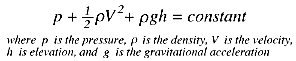
It is nothing more than an application of the principle of conservation of energy to an ideal incompressible fluid, which air very nearly approximates.

Here is the theory:
If you speed up air it gains kinetic energy, so it must lose potential energy ( pressure) by an equal amount. Add in changes in energy due to gravity and you have Bernoulli.

All of the "down wash" theories miss one vital point:
Only air in contact with the wing can produce any force on it.

So lift forces are a result of pressure forces on the wing.
If you disagree with that, then please be sure to give details of what "force at a distance" is in play.
There are only a few to choose from: gravity, electrostatics and the nuclear interactions.

Pressure forces , via Bernoulli, are a result of velocity differences.
So a flat plate, or a symmetrical section, or an inverted Clark Y all make lift the same way - by accelerating air over the top relative to the bottom.
The only remaining question is why does the air move faster on the top than on the bottom?

This is where it gets tricky. If you start with one assumption - air can't flow into the wing, but must move around it,
and apply the relevant physics that pertain to air to this boundary value problem you end up with the concept of "circulation"
Unfortunately the derivation doesn't translate to the sort of non mathematical hand waving arguments that are normally used.
In other words it flows the way it does because it has to. Physics demands it.

It can be imagined by picturing the flat plate at an angle of attack. Add a circular airflow centered on the section to the horizontal flow going by it.
You will get up flow in front of it, faster air over the top, slower air over the bottom and down wash behind it.
Which describes very well the observed airflow around a wing, or a golf ball with backspin.

To increase lift we must increase circulation. To do this you add camber or increase AOA.
Doing so will increase both up wash and down wash, but neither of these "produce" lift, they are a consequence of it.

Pat MacKenzie

TomN · Oct 14, 2006 10:48 AM

RE: Explaining Aerodynamics??#28 source
Hey Guys,

Remember this is for a 6th grade class.. KISS.. keep it simple.

Ref post #10, Serge's 1) answer is for this.

I used the same paper demo during my first flight Instructor's Oral exam. The FAA examiner amazingly had never seen that before.. Simply blow across the paper and it will lift.. As to symetrical sections.. a slight positive AOA (angle of attack for the 6th graders.. is the simple answer.

Tom N

Pat Mackenzie · Oct 14, 2006 10:54 AM

RE: Explaining Aerodynamics??#29 source
Simple but accurate:
- Air flow follows rules
- These rules cause the air on top to flow faster if you have angle of attack and/or curve to the wing, or a spinning ball
- higher speed = lower pressure = lift
Pat MacKenzie

EbonBetta · Oct 14, 2006 12:29 PM

RE: Explaining Aerodynamics??#31 source
OK now to explaine the Dynamics of bernoulis principal and how it is the basis of ALL powered flight.
1. as air moves faster ..presser is reduced.
2. This principal is in fact at work in wings,turbine engines and Jet engines. Remember I said you had to think about what is happening NOT what you think is happening.
Ths long and short of bernoulis principal is that as an object moves the air in front of it will attempt to stay in relation to the air next to itself when an object passes. In order for this to happen it must move at different speeds to accomplish this.

"I am not an engineer, a lot of the technical answer is in fluid dynamics I belive."
Now the answers to the questions posed by "Dick Fowler"
1.Question - What causes this same flat wing to create lift when it is tilted a few degrees
The fact that the wing is NO LONG Flat. Remember I said that the wing is moving straight.
The four forces in flight and their relationship.
Lift
Thrust Drag
Gravity


In straight level flight.......
As we change the attitude of the plane the vector of thrust is changed. So what direction is the plane actually moving ? Is the flat wing creating lift or is the thrust creating lift ?
Going straight up is the top of the wing creating ANY lift ?
So if the flat wing is being pulled at a 45 degree angle to the earth is the wing creating lift? The answer is still no.
So why is it still flying ? Thrust is the only force creating a positive moment. But, remember that gravity is still pulling the airplane down. So why doesn't the plane hit the ground ? If the thrust was too small it would. Remember that trust is in a straight line, and while the plane appears to fly straight it really isn't. For models it is more deceiving because the earth is very large and we cannot see the actual changes in vector as the planes fly.

Question - Where is the section of the rocket that will create lift using Bernoulli's principle?
Remember that Lift is only a force......an upside down plane giving slightly up elevator is still creating lift....unfortunatly it is directly in accordance with gravity an causing the plane to move closer to earth.
Bernoullis principle is that as air moves faster pressure is reduced.
In a rocket engine the nozzels restrict the "gas exhaust" to increase the Speed of the exhaust gas.
Bernoulli's principal is not a law about Lift per say.
It's a law about pressure.

Why does a baseball curve ? Well thats a much deeper study but here's the skinny answer. Remember where looking at movement of an object through the air. If the ball is spinning. the air on one side is going to touch MORE ball than on the other side of the baseball. Or another way to think about it is...as the ball is moving foward the side of the ball turning towards the direction of travel is going faster against the passing air, and the side of the ball that is turning towards where the ball came from is going slower in relation to the passing air. Here is where I will make a statment that I am not 100% sure of. But if my understanding of bowlingballs is correct I think I have the correct principal applied.
The net effect at the end or near the end of the baseballs flight is where gyroscopic precession take control causing the curve.

---------------------------------------------------------------------
Now the sheet of paper is the best method to display bernoullis principle. That faster moving air causes a resultant decrease in air pressure.
The higher air pressure under the paper pushs the paper UP.


Dick Fowler · Oct 14, 2006 12:40 PM

RE: Explaining Aerodynamics??#32 source
Thanks for taking the time to respond. I now understand.

PJ · Oct 14, 2006 01:17 PM

RE: Explaining Aerodynamics??#34 source
just make sure you explain that a symetrical airfoil, with no angle of attack, wont produce lift.

Im sure that was metioned elsewhere, but my browser is playing funny games and i cant view all of the thread.

Where's the KA-BOOM? There was supposed to be an earth shattering KA-BOOM!

phantomflier · Oct 14, 2006 08:39 PM

RE: Explaining Aerodynamics??#35 source
>
>Why does a baseball curve ? Or another way to
>think about it is...as the ball is moving foward the side of
>the ball turning towards the direction of travel is going
>faster against the passing air, and the side of the ball
>that is turning towards where the ball came from is going
>slower in relation to the passing air. Here is where I will
>make a statment that I am not 100% sure of. But if my
>understanding of bowlingballs is correct I think I have the
>correct principal applied.

Sounds backwards to me. Go to a public golf course and watch balls some when hit low will proceed to rise quickly. The ball has a lot of backspin and the direction of movement is towards the side that is retreating with the passing air. The same applies with a tennis ball backspin causes it to float while topspin causes it to dive. Hold a yard stick level and toss it flat with backspin, if you give it enough backspin it will rise, slow the backspin and it will float like a glider. In all these cases the direction of travel is towards the retreating side of the object. This has to mean the retreating side has the lower pressure not the advancing as you described. My non engineer thoughts are that the parasitic drag of the rotating object causes the air to follow a circular path in the direction of rotation putting the slower air on the advancing side.

Carl

Pat Mackenzie · Oct 14, 2006 09:08 PM

RE: Explaining Aerodynamics??#36 source
The main way drag comes into it is that the rotation of the ball creates the circulation of the air around it.
Without drag that would not happen.
The path the ball takes is mainly a result of the lift this circulation generates.

For example a ball with "top spin" is rotating so the top is moving in the direction of motion.
The circulation this creates slows the air on the top and speeds it up on the bottom so the lift is down and the ball dives.
This might seem backward but it is the speed of the flow relative to the free stream flow that determines the pressure, not the speed relative to the objects surface.

http://www.teachingtennis.com/site/spin.htm

Pat MacKenzie

Iskandar Taib · Oct 15, 2006 12:15 AM

RE: Explaining Aerodynamics??#37 source
LAST EDITED ON Oct-15-06 AT 01:02 AM (CST)
 
>>
>>Why does a baseball curve ? Or another way to
>>think about it is...as the ball is moving foward the side of
>>the ball turning towards the direction of travel is going
>>faster against the passing air, and the side of the ball
>>that is turning towards where the ball came from is going
>>slower in relation to the passing air. Here is where I will
>>make a statment that I am not 100% sure of. But if my
>>understanding of bowlingballs is correct I think I have the
>>correct principal applied.

>Sounds backwards to me.

It is backwards.

Forget baseball. Try playing some table tennis. Not "ping pong", the real table tennis with sponge rackets and with someone who can spin the ball several thousand RPM. The ball will always curve towards the direction the front of the ball is moving in. A topspin ball will dip. A backspin ball will float. A true slow loop drive (heavy, heavy topspin) is a sight to behold (and pretty darned xhard to return). The ball curves like a rainbow and jumps at you when it hits the table.

The explanation I've heard was that the ball's rotation, and the drag of the surface against the air causes the pressure of the air to increase on the side where the ball's surface is moving forward.

Now back to golf. Those dimples in the ball make them go further, I've been told. They help bring air from the front of the ball to the back of the ball, where the pressure is low.

Serge Krauss · Oct 15, 2006 12:56 AM

RE: Explaining Aerodynamics??#38 source
Whichever explanation is valid - if not both - there is agreement in your posts on which direction it moves. That's the same result I got as a kid throwing simple side-arm curves; the ball spun clockwise, as viewed from above, and curved to my right. Is there an important disagreement here - other than drag vs. lift?

SK

Serge Krauss

EbonBetta · Oct 15, 2006 03:41 AM

RE: Explaining Aerodynamics??#39 source
Questions on the Movement of balls that are spun.......
and contradictions on stuff I have heard here today....
1- a tennis ball struck with topspins dives inflight......
hmmm this sound possible with all the discription that was given but I feel it is incorrect to what actually happening..also same with the table tennis ball and BOWILNG balls....bowling balls though arent in flight but do explane the pattern.
The difference is what you think is happening and what actually is happening.
1- a solidly hit forhand without any english imparts more thrust to a ball.
2- a slice ie any hit meant to apply english weather back spin is at a reduced thrust vector.
If this is not true please explane how since I have yet to see it. If you think I am wrong then please go to newtons laws and try to explaine it to me.
So heres a question to consider if an object is hit and is producing Lift as it spins ie a top spun shot....what happens near the end of it's flight when the lift and thrust suddenly fall off ? Why it dives suddenly....due to no physical force affecting its rotation it hits the ground and the spin cause it to change the resultant vector to jump low away from it's bounce point.
the paddle or racket have to hit the ball at an angle and carry on upwards or over the balls incoming flight path.
The reverse is true with a ball with back spin the paddle or racket hits below the incoming balls path or down and under the incoming path to impart spin. Remember to keep in mind that the actual force vector is not straight through the ball.

Now to consider the curve ball....since thrown overhand or side arm there is something to remember here flight I said flight has Nothing to do with lift. Here is a great example. Thrust is supplied by the hand and shoulder movement as the forearm uncocks and the wrist is snapped in a motion to send the ball along the fingers in a way to impart a rotation to the ball.
I am right handed. If I throw side arm and let the ball roll from my hand to impart a clockwise motion the ball will attempt to curve to the right near the end of its flight. This is 100% true. But it is Not in any way a disoprovement of bernoulllis principle. It is in fact a proof of it and here is how and why.
You have to remember that 1 the ball is spinning clockwise thats true. Near the end of the balls flight thrust has fallen off as thrust falls off gravity remains the same. Since the thrust has fallen off lift drops. So the drag takes over. Moving the ball in the direction of the highest drag.

It works like a bowling ball going down a typical oiled bowling alley.
As the bowling wall is thrown the bowlers fingers pull up and through the back of the bowling ball imparting an angular topspin. the rolling ball is actually spinning roughly 45 degrees to the direction of travel. As the ball speed starts to drop to the point that the drag of the lane on the ball is greater than the actualy direction of travel. the Ball actually appears to turn and curve into the center of the lane hitting the pocket.

We have rotation,Thrust,drag...when drag is greater that thrust the we get a new path of travel.

There problem here is that aircraft for us has to do with thrust in just 1 direction .
Here is a question to ponder. But be careful AOA is not neccessare for lift.
If I take model helicopter with a curved top and flat bottom rotor and set the blade horizontal to the path of rotation. Ie. 0 incedence. will the blades at all speeds remain totally flat?
I already know the answer but remember that while a wing must create lift to make a plane fly. Planes do not fly just on lift. They need thrust and lift.and those together are needed to overcome gravity.
For simplicity thrust is straight ahead. Lift is straight up, drag is straight back and gravity is straight down.
----------------------------------------------------------------------


Iskandar Taib · Oct 15, 2006 04:01 AM

RE: Explaining Aerodynamics??#40 source
>So heres a question to consider if an object is hit and is
>producing Lift as it spins ie a top spun shot....what
>happens near the end of it's flight when the lift and thrust
>suddenly fall off ? Why it dives suddenly....due to no
>physical force affecting its rotation it hits the ground and
>the spin cause it to change the resultant vector to jump low
>away from it's bounce point.

It's producing lift all right, but towards the ground. (Or rather, at right angles to the direction of flight, directly towards the ground for the part of the flight that is horizontal.) Hence it dips down faster than it would than if you simply dropped it. It bounces low (and, in the case of the slow loop drive, it gains considerable forward speed when it bounces) because the ball contacts the table and there is friction between the rapidly spinning ball and the table. Imagine, for a minute, a madly spinning tire dropped vertically onto the pavement.

EbonBetta · Oct 15, 2006 04:14 AM

RE: Explaining Aerodynamics??#41 source
The madly spinning tire drops NO faster than the none spinning tire. It does attempt to move in a different vector due to newtons laws. As well as the earth will attempt to spin in the opposite direction purortonial to the force applied. Neither has any real revelance to bernoullis principle.
Why does the golfball travel further...has nothing to do with lift per say.......the answer is that the dimples cause turbulance which breaks up the boundry layer and reduce drag.

-----------------------------------------------------------------------
Going to start a new thread and see about starting with the real basics.

Pat Mackenzie · Oct 15, 2006 08:06 AM

RE: Explaining Aerodynamics??#42 source
There is no "thrust" during the ballistic phase of a ball's flight, only drag, gravity and any lift forces that result from the rotation.
It is just like a glider but with an extremely poor L/D.
The link I posted above explains quite well why a tennis ball seems to dive toward the end of the flight.
Pat MacKenzie

Dick Fowler · Oct 15, 2006 08:32 AM

RE: Explaining Aerodynamics??#43 source

Iskandar Taib · Oct 15, 2006 10:41 AM

RE: Explaining Aerodynamics??#44 source
>The madly spinning tire drops NO faster than the none
>spinning tire.

It would if it had significant forward speed.

>It does attempt to move in a different vector
>due to newtons laws.

To invoke Newton, you have to account for all forces acting on the object. If there is lift acting towards the ground, it would fall faster than it would given gravity alone.

>Why does the golfball travel further...has nothing to do
>with lift per say.......the answer is that the dimples cause
>turbulance which breaks up the boundry layer and reduce
>drag.

It reduces the drag in the low pressure bubble behind the ball by bringing air from the front of the ball to the back. And this only works if the ball is spinning.

phantomflier · Oct 15, 2006 05:14 PM

RE: Explaining Aerodynamics??#45 source
>Why does the golfball travel further...has nothing to do
>with lift per say.......the answer is that the dimples cause
>turbulance which breaks up the boundry layer and reduce
>drag.
>

If there is no lift explain why I have seen balls that are hit level inches off the ground rise in a curved path until they're higher than the surrounding trees. The ball has to be generating lift (or push) away from the ground.

Iskandar Taib · Oct 15, 2006 10:35 PM

RE: Explaining Aerodynamics??#47 source
Yes, there is considerable lift also, because the ball is given a healthy backspin. But experiments show that the dimples also help a great deal. Smooth balls don't fly nearly as far, even though they also make lift. Their forward speed dies off much quicker, and if the forward speed dies off, so does the lift.

EbonBetta · Oct 15, 2006 11:05 PM

RE: Explaining Aerodynamics??#48 source
Ok the ball does throw a curve in to some of what I stated..Though and this is a very big though....
You cannot show me any airplanes that actually spin to fly...
All the information on the supports the effect on SPINNING objects.
But NO known aircraft spin to fly.
While the increased spin does seem to increase drag. Above what a ball with little or NO spin has. This doesn't change the effects of bernoulis principles.

But here is a thing to consider. Aasuming a sled is sitting on the ground. Doesen't matter which type sled it is. snow, or board used to move something.
The movement of an object upwards is the basis of an inclined plane.
force foward....more pressure under than above. Bernoulies principle is a defination of how this applies to air or liquid. Though the wind does in fact act like an inclined plane as it is Pulled or pushed into the air forward. I state that it does not need need any Aoa to work. Since I have never see any wing that was flat and had a 90% perpendicular leading edge that went square and flat to the lower surface.
Somebody may someday build one to prove it works but it is an inconsequential statment. The total of how fluid dynamics work if far greater than anything needed to explanie flight to children, nor most people involvend in any thing except engineering.
I'd love to see a plane that works like a ball... but I highly doubt that todays models nor real aircraft have evolved to find a way to make use of that.


1-thing to throw into all this stuff. One of the lastest things I have seen info on is development of supersonic projectiles for use under water. I am not yet sure they have acheived it yet, but its in the works.

Pat Mackenzie · Oct 15, 2006 11:21 PM

RE: Explaining Aerodynamics??#49 source
>Ok the ball does throw a curve in to some of what I
>stated..Though and this is a very big though....
>You cannot show me any airplanes that actually spin to
>fly...
>All the information on the supports the effect on SPINNING
>objects.
>But NO known aircraft spin to fly.
It has been tried:
http://www.airbornegrafix.com/HistoricAircraft/ToFly/Rotorplanes.htm
I know I have seen pictures of models built on this principle that were able to fly.
Pat MacKenzie

Howard Rush · Oct 16, 2006 12:24 AM

RE: Explaining Aerodynamics??#50 source
Cool. Some guys in Peru (I think) published a bunch of stuff on rotating-cylinder flaps. Those might work for stunt if you could start and reverse them fast enough.

EbonBetta · Oct 16, 2006 12:33 AM

RE: Explaining Aerodynamics??#51 source
Now thats very bizzar and interesting.
All the info I did look at that had info on balls and spin were about very high rates of spin. I think that the specific density of the fluid has a lot to do with what happening in relationship to the spin and movement. Now if this was tried as a submarine it might become very viable.

USRACER_843 · Oct 16, 2006 03:55 PM

RE: Explaining Aerodynamics??#53 source
The current rash of "foamie" R/C airplanes are flat plates with square edges and they fly just fine! They don't glide worth a darn but those who fly them don't care.

don Burke
Menifee, CA

Iskandar Taib · Oct 17, 2006 12:50 AM

RE: Explaining Aerodynamics??#54 source

Sunnybreeze · Oct 15, 2006 05:30 PM

RE: Explaining Aerodynamics??#46 source
I just want to say thank you to all who replied. I never dreamed I would create such a stur! I will revert with the result of the 6th grade class tomorrow
Thanks to all again

Steve Everett

Serge Krauss · Oct 16, 2006 12:50 AM

RE: Explaining Aerodynamics??#52 source
Good luck, Steve!

SK

Serge Krauss