Pat MacKenzie
Rich outside, Lean inside
Stuka Stunt Main Forum · 29 of 29 known posts recovered
Pat MacKenzie
>Opinions please. Why do virtually all
>motors run rich outsides and lean insides?
>This is not just in PA. Even Combat motors
>on bladders exhibit this behaviour. Once
>you have raised the tank/lowered the engine
>as much as you can, what else can you do?
>Even at the W/C many planes are .1 to .2
>second slower inverted.
> Pat MacKenzie
>
I don't understand the question because I don't agree with it. A side mounted engine may exhibit that characteristic since the bypass (on a loop scavenged engine) or the boost port (on a Schnurle) engine is on top. Fuel will be thrown into the port on outsides, away from the port on insides. Thus many engines mounted sideways will need to have the tank raised slightly. But, raise the tank, and that usually solves the problem.
On an upright or inverted engine they are pretty much straight away. On an inverted engine you will be throwing fuel towards the head on insides and away from the head on outsides, but that usually just produces a burp, not a lasting effect. And, if there is a difference, once again, raise or lower the tank. There may be some slight difference in lap time resulting from an effort to make inside and outside loops the same, but that would be minor.
I find your premise that the inverted laps were slower interesting because I was always taught to err in the opposite direction. If one is going to be faster, make it the inverted laps. That way, if you get off to a bad setting and start your wingover you will be assured that the engine will run as strong or stronger inverted to get you back over.
If it is off, as you say, you can always move the tank.
Leonard Neumann
Jim Thomerson
Perhaps they haven't raised or lowered the tank enough? I always set my tank height by listening to the engine doing 3 inside loops, then doing 3 outside loops and the making the adjustment. Just flying inverted to adjust the tank will only get it in the ballpark. When adjusting the tank doing the looping method, you are taking in acount the entire flight dynamics of the plane. Allen Brickhaus showed me this and it works great!
Crist Rigotti
"A driver trying to be a pilot"
I wish I could take credit for this, but Big Art showed me this trick and it works. The Adamisins do not move their tanks up and down to equalize mixture, they do it by turning the spraybar to redirect the fuel stream. Normally the hole in the spraybar would be pointed straight down the venturi. If you can imagine the inverted engine in outside maneuvers you can imagine the fuel, in its heaviest state, being slung down the venturi accelerated by centrifugal force. The same fuel with the engine during inside maneuvers is slowed by the centrifugal force leaning the mixture. What Art told me to do is to turn the spraybar in small increments so that it points to the rear of the venturi causing the fuel to spray against the rear wall rather that straight down the throat. This tends to slow it down in outsides while having no effect during insides. This same senario would hold true for an upright engine, but it would be rich during insides and lean during outsides.
Give this a try, I'd be very surpirzed if you don't find the happy spot for the spraybar to even out the mixture problem.
Randy
>it works. The Adamisins do not move
>their tanks up and down to equalize
>mixture, they do it by turning the
>spraybar to redirect the fuel stream.
>Normally the hole in the spraybar
>would be pointed straight down the
>venturi. If you can imagine the
>inverted engine in outside maneuvers
>you can imagine the fuel, in its
>heaviest state, being slung down the
>venturi accelerated by centrifugal force.
>The same fuel with the engine during
>inside maneuvers is slowed by the
>centrifugal force leaning the mixture.
>What Art told me to do is to turn the
>spraybar in small increments so that
>it points to the rear of the venturi
>causing the fuel to spray against the
>rear wall rather that straight down
>the throat. This tends to slow it down
>in outsides while having no effect
>during insides. This same senario would
>hold true for an upright engine, but
>it would be rich during
>insides and lean during outsides.
>
>Randy
Interesting, Randy, because Art suggested the same thing to me. I tried it several times with several different engines and never could tell any difference. Straight down, towards the front, towards the back, so long as the hole was out of sight the engine would run just the same. So, if this does work (and Art said it did) it may not work for all engines.
Leonard Neumann
I've used this on OS 40 FPs, Stalker .51 RE, Fox .35 and McCoy 35-29 with good results. There is such a thing as the tank being too high or low for this to work. Mine were all within about 1/8" to start with. If it gets much bigger than that I'm not sure if it would work or not. My feeling is that it wouldn't
Randy
>
>I've used this on OS 40
>FPs, Stalker .51 RE, Fox
>.35 and McCoy 35-29 with
>good results. There is such
>a thing as the tank
>being too high or low
>for this to work. Mine
>were all within about 1/8"
>to start with. If it
>gets much bigger than that
>I'm not sure if it
>would work or not. My
>feeling is that it wouldn't
>
>
>Randy
I tried it on the 35/40 FP and Fox 35. NaDa. I was using uniflow and muffler pressure. I wonder if that makes a difference.??
Leonard Neumann
Randy
>was running uniflo and muffler
>pressure.
>
>Randy
Reminds me of a quote from "Airplane" (I think). "Now that's strange!"
Don't know what to say. Worked for Art. Worked for you. Didn't work for me.
Leonard Neumann
>Opinions please. Why do virtually
>all motors run rich outsides
>and lean insides? This is
>not just in PA. Even
>Combat motors on bladders exhibit
>this behaviour. Once you have
>raised the tank/lowered the engine
>as much as you can,
>what else can you do?
>Even at the W/C many
>planes are .1 to .2
>second slower inverted.
I don't doubt your observations, but I have no idea what you are seeing. Given your very extensive combat background, I assume you are talking about side-mounted engines. Schneurle stunt motors, mounted inverted, almost always do exactly the opposite. Shim the tank for equal upright and inverted speeds, and they almost always want to run faster on outside turns, and slower on insides. Leonard's explanation, or something similar having to do with acceleration effects on internal gas flow, is almost certainly the cause.
Schnuerles depend on the momentum and direction of the incoming charge to create the scavenging action and are presumably more effected by acceleration than baffle piston engines (where the baffle forces the incoming charge to go where you want). Sure enough, baffle-piston engines are much less prone to this effect. It may not be perfect theory, but it's pretty close. The "spigot venturi" improves the situation, but doesn't really fix it entirely. Shimming the tank to have different upright and inverted speeds is a real band-aid that is very unsatifying.
The "schneurle effect" is a very frustrating problem to solve and it's the one thing I don't like about the modern engines.
Brett
igor
>a trouble. But if you
>see that inverted engine is
>rich one way and outboard
>engine just opposite way, the
>clear solution is 45 degrees
>mounted engine - just as
>I do it. It solves
>that problem.
>
>igor
Now, Igor, are you sure that 45 degrees is the proper angle? Are you sure that it shouldn't maybe be 43 degrees or maybe 47?
(Just funning with you. Thought maybe we could start a whole new thread and get another whole new argument going.)
But you may be right in that this could help. Unfortunately, it makes for a change in how the engine is mounted (radial mount) and structural changes for the nose. More things to ponder.
Have a good day.
Leonard Neumann
Definitelly, just you must be sure your model rolls within tolerances of +/- 0.1 deg. 
>>>Unfortunately, it makes for a change in how the engine is mounted (radial mount) and structural changes for the nose. More things to ponder. <<<
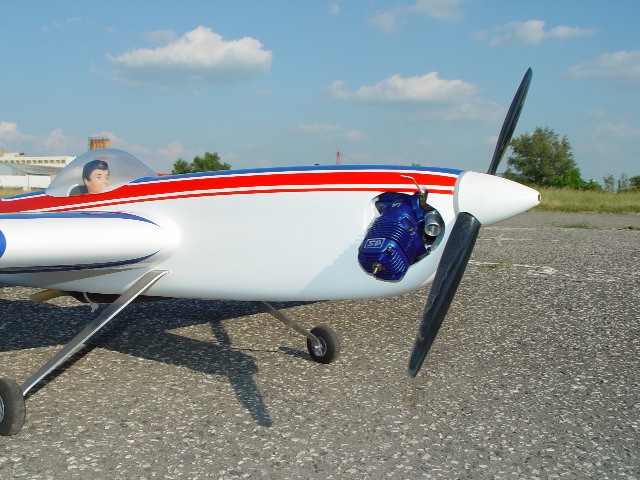
First I affraided of it, but once I tried it, it looks much easier. you not need any cowl if you can accept that look. I mounted it by backplate screws, so only you need is hard firewall and four holes.
a picture?
igor
>>>>Unfortunately, it makes for a change in how the engine is mounted (radial mount) and structural changes for the nose. More things to ponder. <<<
>
>First I affraided of it, but once
>I tried it, it looks much easier.
>you not need any cowl if you can
>accept that look.
I can, but will the appearance point judges?
>I mounted it by backplate screws,
>so only you need is
>hard firewall and four holes.
>
>
>
>a picture?
>
>igor
Yeah, send us a picture, Igor.
Leonard Neumann
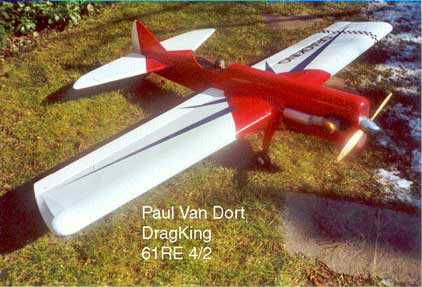
After several years of frustration with this problem, I took the decision to buy a front intake/ rear exhaust engine (Stalker 61 RE), and build it in on its side (90 degrees) Perfect symmetry in running behaviour inside/outside turns. Skywriter like construction (Thanks to Kim Doherty)

Perhaps Brett's observation about loop speeds versus lap times accounts for
what I am seeing at W/C when I time models. It makes much more sense to get the
speed in manoeuvres consistent, than to worry about the 6 inverted laps. I will
definitely try this approach when trimming my next model.
I have built only 2 PA models. The first was a Gieske Nobler with a Fox 35. The
permanent tank installation made moving the tank impossible, and ground clearance
for the 11-5 prop that it flew best with made shimming the motor a bad option. It
also would have ruined the alignment of the spinner. To get a good run upright and
inverted I:
raised the head
used a hotter plug
ran muffler pressure
used an Enya NVA
stuffer backplate
All of these tend to make the needle less critical, so the speed varies less between
upright and inverted. I used it like this to make the Canadian team in '94. The
biggest problem was that leaks in the joint between muffler and motor caused
inconsistencies, so I went back to regular uniflow.
In Dallas for a combat contest I had the pleasure of watching Bob Gieske test fly
his Nobler, with a Fox.35. He was running an 11-5 as well, but he was running 15%
nitro. A bit more nitro also makes the needle less critical.
After seeing him with 15%, on hot days I would run 5%, in cooler weather
10-15% (always 29% castor). I used it and it ran well until a leadout failure last
summer ruined the model, the motor and my day!. I never did solve the burp on the
first corner of the outside square.
My other model was a full take apart Saturn with the then new PA40 that I built
to take to China in 94. This was much easier to get working well. I just followed the
instructions in Paul Walker's Impact article! I did run the pipe longer than Randy
recommended, since I found the speed jump from on the pipe to off the pipe to be
too much. As to the upright/inverted thing, I followed the advice of Fred Tellier,
and just bent the muffler pressure line up or down in the RST tank to change the speed.
With the long-ish pipe, 10% nitro and the light model (50 oz) that motor was a
pussy-cat. I think the whole time after I had it set up I only had one bad run. The
needle valve was just a lap-time control. A bird strike (while the plane was on loan)
a few years ago ruined the model, the motor, and my friend Kim's day. He had
borrowed it to fly at the Canadian team trials, so that bird almost certainly cost him
a trip to France.
I have built a few more than 2 combat models
. In slow the tank was usually 1/4"
above centre. This is evidence that something is going on inside the motor affecting
fuel flow upright and inverted. The solution is clear, it was the theories of the cause
I was curious about.
When running bladders and with a good needle you don't see any difference
inside/outside. If the needle is a little lean, they always run more lean inside, and
less outside. If the needle is a bit rich (or the motor is going rich at the end of the
bladder) they will run less rich inside, and more rich outside. Some F2D motors are little affected, and some a lot. We do have the motor mounted about 3/16" above centre so the
muffler(!) can clear the LE spar, but when using my old centered models with FP25
motors in speed limit the same thing is seen.
Sorry about the length,
Pat MacKenzie
>
> I have built only 2 PA models.
>The first was a Gieske Nobler with a
>Fox 35. The permanent tank installation
>made moving the tank impossible, and
>ground clearance
>
>for the 11-5 prop that it flew best
>with made shimming the motor a bad
>option. It also would have ruined
>the alignment of the spinner. ...
We did, in fact, shim the engine on a Still Stuka (Matt's first built exactly to plans with no adjustables) and that was the last plane either of us built without a moveable tank. When the tank is moveable you can cure the problem quite easily.
>
>I have built a few more than
>2 combat models
. In slow
>the tank was usually 1/4"
>above centre. This is evidence that
>something is going on inside the
>motor affecting fuel flow upright
>and inverted. The solution is clear,
>it was the theories of the cause
>I was curious about.
>When running bladders and with a
>good needle you don't see any
>difference inside/outside. If the
>needle is a little lean, they always
>run more lean inside, and less
>outside. If the needle is a bit rich
>(or the motor is going rich at
>the end of the bladder) they will
>run less rich inside, and more rich
>outside....
> Pat MacKenzie
>
With the rigid, non-pressure tank, you can move the tank to "correct" the situation. With the pladder on pressure moving the tank has no effect. So, yup, you have got it figured out.
Leonard Neumann
>bladders and with a good
>needle you don't see any
>difference
>inside/outside. If the needle is a
>little lean, they always run
>more lean inside, and
>less outside. If the needle is
>a bit rich (or the
>motor is going rich at
>the end of the
>bladder) they will run less rich
>inside, and more rich outside.
>Some F2D motors are little
>affected, and some a lot.
I've heard the Cyclon PC4 was prone to this.
>
>After several years of frustration with
>this problem, I took the decision to buy
>a front intake/ rear exhaust engine
>(Stalker 61 RE), and build it in on its
>side (90 degrees) Perfect symmetry in running
>behaviour inside/outside turns. Skywriter like
>construction (Thanks to Kim Doherty)
>
>
>
With a side exhaust engine, this wouldn't work since the boost port is on the side opposite the exhaust. (Obvious solution, block the boost port.) But with the rear exhaust you have the boost port to the front and one bypass on top and the other on the bottom. This gives uniform fuel flow upright and inverted, and, as you discovered, you now have symetry in your runs.
That is one simple solution to the problem with no real negatives except for the engine sticking out the side.
Leonard Neumann
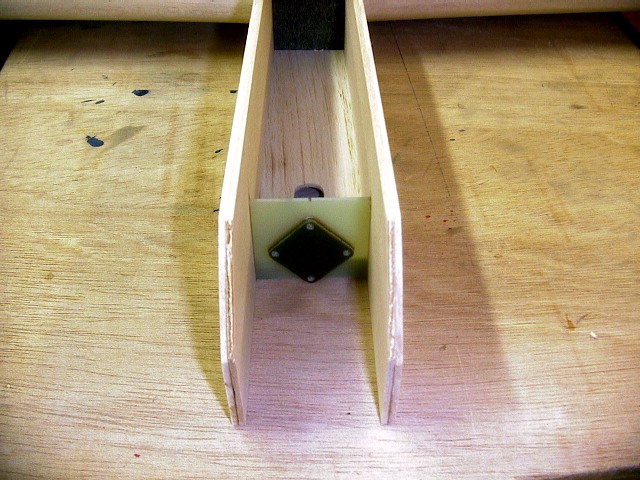
Here you see GF firewall with shimming for back plate as the LA exhaust exceeds back plate. Holes are of the back plate pattern.
This picture shows it “inside” and shows it does not need any cowl – you are right, it can cost appearance points – but sorry I fly FAI 
This picture was here several times – it shows the “result”.
Oops, that was three questions. Sorry.
Leonard Neumann
Oh, and when I said I wanted pictures, didn't I mention, I wanted one of you.
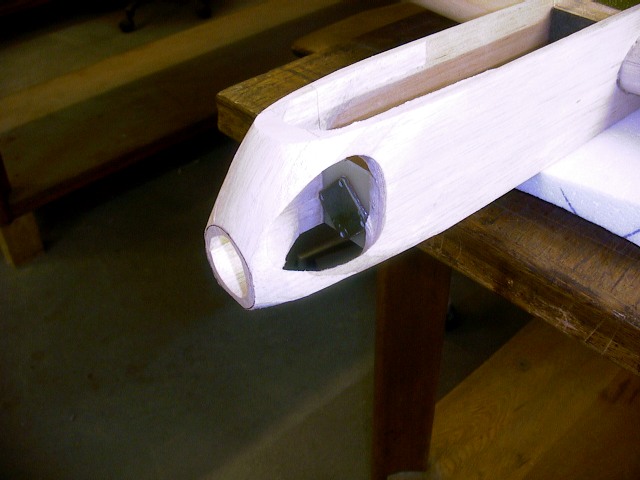
Len, the fuselage is in one piece – now cowl. There are three holes. You can see all on this picture:
The front hole is for engine and is also used to install it. The rear hole is for installing pipe from backside. The hole in between (from bottom side) is for:
1/ installing screws of engine – before tank installation
2/ for installing tank - its width is equal to tank height – it is necessary to turn it 90 degrees to go thru
3/ it is went for cooling air – it is designed in very sophisticated place and shape
. The front part has little low pressure (suction) thanx of angled nose front of it to cool down exhaust manifold while it has little higher pressure at back side to force some air to cool down the pipe. It makes also very strong whirlpool around the tank, which does not allow heating of tank. I never got problems with richening end of flight, even tank is not shielded from hot pipe venting around.
More pictures are:
http://www.netax.sk/hexoft/stunt/the_max.htm
and
http://www.netax.sk/hexoft/stunt/the_max_ii.htm
igor
... BTW I have also neat blond girl in one model, but I do not like her too much - she already crashed once 
>Len, the fuselage is in one
>piece – now cowl. There
>are three holes. You can
>see all on this picture:
>
Oh, Igor, now you have disillusioned me. Here I thought you had made a very tight fitting cowl where you could even see the separation point. I guess that is why I couldn't see it.
>
>... BTW I have also neat
>blond girl in one model,
>but I do not like
>her too much - she
>already crashed once
Woman driver! And a blonde, too! (Ho, boy, that ought to get the hate mail started.)
Leonard Neumann
>Now, Igor, are you sure that
>45 degrees is the proper
>angle? Are you sure
>that it shouldn't maybe be
>43 degrees or maybe 47?
>
>(Just funning with you. Thought
>maybe we could start a
>whole new thread and get
>another whole new argument going.)
>
>
>But you may be right in
>that this could help.
>Unfortunately, it makes for a
>change in how the engine
>is mounted (radial mount) and
>structural changes for the nose.
> More things to ponder.
I was hoping Ted would jump in here, but the "tilt the engine" effect is very real and should tell us a lot about the cause and potential cure for this problem. When he was trying various 40 schneurles for the Imitation article, he discovered the schneurle effect. Since the Imitation had a radial mount, it was easy to tilt it. The whole list of details escapes me, but at 0 degrees (cylinder down) it was rich on insides and lean on outsides. At 45 degrees, it was rich in outsides and lean on insides. Splitting the difference at 22.5 degrees it was the same in both directions! Note this had nothing to do with tank position, venturi, glow plug heat range, and all the other things that are usually proposed to solve this problem.
Brett
1/ I guess the problem has something to do with different fuel accumulation in crankcase at different G’s. Thus, if the “G” changes, the accumulated fuel changes its volume and thus it make those problems, and this is also reason why tank shimming or whatever does not help – and if, than in only one maneuver and another makes worse. The only what can be changed is SENSITIVITY of engine for this problem – like opened silencer and smaller ventury, or pipe keeping the run somehow or so.
2/ There are engines sensitive different way to “side” asymmetry (outboard mounted engine) and different way to “inverted” engine. But always – inverted engine tends to be rich insides and outboard engine tends to be rich outboard. I never saw opposite effect. It leads me to believe that outside turn accumulate fuel in crank (lean) case of inverted engine while inside turn pushes it directly to the cylinder (rich). The typical effect is in round eight in intersections. Similar problem has side-mounted engine. Because of crank rotation – especially side exhaust. Outside turn pushes fuel to top of crankcase (side mounted engine) and crank throws it toward the. It makes asymmetry, which is just opposite to the inverted engine, so “somewhere in between” can solve the problem. It looks to be very simple reason, but it is hard to check, especially if there are engines proof of that effect.
3/ I do not think it has what to do with porting. I know also some schnuerle-ported engines not showing any sign of that problem, while cross scavened engines making serious problems. Example can be what Paul vD wrote. Stalker cross is scavened engine and I know it is asymmetric if inverted. I did not see side mounted Stalker, but I know that very similar Retro makes exactly the same and often works well side mounted, but one release did SERIOUSE problems also side mounted – without any visible difference in construction. We tried to rework crank to make more whirlpools and limit the volume around crank – by my theory it had to help, or at least to show some change, but it did not
. I start to believe it has also something to do with sleeve in case or piston in sleeve fit. It looks worse fit (free sleeve in case or too much taper) helps to suppress the effect.
4/ The thing is even more miraclic: it looks the richness can affect it also. Richer run sometimes change the effect and sometimes also needs to move tank little bit to get same lap times upright and inverted. Difficult to say, if it is problem of my model or the engine.
5/ From everything written I think the optimal angle differs engine to engine. Probably also prop to prop and fuel to fuel. The only I can say that my piped LA .46 with 12x3.5 prop works well at 45 degrees (without any sign of that problem). Some muffled Retro engines are well at 45 deg, but some of them need only 20 (those which are symmetric if side mounted).
Now the question is what from above is truth, what is “just about right” and what is senseless. So please comments … may be we can convergate to something.
igor
Appreciate your clarification.
Jim Thomerson
>read to say that the
>tank was left alone as
>the engine was rotated, in
>which case I would understand
>what went on in a
>very different light.
>
Well, that's why I would prefer Ted to relate his experiences directly. But my understanding was that the tank was shimmed/uniflow vent moved in order to even out the upright/inverted lap times.
They key to the issue is that the engine runs differently under varying Y axis accelerations. + or -1g seems to be different than +2 or -2, and +2 is different from -2.
I also think the idea that you should shim the tank to get it the same in the maneuvers, and different in level flight, is at best a band-aid. It may well be better than "even in level flight and uneven in the maneuvers", but I find neither acceptable in any great degree.
Moreover, it doesn't really work in all cases. With engines that have this effect to a strong degree, you can have it shimmed to run 5 seconds upright and 6 seconds inverted, and *still* have it take off like a rocket in the outsides, and bog down in the insides. I had a Royal 45 from one of the reworkers that was like this. It had gangbusters power compared to the ST46, but the speed differential was simply unacceptable. The inside/outside effect simply completely swamped the tank shimming by 3/8"-1/2". I'm not kidding, it was so rich inverted that it would barely stay running, but in the horizontal 8 it was like somebody lit a JATO bottle when you switched from positive to negative G. Eventually I gave it away to somebody who had a profile, and it worked relatively well on its side.
Most schnuerle engines have this to some degree. Watch NAT's videos and tell me how many people's engines *don't* audibly take off in the outsides. With piped engine there's a lot more control and it's really not a huge problem. But a big motivation of the "run in a 4-stroke all the time" setup is to make it not break into a 2-stroke at the top of the outsides of the square 8. This is of course the worst possible time, as it's accelerating about the same time you are getting ready to dive into the bottom.
I *have* seen this effect to small degree on baffle-piston motors, but on the average baffle-piston stunt motor like the ST46 or 60, it's almost imperceptible.
The best effect of the "spigot" venturi is that it reduces this effect tremendously over the "not spigot" venturi. But it's *clearly* not really fixing the underlying problem, merely reducing it. I should also note (and Ted noticed this first, too) that the effect is *vastly* more pronounced in thick sea-level air like we have locally. In the relatively thin/humid air in the Midwest/Southeast in the summer, the degree of the problem is very greatly reduced. I think this speaks volumes about why the problem is frequently attributed to delusions on our part.
Brett
One of the great mysteries of stuntflying. I remember a visit to the British Nats. My ST51 (mounted inverted) was working perfectly at home. At the nationals in Barkston however, I couldn't even get it to run trough the inside loops. Going richer and richer to finally quit... The problem was not so much a leaning out in the outsides than a getting richer in the insides.
Conditions are different in England than in Belgium (sealevel). Heigth? (Can anybody tell me on what altitude Barkston RAF airfield is situated on?) Perhaps humidity?
I found out that the ST51 did not have this problem when propped with an APC 11x4. A very small prop that allows the engine to run in a 4 stroke mode at a speed it likes... This way I flew at the Wch in Sweden in 1996. Sometimes there was a runaway though, so this setup was not 100% reliable.
I've tried a Stalker 61 SE (Side Exhaust) inverted as a replacament of the ST51. With this engine, the difference in power outside-inside was huge! Giving up elevator was like pushing the accelerator!! Playing with the tankheigth did change the laptimes upright-inverted, but the problem in the loops and squares was still the same.
It is my opinion that we have to make a distinction between 2 phenomena:
1. Extreme leaning out in outsides and just barely richening in insides: The Stalker 61 SE problem
2. Richening heavily in insides and a 'normal' leaning out in outsides:The ST51 problem
Phenomenon 1 is the problem this discussion has been dealing with so far.
I was lucky to have it solved with my 90 degrees mounted STALKER 61 RE engine (see pic) with a symmetrical scavening round the pich axis.
As Igor has mentioned, this is not the cure for every engine of this type. The only assymetry left in the engine is the rotating crankshaft, creating assymetric turbulence in the crankcase (anything else?).
Perhaps there exist engines with side exhaust where the effect of the assymetric scavening and the effect of the assymetric crankcase turbulence neutralise eachother. In other SE engines this effect can be amplified when the two effects work together. One can imagine that these two effects also vary independently with RPM and richeness of the mixture....
It might be an interesting experiment to have the engine run in the opposite (=clockwise) direction (investment: 1 crankshaft and 1 prop) and see what the difference in behaviour is... any volunteers?? Users of a Rabe rudder be warned: the precission effect will be opposite with a clockwise running spinning prop...
Phenomenon 2 is due to a plug that is being flooded. Because of the g force, oil is pulled to the cylinderhead and will flood the plug, putting out the fire. Experimenting with plugs, props and compression ratio is necessary to fix it. I don't think this problem is related with phenomenon 1
One important question today: Are 4 stroke engines sensitive to one of these phenomena???
FWIW
Paul