Stuka Stunt Control Line Forum
Archive, 2000–2021 · recovered from the Internet Archive
Forums › Stuka Stunt Main Forum

Lurker response, OT "Q

Stuka Stunt Main Forum · 23 of 23 known posts recovered

Chip · Feb 20, 2003 07:53 PM

Lurker response, OT "Q" for Zilla & Ted #0 source
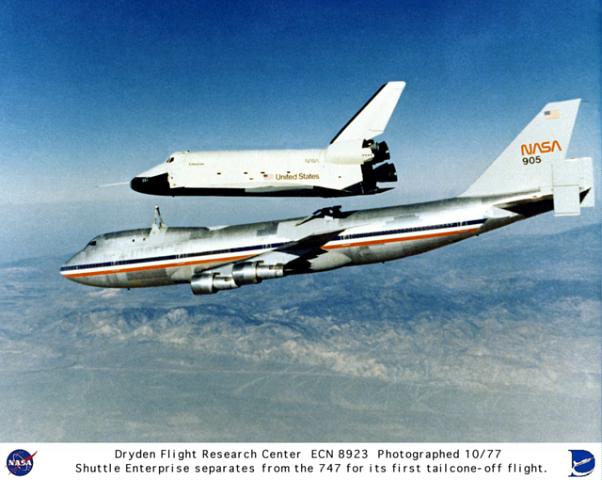
At a Government facility today I saw an old photo of the Shuttle "Challanger" being shuttled on a 747. The photo was from the air, so the perspective may not have been that great.

With the shuttle sitting on top of the 747 it looks like the rudder on the 747 would be made somewhat ineffective. Of course the 747 had vertical fins on the outboard tips of the stab/elav assembly. I assume the fins were added for better control due to the shuttle blocking the rudder.

I haven't read or heard much about this, but was wondering if in that setup it is possible they could somehow use the shuttle rudder also, as an aid in overcoming the handling difficulty presented with the babyback ride. In other words could they use the controls on the shuttle in addition to the 747 controls?

The photo sparked my curiosity.

Chip
kdheath · Feb 20, 2003 10:15 PM

RE: Lurker response, OT "Q" for Zilla & #1 source
Been a long while since reading about the piggy-back rig, but
TTBOMK they don't use the shuttle surfaces in flight.

Ted Fancher · Feb 20, 2003 11:34 PM

RE: Lurker response, OT#2 source
LAST EDITED ON Feb-20-03 AT 11:37 PM (CDT)
 
HI Chip,

That's an interesting question and the short answer is that the yaw considerations for not only normal flight but emergency events like engine failures etc. have been carefully considered and dealt with.

The slightly more complex answer is that we must remember the shuttle is a particularly streamlined device...after all, its the fastest pilot controlled vehicle in history! As a result, it is pretty much a given that airflow behind the vehicle is not particularly turbulent. As a result, even though it sits just ahead of the vertical surface of the mother ship the airflow around the vertical fin is obviously a controlled environment in which the ability to control yaw is largely undisturbed. Thus it still provides its two basic functions...yaw stability in normal flight and yaw control in conditions in which yaw is influenced by other factors such as assymetrical power or control surface anomalies, etc.

The second part of the answer deals with the added vertical surfaces on the tips of the horizontal stab. My best guess is that these function as a means to control the aerodynamic center of the combined shuttle/mother ship vehicle. The fore and aft location of the shuttle atop the '47 is largely determined by center of gravity considerations. It's location in that area adds a huge amount of surface area in a comparatively forward position, thus moving the aerodynamic center of the vehicle forward of where it would be on the 747 without the shuttle.

Stability requires that there be an adequate distance between the center of gravity and the aerodynamic center (also discussed as the "neutral point" in other threads) for stability. This is known as the "static margin". My guess is that the large vertical additions to the tail are necessary to move the aerodynamic center far enough aft to make the combined vehicle stable, particularly in the yaw axis and to therefore minimize dutch roll which would put a significant load on the coupling devices between the two aircraft.

IMHO

Ted

Randi Gifford · Feb 21, 2003 12:58 AM

RE: Lurker response, OT#4 source
I lived in Houston at the time the shuttle was being developed. According to friends who worked at NASA, when they first began testing the shuttle one of their primary concerns was the possibility that it might damage the vertical stabilizer on the mother ship when it separated for test landings. To compensate for this and allow at least a chance of bringing the 747 back to earth in one piece, vertical fins were added at the outer edges of the horizontal stabilizer.

Ted Fancher · Feb 21, 2003 04:00 PM

RE: Lurker response, OT#8 source
>I lived in Houston at the time the shuttle was being
>developed. According to friends who worked at NASA, when
>they first began testing the shuttle one of their primary
>concerns was the possibility that it might damage the
>vertical stabilizer on the mother ship when it separated for
>test landings. To compensate for this and allow at least a
>chance of bringing the 747 back to earth in one piece,
>vertical fins were added at the outer edges of the
>horizontal stabilizer.

Randi,

I've got to display my ingorance here. Did they actually launch the shuttle from the Boeing mother ship for test glides? I don't know and could be entirely wrong but I'd be very interested in how they could force the separation safely since the shuttle would be unlikely under any scenario I can envision to be able to develop enough lift at speed of which the 747 is capble to actual "zoom" safely up and away. I'd have to think only a drop launch would be viable.

Anyone know for sure?

Ted

Brett Buck · Feb 21, 2003 04:26 PM

RE: Lurker response, OT#10 source
LAST EDITED ON Feb-22-03 AT 00:49 AM (CDT)
 

>I've got to display my ingorance here. Did they actually
>launch the shuttle from the Boeing mother ship for test
>glides? I don't know and could be entirely wrong but I'd be
>very interested in how they could force the separation
>safely since the shuttle would be unlikely under any
>scenario I can envision to be able to develop enough lift at
>speed of which the 747 is capble to actual "zoom" safely up
>and away. I'd have to think only a drop launch would be
>viable.
>
>Anyone know for sure?
>

They certainly did do drop tests. The first shuttle airframe,OV-101/Enterprise, was taken aloft and dropped/flown off the 747 carrier aircraft. The first few tests were with a tail cone to streamline it for better glide, and the last were flown with the tail cone off to get a good test of the "as built" flying characteristics.

The stall speed is pretty high, but its not necessarily all that high. The speed at touchdown is about 200 mph +/-. The separation conditions were a 7 degree dive, about 20000 feet, and something around 300 mph. The 747 engines were at idle and the airframe was as draggy as possible.

The only significant difference with the ferrying configuration is that the forward strut was much higher, providing higher incidence relative to the 747 so it would pop up and off more quickly. The actual drop procedure was to fly it up pretty high, then go into a shallow dive, separate the shuttle, and then to a slightly negative-g pitchdown to make sure it cleared.

This was all around 1977.

Brett

Randy Ryan · Feb 24, 2003 09:23 AM

RE: Lurker response, OT#12 source
I was stationed at George AFB at the time, as you can see in the picture the desert air was crystal clear and these drop tests could be see from the ground with binoculars, an incredible thing to watch.

Randy Ryan
AMA 8500
SAM 36
I fly 'em all and love it!

DMoon · Feb 24, 2003 10:36 AM

RE: Lurker response, OT#13 source
I remeber all of this it was AWESOME! Still is!

These guys must have wheelbarrels to carry their balls around in!

DMoon

Ted Fancher · Feb 21, 2003 04:13 PM

RE: Lurker response, OT#9 source
>I lived in Houston at the time the shuttle was being
>developed. According to friends who worked at NASA, when
>they first began testing the shuttle one of their primary
>concerns was the possibility that it might damage the
>vertical stabilizer on the mother ship when it separated for
>test landings. To compensate for this and allow at least a
>chance of bringing the 747 back to earth in one piece,
>vertical fins were added at the outer edges of the
>horizontal stabilizer.

Randi,

I've got to display my ingorance here. Did they actually launch the shuttle from the Boeing mother ship for test glides? I don't know and could be entirely wrong but I'd be very interested in how they could force the separation safely since the shuttle would be unlikely under any scenario I can envision to be able to develop enough lift at any speed of which the 747 is capable to actually "zoom" safely up and away. I'd have to think only a drop launch would be viable.

Anyone know for sure?

Ted

Brett Buck · Feb 21, 2003 12:18 AM

RE: Lurker response, OT "Q" for Zilla & #3 source

>I haven't read or heard much about this, but was wondering
>if in that setup it is possible they could somehow use the
>shuttle rudder also, as an aid in overcoming the handling
>difficulty presented with the babyback ride. In other words
>could they use the controls on the shuttle in addition to
>the 747 controls?

I'm not Ted or Brad, but I strongly suspect that the shuttle control surfaces are not active during ferry flight. Conceptually, it could be, but from a practical standpoint, not very likely. Since it doesn't have engines for most of it's aerodynamic flight, the hydraulic systems are powered by APUs. These run on nitrogen tetroxide and hydrazine - very toxic chemicals (in fact, NTO is the primary danger in shuttle debris that they have been warning about). But to have them running in order to operate the control surfaces would require the shuttle to be active and large numbers of the subsystems up and running. There's also a limited supply of these for APU use - only enough to make it through the launch (maybe 15-20 minutes) and the re-entry and landing (maybe hour and a half). You would also have to supply control coupling through the tank umbilical door.

This just scratches the surface of the issues.

I think that the combination of the toxicity and the complexity means they don't run it while being ferried.

Not that it couldn't. Of course, it was done for all the drop tests of "Enterprise" and several of the captive test flights. But it was also manned by two astronauts and was treated like the toxic hazard it is once it landed. You wouldn't dare land along the way with the shuttle APU's running.

Brett

mrwhizkers · Feb 21, 2003 01:00 AM

RE: Lurker response, OT "Q" for Zilla & #5 source
According to "Discovery-Wings", the 747 that hauled the shuttle around had oversize tail feathers to compensate for blockage.

godzilla · Feb 21, 2003 12:57 PM

RE: Lurker response, OT "Q" for Zilla & #6 source
>
I am an aerodynamic retard.

Brett, Al, Ted, just about anyone can explain true aerodynamic questions better than me.

I approach airplanes like balance beams. My approach is more "mechanical".

Thanks for the compliment, though.

The City Smasher

wcrane · Feb 21, 2003 01:56 PM

RE: Lurker response, OT "Q" for Zilla &#7 source
You'd be in a helluvalotta hurt trying to use the outboard verticles on the 747, they have no rudders. These were additions to compensate for the blockage and of airflow around the shuttle. It is aerodynamic like a freight truck and plows it's way through the atmoshpere, landing speed around 200 knots isn't it.

During the testing program, before the first piggyback ride, an RC scale version of the conglom was tested without the fins and it proved the combination unstable. With the outrigger verticles added to the modle, it was stable and so they were added to the full size ship.

No power on the Shuttle during piggy back, extra hookups for hydraulics and the like would be just one more thing to go wrong in space. Then just think what the rudder would do midsection of the fuse and all the way up there above where it normally is.

The shuttle developes a ton of lift,,,,, AT MACH 21!!!! At 500 mph it falls like a brick.

From somewhere near Parkville, Mo.
William Crane
AMA 6733

Randi Gifford · Feb 22, 2003 12:30 AM

RE: Lurker response, OT "Q" for Zilla &#11 source
Hi, Bill! It's good to hear from you. I wanted to clarify the purpose of the vertical fins on the 747 ferry ship. You're right...they didn't have rudders. But you don't need a rudder to steer a jumbo jet. Al Haynes proved that. You do need a vertical stab to keep an airplane going somewhat straight ahead and that was all those pieces were intended to do. NASA wasn't sure what would happen the first time they separated the shuttle from the mother ship. They were trying to up the odds of getting everything back on the ground in one piece.

I saw the two-ship assembly land and take off at Ellington Field when they were still using the 747 to ferry the shuttle back to Canaveral. It was the most impressive thing I've ever seen. The astronauts got a lot of glory. I think the pilot of that 747 deserved as much.

Best regards,
Randi

DMoon · Feb 24, 2003 10:38 AM

RE: Lurker response, OT "Q" for Zilla &#14 source
What is the Take off speed with the Shuttle on the back?

It seems like it might be less because of the extra wing up there. But then again it isnt making much lift at 150nots seeing how it is designed for FREAKING MACH 21!!! Holy Crap that is fast!

DMoon

n42222 · Feb 24, 2003 11:24 AM

RE: Lurker response, OT "Q" for Zilla &#15 source
It would be interesting to know the ZFW, then OWE, and finally the payload- in this case the Shuttle itself. Density altitude at takeoff is probably close to STD, so V1,Vr and V2 would be about 16okts-170kts and 180kts- just guessing. But the density altitude when its travelling Mach 21? Probably not much air that high so not much lift. hat was the question again, Doug? Enjoy the day- Linda Bob and I are going to run down to the Hobby Shop and pick up a few things. We're chicking with John on a CF gear for the new Oriental. dale g

Brett Buck · Feb 24, 2003 11:55 AM

RE: Lurker response, OT#16 source
LAST EDITED ON Feb-24-03 AT 11:56 AM (CDT)
 
>It would be interesting to know the ZFW, then OWE, and
>finally the payload- in this case the Shuttle itself.
>Density altitude at takeoff is probably close to STD, so
>V1,Vr and V2 would be about 16okts-170kts and 180kts- just
>guessing. But the density altitude when its travelling Mach
>21? Probably not much air that high so not much lift. hat
>was the question again, Doug?

Funny you should mention this. In amateur analysis of the Columbia problem, it's clear that at high velocity occurs at such high altitude that there isn't a lot of pressure, and hence, not a lot of lift. In fact, you can't have a lot of lift because the G loading only gets up to around 2 gs - the same as a constant-altitude turn at a 60 degree bank. Something that happens every day in Cessna 150s.

In the case of the Columbia, the first know parts shed at a dynamic pressure of only about 3 psf - equivalent to something like 35 mph at sea level. The final breakup appears to have begun at only 65 psf, or around 180 mph. This tells you it that the structure had to ahve been severly compromised - otherwise it almost couldn't come apart.

Sea level air density is .002377<*1> slugs/cu. ft. At 207000 feet (point of last transmission from Columbia), it's .000000405<*1> slugs/cu ft. Even at 18000 fps, this isn't much pressure<*2>.

The highest loads are at lower altitudes and velocities.

Brett


<*1>: US Std Atmosphere, 1976

<*2>:

q=(rho*v^2)/2
= (.000000405 sl./cu. ft. *(18000 ft/sec)^2)/2
=65.6 lb./sq. ft.

Steve Fitton · Feb 24, 2003 12:39 PM

RE: Lurker response, OT#19 source
I wonder if the shockwaves attached to the wing change the dynamic pressure drastically from your ballpark calculations. I doubt there is much hard data from that flight regime to modify the equations, though. I think "wind tunnel" data stops at about 4,000 mph.

But if dynamic loads are so low, one might think there would not be sufficient pressure to overload the vehicle structure even if it broached sideways due to uncontrolled yaw. That would present a time frame where the vehicle might be in uncontrolled flight but intact. It looks like whatever happened occured pretty fast for data to stop so abruptly. Very much a fascinating scientific mystery, albeit one of a very unfortunate nature.


Steve

Brett Buck · Feb 24, 2003 01:07 PM

RE: Lurker response, OT#20 source
>I wonder if the shockwaves attached to the wing change the
>dynamic pressure drastically from your ballpark
>calculations. I doubt there is much hard data from that
>flight regime to modify the equations, though. I think
>"wind tunnel" data stops at about 4,000 mph.

Yeah, I limited the analysis to the gross loading. The local pressure is certainly be higher in spots.

I'm sure the guys actually doing the work know.

I think the crucial question is not how it managed to come completely apart at the loads it seemingly experienced towards the end. That's pretty easy to explain if you assume thermally-weakened structure (which is almost impossible to find a counter argument for - the left wing was clearly being blowtorched off for quite a while before loss of contact).

The big question is how it managed to be shedding parts at 2 psf over the Pacific ocean. There's not enough time or heat content to have melted a lot of structure at that point. So you almost have to assume it was barely hanging even before then. If it was due to insualtion hitting the wing, how did it manage to stay together on the way up (where the pressure was *vastly* higher), and still be able to come apart at very low pressure on entry.


>But if dynamic loads are so low, one might think there would
>not be sufficient pressure to overload the vehicle structure
>even if it broached sideways due to uncontrolled yaw. That
>would present a time frame where the vehicle might be in
>uncontrolled flight but intact. It looks like whatever
>happened occured pretty fast for data to stop so abruptly.
>Very much a fascinating scientific mystery, albeit one of a
>very unfortunate nature.

Tthe general consensus is that if it had gone out of control at the point of last contact, there's not a lot of mystery about what happened later. The general presumption is that the left wing folded or otherwise experienced massive structural failure, putting it out of control, and then breaking up completely 32+ seconds later.

It is an interesting problem. Unfortunately, most really interesting aerospace problems are the result of something bad having happened.

Brett

Steve Fitton · Feb 24, 2003 03:05 PM

RE: Lurker response, OT#21 source
When you look at it from the viewpoint of shedding parts at 3 psf, the theory regarding one of the RCC leading edge sections falling off outright would gain some weight. There was some discussion in Aviation week, I think, regarding corrosion in the iconel bolt/aluminum structure attach point. With that gone tiles would probably be more vunerable to falling off very early in the descent, while heat could enter through the blunt aluminum wing box facing the airstream. I guess that could produce the objects imaged by people in California early in reentry. It would be fascinating to be able to study just how the wing shape would act on the aerodynamics under the conditions of Columbia's descent. I'd love to see a good copy of the image obtained by the AF showing the disturbed vortex off the wing te.
The email traffic regarding the gear doors is interesting, but hard to judge how urgent it really was. I remember early in the program when Aviation Week would closely document each flight and have discussions on orbiter damage or other noteworthy subjects. I imagine every flight has some urgent problem of one type or other, they just don't get to the media anymore because if it does not crash nobody cares. It makes it hard for the lay person to put into context how usual or unusual the Langley involvement on gear door problems was. If it was not a routine exchange, my money is on some telemetry from ascent or orbit giving them a feeling the integrity of the door seals was not there even before they looked at the footage of the foam impact. And there is the potential for the tank to have shedded more foam out of camera range. As you pointed out, the ascent has some signifcant thermal and dynamic loads, and I think the max thermal load on the tank occurs much later than the high dynamic loads do, so it may have thrown more foam off it all the way to release. Its hard to filter through mass media reports of earlier foam damage and how it might disturb the gear doors, or if it ever did in the past.
The lack of good info sources on this is sometimes frustrating. I'll probably have to wait untill my Dad gets his hands on the unclass report of this before it is presented clearly.

DMoon · Feb 24, 2003 12:23 PM

RE: Lurker response, OT "Q" for Zilla &#18 source
Dale,

RSM Makes a really mice CF gear also. One piece. Nice stuff.

DMoon

Doug Moon

Brett Buck · Feb 24, 2003 12:10 PM

RE: Lurker response, OT "Q" for Zilla &#17 source

>The shuttle developes a ton of lift,,,,, AT MACH 21!!!! At
>500 mph it falls like a brick.

500 MPH at low altitude, and it could to a pretty decent zoom climb. Probably couldn't make a loop. The equilibrium glide speed at low altitudes is in the 250 knot range.

The low altitude L/D is not terrible. It's no sailplane, but it's not a lot different from some early hang gliders. It lands fast because of the high wing loading.

Brett

Iskandar Taib · Feb 25, 2003 07:54 PM

RE: Lurker response, OT "Q" for Zilla &#22 source
Don't know about surfaces being "blocked", but whenever you add area forward of the CG, you have to compensate with area behind the CG, since area ahead of the CG is destabilizing. This applies to vertical area as well as horizontal area.

Spitfire tails got bigger and bigger with time partly because they kept adding blades to the prop. And the three Spitfire floatplanes that were built had much enlarged tail fins.