Stuka Stunt Control Line Forum
Archive, 2000–2021 · recovered from the Internet Archive
Forums › Stuka Stunt Main Forum

Lead-outs....silly questions?

Stuka Stunt Main Forum · 15 of 15 known posts recovered

GravityWell · Jul 24, 2003 09:18 PM

#0 source
In several threads I have seen comments about lead-outs and they have made me curious.
1. Why is it considered unsafe not to use the same size lead-outs as the line size we fly with. If its safe to fly with .015 lines, why not .015 lead-out wire?
2. Some have made durogatory comments about solid lead-outs, why is this? The only thing I can think of is that once in awhile they may be bent by accident and that may cause some difficulty. Any other reason/s?
I have used both solid and "same as flying wire size" and have never had a failure in either one, although I have had flying lines give way with usual results!

“I have never crashed, but I have proven the theory that gravity sucks!”
Glenn Reach

Jim T. · Jul 24, 2003 10:06 PM

#1 source
One answer is that the leadouts rub on the leadout guide and also, if not in a tube or whatever, also rub at the bellcrank. Thus, in a way, they get more opportunities to fail than lines do. Also, an airplane might outlast several sets of lines. I've also had airplanes where I attached the lines directly to the bellcrank (like on a Ukie) with no problem.

So far as solids go, the bend problem is enough for me. Also they have been know to fail at bends on the ends. Apparently there has been a problem with solid wires which were not designed to be made into leadouts. Incidentally, I made some short leadouts out of rather soft solid wire on a 15-size airplane. I could get to them easily to replace them if needs be. After several hundred flights, the leadouts and bellcrank show no wear, but I've had to rebush the pushrod.

Jim Thomerson

Iskandar Taib · Jul 24, 2003 10:25 PM

#2 source
Not only do they rub on the leadout guides. They bend while being rubbed. And they abrade against the bellcrank. So standard practice has always been to use much heftier wire for leadouts than for flying lines. That's not to say it's universal. Standard practice in Combat these days is to not use leadouts at all - instead, the lines are attached directly to a bellcrank. Usually external, of course, but I know that one person actually builds the lines into his 1/2-A combat models.

The solid vs. braided leadout thing has been a point of contention for a long, long time. I can't see solid leadouts working unless you put the bellcrank in such a place as to minimize bending (which is a good idea anyway - I've had the leadouts saw through my leadout guides).

LNeumann · Jul 24, 2003 10:33 PM

#3 source
>In several threads I have seen comments about lead-outs and
>they have made me curious.
>1. Why is it considered unsafe not to use the same size
>lead-outs as the line size we fly with. If its safe to fly
>with .015 lines, why not .015 lead-out wire?

With our flying lines we run the lines through thimbles and wrap them in such a way that the lines never flex. If the leadouts were bushed properly at the belcrank and wrapped such that they could not flex, and if they had thinbles at the wing tip end such that they wuld never flex and if there were no wear action on the leadout guide, you would maybe be OK.

The fact is, there is usually some flex on our leadouts. With the pull-pull arrangement we have from the handle, there is a constant flexing, relaxing action going on at the belcrank--precisely where we cannot see what is going on. Anything that flexes will, eventually break. Now, our flying lines don't really flex under strain, but if they did we can examine them before and after each flight. If they do start to break (strand by strand) we can catch the problem and replace the lines. Leadouts? Well, you won't know until they fail. Stranded would go one strand at a time. Solids will give way all at one time. With solids I can give you a definitive answer. We used .025 solids for a while (very short while) and the flexing at the belcrank caused almost immediate failure. Using .032 solids we have never had a failure, even after more than a thousand flights. Of course, the same answer could be given with larger diameter cable leadouts if they are properly terminated.

>2. Some have made durogatory comments about solid
>lead-outs, why is this? The only thing I can think of is
>that once in awhile they may be bent by accident and that
>may cause some difficulty. Any other reason/s?
>I have used both solid and "same as flying wire size" and
>have never had a failure in either one, although I have had
>flying lines give way with usual results!

Yes, some will make derogatory coments about solids and some will make the same comments about flexible. Solids can be bent. That's their achiles heel. The moral of the story: take care of your plane and don't bend them. Flexibles may be easier to load into the car (don't stick straight out past the wing) but there is that little thing about flexing. I keep saying anything that flexes will eventually break. Eventually. And you can't see what is going on inside the wing. So, we use solids. Others use flexibles. And the debate goes on.

But, by all means, use leadouts at least double the size of you flying wires. A little extra safety does not hurt. A little less than safety does catch up with you. (One ARF Nobler is already down due to failed leadouts.)

Leonard Neumann

Pete Munroe · Jul 24, 2003 11:23 PM

#4 source
Leonard,

I feel more comfortable with solids than braided, but have recently bent the exposed solids on a recovered model due to carelessness.

( the model got blown off a picnic table, kinking one of the brand new leadouts...dumb, dumb....)

Assuming you use care and do not damage the exposed line at the tip, how do you bend your loop at the bell crank and line attatchment so as to preclude fatigue?

I have tried to make smooth, unkinked, loops at both ends, but would like to see your ideal solid wire loop and tie off, or whatever.

Solder or no solder...me thinks no solder due to corrosion.

Thanks for the forum,

Pete

GravityWell · Jul 25, 2003 12:14 AM

#5 source
Yeah Leonnard....how about a little discussion on how you do your ends. That would be great...and anyone else out there for that matter....would be nice to have a little clinic on both solid and flexible lead-outs. I know I could use the education.

“I have never crashed, but I have proven the theory that gravity sucks!”
Glenn Reach

Jim P · Jul 25, 2003 09:34 PM

#6 source
No solder needed on solids and I would think it is not a good idea on cable.

I rely on experience. One lifetime leadout failure with cable, none ever with solids and 90% of my models(lifetime) have been solids. No real problems with wingtip bends either so solids get my vote.

Not to mention much cheaper and easier to install-Brodak asks .19 each for .032 solids retail and installation time is maybe one minute for each end-just make a nice rounded loop with three full wrap arounds and cut the excess closely.

Jake · Jul 26, 2003 05:52 PM

#8 source
LAST EDITED ON Jul-26-03 AT 06:05 PM (CDT)
 
>No solder needed on solids and I would think it is not a
>good idea on cable.
>
>I rely on experience. One lifetime leadout failure with
>cable, none ever with solids and 90% of my models(lifetime)
>have been solids. No real problems with wingtip bends either
>so solids get my vote.
>
>Not to mention much cheaper and easier to install-Brodak
>asks .19 each for .032 solids retail and installation time
>is maybe one minute for each end-just make a nice rounded
>loop with three full wrap arounds and cut the excess
>closely.


Solder will hurt nothing- the solder is many times softer than the steel in the wire or cable is, and you can't get it hot enough to affect any heat treat (such as it may be) in the solid wire anyway.
The Brits have for many years used with perfect safety and success "Laystrate" lines- which are three-strand cable SOLDERED together.
I have ALWAYS wrapped and soldered all lines and leadouts- never had a single one fail- although the lines (cables) DID break, but NOT at or anywhere near the end terminations.
The main reason lines fail is not so much the flex as it is being constantly abraded back and forth (like a saw) across one another whilest under tension and being twisted and untwisted at the same time. That is why they wear first at the airplane end, and you can "swap ends" with the lines and get a few more flights out of them- the model is what does most all of the shifts in position- your handle (and the hand that holds it) stays most always in one orientation relative to the model.


John

Giffy · Jul 25, 2003 11:03 PM

#7 source
One thing about solid lead outs is that one of the ribs about 2/3rds the way out from the fuselage should be a close fit on the wires. Sometimes an engine can vibrate the lead out wires and, if they are allowed to move, they will wrap your flying wires together and lock the controls. You should also keep the leadouts short for the same reason.

gcb · Jul 26, 2003 06:10 PM

#9 source
If a kit has braided, I use braided.

If scratch building or leadouts not in a kit, I use solids.

A few opinions on using solids:
1) make all bends with roundnose pliers to prevent creating stress risers (cracks).
2) make the connection long enough at the bellcrank so it will not cause flex in the leadout with full movement.
3) Make sure there is adequate clearance around the bellcrank so the leadouts can not get caught on anything (like a rib...yes I did).

...Actually, I guess 2 and 3 apply to any leadouts.

Which is best? I don't know...I've never had a plane last a thousand flights

George

Gary Weaver · Jul 27, 2003 09:03 PM

#10 source
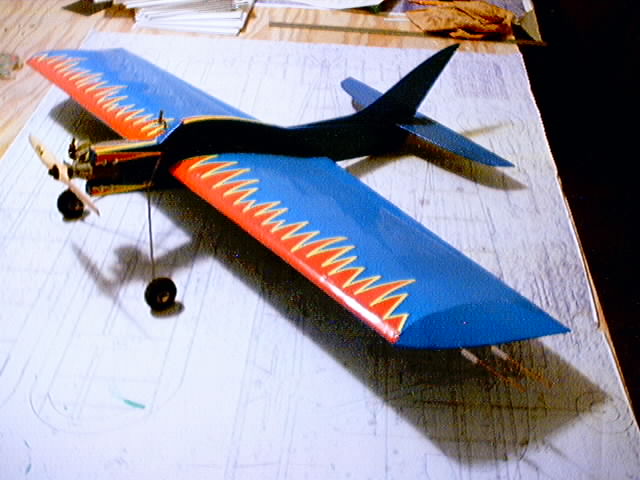
The Russians have the best idea for lead outs I have seen yet. I thought I had some good lead outs up until about 2 years ago.

Check out this picture.
Close up view of wing tip
[photo not recovered: lines.jpg]
View of entire airplane

Lead outs are .035 copper coated steel wire. The loop at the bell crank is wound with .024 copper wire and soldered. The coolest part is the part you see at the wing tip in the picture. Its an open loop with a piece of fuel line that slides over the loop. Slide your .015 control line wire loop over the .035 lead out loop then slide the hose over the loop to prevent the control line from comming off. You can not bent it, it won't stretch, you can not break it and you don't need connectors. You can attach your control lines in 5 seconds. Its so simple. All the airplanes that you buy from Russia have this type of lead out. I put this on all my airplanes now. The best wire is .035 welding wire available at any welding supply store in 3 ft lengths sold by the lb. about 75 wires in a lb. for only about $2.00 a lb.

Lead outs need to be stronger than the normal .015 control line wire because they rub on the bell crank and it will soon break.

Gary Weaver

Iskandar Taib · Jul 28, 2003 03:40 AM

#11 source
LAST EDITED ON Jul-28-03 AT 03:42 AM (CDT)
 
I like using the welding rod material (the aluminum variety, though) for pushrods. The steel variety would work, too, just heavy.

GravityWell · Jul 28, 2003 10:46 PM

#12 source
Man, now that is a cool idea! One of those things you see and say...."Now why didn't I think of that!"

“I have never crashed, but I have proven the theory that gravity sucks!”
Glenn Reach

Swordsman18 · Jul 29, 2003 10:22 AM

#13 source
>The Russians have the best idea for lead outs I have seen
>yet. I thought I had some good lead outs up until about 2
>years ago.
>
>Lead outs are .035 copper coated steel wire. The loop at
>the bell crank is wound with .024 copper wire and soldered.
>The coolest part is the part you see at the wing tip in the
>picture. Its an open loop with a piece of fuel line that
>slides over the loop. Slide your .015 control line wire
>loop over the .035 lead out loop then slide the hose over
>the loop to prevent the control line from comming off. You
>can not bent it, it won't stretch, you can not break it and
>you don't need connectors. You can attach your control
>lines in 5 seconds. Its so simple.

This is really clever, but I still have one question: Is there anything other than friction to keep the fuel tubing over the loop and the loop closed? I would still worry about having the tubing vibrate back and the loop come open. Perhaps a little bend at the end of the loop wire to constrain the tubing?

Andy Tomasch

Gary Weaver · Jul 29, 2003 11:26 AM

#14 source
Do an experement like I did. Bend you a loop on the lead out wire. Don't put any fuel line hose on it. Clamp it in the work shop vise. Put your control line wire on the loop and pull as hard as you can. It will not streatch open the loop.

If you get a bunch of slippery fuel on the loop and fuel line hose it will slide easyer but it still does not come loose. Even if it did centrifical force will keep the lines from coming loose.

Gary Weaver