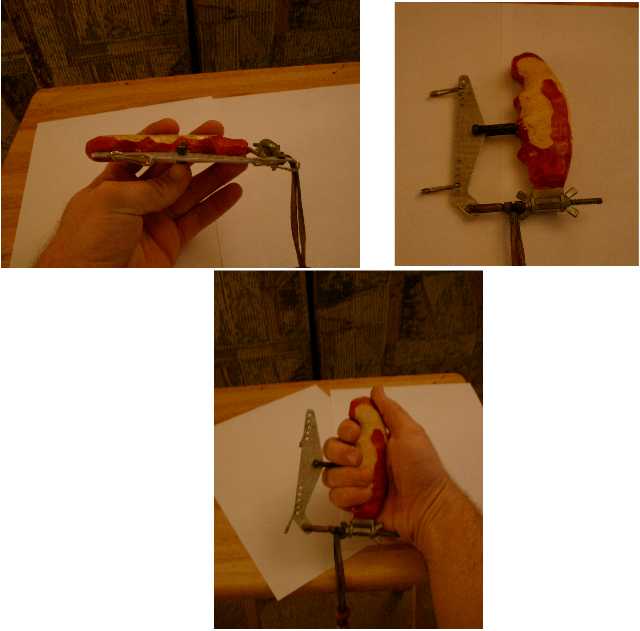
Larry Foster · Jul 30, 2003 03:53 PM
#0 sourceLarry Foster
Stuka Stunt Main Forum · 45 of 45 known posts recovered
Larry Foster
Larry
Flying Control Line is not a Hobby it's a way of Life.
Be Safe.
Larry Foster
I kept Telling Ted that he needed to set up a shop in that 747 to give him something constructive to do on overseas trips. He finally got around to it after he retired. (Of course, having them lazer cut wasn't a bad idea.)
Leonard Neumann

[photo not recovered: 3e69bb3870f12ad5.jpg]
"The person who knows how to laugh at himself will never cease to be amused." -Shirley Maclaine
Steve[photo not recovered: dcboard.cgi]
http://clstunt.com/htdocs/dcforum/DCForumID9/66.html
The handle looks great.
Cy
The Cat Whisperer
Larry
Flying Control Line is not a Hobby it's a way of Life.
Be Safe.
Larry Foster
The original idea of the events forum was to keep these separate and allow me to delete them when they are over and not clutter up the arcives. Same with the classifieds. Keep these separate and allow me to lock them down when sold and delete them. If you don't want to mess with the jokes, well, the humor section is separate, too.
With the products review category it was originally intended, as Joe Belcrank (OK, John Miller) did with his first excellent review, for people to pick out products that they have used and then give a detailed report of their likes, dislikes, and even suggested changes in using the product. John even added his 1-5 ratings (or was it 1-10) of the various items, which was very well done. It would be good to reread this and for others to follow.
In this particular thread we have people discussing, not just the product, but the theory of the design, etc., and I see no reason why it should not continue here along with Ted's own answer to Larry's question.
I think it can be very beneficial to learn
"Why not cables on the handle?"
"Why not a lot of overhang on the handle?"
"Why not allow more room for the hand to slide up and down?"
"Why is it important to keep extra weight down on the handle, just as it is on the plane?"
"How many adjustables do we need (and why shouldn't I just keep using my old U-Reely?)?"
Yes, it may be said that Ted would be promoting his product here. But no more so than if someone asked him a question about his Trivial Pursuit and he were kitting that design. What Ted would have to say in response to these questions would apply to anyone who might want to construct their own handles or vary the design to suit their needs.
OK, Ted, the floor is yours. Post your philosophy on the above questions (and any others) related to handles. I feel it can be quite instructive for the forum.
Leonard Neumann
Thanks, Ted, for such a fine product!
See Ya
Peabody
Glad you like them, Rich. Hope you like the way they work.
Speaking of which. The handles come with a two page instruction sheet that covers some of my handle philosophy that went into the design (plus the fact that I ripped off a lot of the concept from those who've gone before me!).
As soon as I get enough free time I'll expand on some of those thoughts in response to the queries from Larry and Len. I'll try very hard not to make them sound like ads since, I agree, Len's classified section is more appropriate for anything that obvious.
On the other hand, handle design and philosophy in general is a very worthy subject for the general forum. I'll try to make it appropriate.
Ted
Ted
Ted Fancher’s
“Precision Pro”
Control Line Stunt Handle
The choice of Precision Aerobatic Champions
Congratulations on your choice of the Precision Pro Control Line Stunt Handle. If your goal is to be a champion CLPA pilot, you’ve just taken a step closer to making that goal a reality. The Precision Pro is genetically derived from the legendary Hot Rock, a Hallmark of stunt’s first century. Your Precision Pro takes that ideal simplicity into the 21st Century. The Precision Pro, a classic case of form embracing its function. Welcome aboard!
Why will the Precision Pro make you a better stunt pilot? Four very important reasons!
First, Hard Point Attachment! One of the least recognized but most significant impediments to precision control of a stunt ship is unintended control input from inefficient elements of the control system itself. The most common is probably stiff or springy hinges on the airplane itself, fighting the pilot for control with every input. The next most common is the large diameter cable in the, heretofore standard, bar and cable equipped adjustable stunt handle. These cables all have a degree of “spring” and or “curl” in them that is constantly trying to alter the control input the pilot desires. Every time you change the neutral setting for a few flights a slight kink is added to the cable where it exits the bar. Each of the slight kinks adds a degree of unintended variation to every input and relaxation input to the system by the pilot. The Precision Pro eliminates that source of undesired input. First time users have compared the difference in feel to that which occurs when switching from cable control lines to solids. The beauty of using the hard point attachment handle is that you don’t suffer the negative consequences of solid lines of which we all are familiar; wear and stickiness with moisture. An important added benefit is that, unlike adjustable handle cables, failures of the steel line connection brackets of the Precision Pro are unheard of.
Second, Symmetrical Shape! You go to great lengths to make your on-board control system exactly symmetrical to insure uniform response to your commands. Every bit as important to that uniformity is that your interface to that system be symmetrical as well. Don’t be fooled by those who would have you distort the pilot’s end of the control system to adapt to some preconceived but unessential notion of “natural hand position”. The right hand position for Championship flying is a vertical grip of a symmetrical handle at neutral. The Precision Pro provides that symmetry by design!
Third, Complete Adjustability! At the heart of the Championship level man/machine stunt package is the means to adapt and trim the feel and response of our stunt ships to suit our personal characteristics and desires. Trimming the aircraft to maximum performance is the first and most important half of the trim process. Matching that performance to the taste of the pilot is the job of the modern stunt handle. Available in two grip sizes, regular and expanded, the Precision Pro provides precise and secure adjustability of: Line Spacing, to fine tune the response rate; Neutral, to refine response balance, and to “groove” our horizontal and vertical flight paths; Overhang, the distance from the grip to the line attachment plane which allows us to refine the load the pilot “feels” when giving control inputs; Bias, if desired (but not recommended). The sliding arms can be used to allow a modest amount of “natural” relaxed hand position in neutral.
Fourth, Security! Fly with peace of mind! The Precision Pro’s unique sliding line connection brackets are carefully designed for security and fail safe operation. Bracket security is insured by even the slightest compression of the hard ply core doublers into the specially designed “caterpillar” shaped cutouts through which the dual, hardened steel 4-40 tensioning bolts pass. Only modest tension from the bolts is required to “lock” the bar in place. The bolts themselves act as failsafe devices in the event the user forgets to properly secure the tensioning bolts prior to flight. Unlike cable failures which have and will result in lost stunt ships, any slippage of the brackets on the Precision Pro will almost certainly be stopped prior to a disaster. Nonetheless, you are urged to pre-flight the tension on the screws before every flying session.
Good Luck and Good Flying with your Precision Pro!
Remember!
Never fly near overhead power lines and always practice safe flight and preflight procedures!
Precision Engineered and Laser Cut, Courtesy of: “Mikey’s Models”
User Instructions
Assembly of your Precision Pro is straightforward. Only a few items require discussion.
Hints
• The five wooden parts; A, B, C and D (2) are packaged as they will be assembled. Take a moment to study the simple arrangement and design. Assembly procedure and sequence will be obvious.
• Note that the compression bolt holes in the doubler labeled “Doubler A” are sized for the 3/8” X 4-40 bolts and those in “Doubler C” for the blind mounting nuts. Make sure the blind nuts are installed in the proper doubler!
• I suggest that you make a simple jig that allows you to accurately stack the parts square to one another while assembling and gluing. A flat, rectangular surface at least as large as the handle with abutting ¾” deep rails on one horizontal and one vertical side is perfect. This will key the parts perfectly in line with one another for assembly.
Construction
1. In your assembly jig, carefully align and glue the two 1/8” ply doublers, A & C and the 1/16” ply “Core B” together, using medium CA. Take care that no excess CA bleeds into the line connector bracket slot as this will impede bracket installation and adjustment.
2. Securely tap the blind mounting nuts into “Core Part C” and secure each nut with a couple drops of thin CA.
3. Temporarily install the 3/8” X 4-40 bolts with the #4 washers in place on the face of Core Part A. Touch each washer with a drop of thin CA to lock them in place. When secure, remove the screws and complete assembly.
4. Glue the (2) ¼” balsa triplers in place and, if desired, glue the balsa plugs in place over the blind nuts. Dampen the plugs with water to cause them to expand to fit while the glue, preferably aliphatic resin, dries.
5. Carve and sand to desired contours. Do not enlarge the spacing between the top and bottom arms more than absolutely necessary to comfortably fit your hand. The arms are an integral part of the design of the Precision Pro!
6. Finish as desired. I like to make a Precision Pro handle for each of my airplanes and paint them to match! To increase durability I generally cover each handle with ¾ oz glass cloth adhered with clear dope, and then apply the finish.
7. Install safety thong of your choice. A two foot length of thong material is included with your Precision Pro. Do not omit the thong. AMA regulations require its use to preserve your liability protection!
8. Add the line connector brackets, install the compression screws and attach the two Perfect #149 Line Connectors. You’re done! Simple…and Perfect.
Using Your Precision Pro!
• Because of the limited amount of neutral adjustability and the design goal of achieving a vertical handle at neutral, your control lines should be carefully tied to as nearly identical length as possible. Ideally, a user would have sets of lines in approximately two foot length increments in each diameter appropriate for his engine class. For your .46 or larger size stunter you would have three sets of .018” cables in 62, 64, and 66 foot lengths; for smaller engines, perhaps .015 cable in 58, 60, and 62 foot lengths. If you absolutely insist on a relaxed wrist position at neutral my suggestion is that you determine how much longer the down line needs to be to adapt to that style and make the down line of each set longer, thus allowing the handle itself to remain as symmetrical as possible. Again, I strongly advocate the vertical neutral!
• Set the initial neutral by loosening the compression screws, slide the brackets as necessary and retighten the screws snugly. Do not over tighten as excessive torque could fracture the doubler plies! I suggest that you start with the connector brackets as far into the handle as possible. This is the most responsive, least load position which will allow the most aggressive response with the least force.
• Set line spacing to approximate the expected response from your stunter. Install the line connectors on the matching hole on the up and down arms.
• Fly your ship and evaluate the settings. Always use a safety thong!
• If response rate is not satisfactory, relocate the line connectors, either farther apart to obtain quicker response, or closer together to reduce it. Only use differential line spacing as a last resort if the airplane itself cannot be trimmed to equalize response!
• Fine tune your neutral setting in small increments to achieve level flight at the same altitude upright and inverted. (Hint: A very good clue to proper neutral setting is to observe the flight path during the vertical climb of the four leaf clover. This setting, an instantaneously natural one during a dynamic maneuver, can be more illuminating than an observation at level flight. If the ship climbs consistently other than vertically make small adjustments to the line connector brackets until the path is vertical.)
• “Over hang”. The farther from the grip the lines are connected the greater the force required to obtain a given amount of control input. If you like a heavier feel in maneuvers consider moving both line connector brackets further out of the handle while maintaining the same neutral setting. Doing so within the constraints of the adjustability limits will load or unload the handle as you lengthen or shorten the arms. There is only modest adjustability in this parameter as I feel precise inputs are difficult if the force required is high.
Some Thoughts from Ted Fancher
You’ve probably noted my strong aversion to a “relaxed” hand and wrist at neutral. Remember, as the wrist and, therefore, the handle angle is biased from the vertical you get progressively more rapid “up” response and reduced “down”. If the line spacing is narrow enough at the handle it is entirely possible to bias the handle to the point that NO down control is available. The onboard equivalent would be a bellcrank angled at a severe angle when the control surfaces are at neutral. It doesn’t work in the onboard system…and it doesn’t work at the handle end. This isn’t a matter of opinion, it’s physics.
The short “arms” above and below the fingers are an important design feature of the Precision Pro. Smooth and precise presentation of figures are often the result of “fine tuning” control inputs during maneuvers…even during a very sharp corner…so as to end up where you (and the judges) want you to be. The arms on the Precision Pro allow such adjustments to be made by merely applying pressure with the top of the index finger or the bottom of the pinkie rather than attempting to reposition the entire hand and wrist. This is a big advantage. Use it!
Feel free to try solids with your Precision Pro. You may find, however, that the combination of the positive feel of the solids coupled with the similar level of improvement gained with the Precision Pro may result in a ship too sensitive to minor inputs. This is exactly what happened to an early user of the handle--a multiple Walker Cup winner--who has chosen to use either solids or the Precision Pro…but not both, depending on the conditions. It is likely that our systems need a certain amount of elasticity to act as a shock absorber, allowing extremely small uncommanded inputs to be dampened out.
I have decided to make kits of the Precision Pro available to the stunt community due to the large number of requests I’ve received from stunt flyers all over the country. The Precision Pro is a champion’s handle, designed and used by Walker Cup Champions, US World Championship team members and top five flyoff competitors over the last decade. It is not designed to be sexy, swoopy, high tech or otherwise distinctive in appearance. It is designed for only one thing, to perfectly complement the precision with which we build our competitive stunters and their control systems; and to produce the sort of precision in maneuvers which will win championships.
We all know how much better we perform when we use the right tool for the job. Your Precision Pro is the tool you need to fly better. That’s what it’s all about.
That should be enough to get some discussion started.
Ted
This is in no way a criticism, but simply an observation. Maybe if they bought your handle it would encourage them to learn to fly with the elbow bent and the hand closer to the body. This is the only way to eliminate the excessive overhang from the down line anyway. And I am writing this as one who did change after he saw the light. There is a vast difference in response when you do not have that excessive overhang.
Leonard Neumann
Good thing my arms won't bend too far or I would have patted myself on the back. Ha. But the point is it did make a noticable difference in the pattern for me.
But I invite you to watch a group of great stunt flyers. They each have developed their own flying style, and some are quite animated in their body movements. (Tom Lay disrupted a whole group of VSC flyers one year by suggesting we watch them move..)
Although I can understand the desire to emulate a great flyer like Ted in detail, perhaps time would be better spent simply working on what is comfortable for the individual.
As for handles, there are all sorts, and various flyers have adapted to them to produce great flying. Ted's certainly looks like a beautiful product, but I know better than to assume that I'd automatically fly <much> better with one. (There may not be any real help for me..)
It would be interesting to compare a data base of photos of handles of top 20 flyers for the last 10 years.
[photo not recovered: 3e69bb3870f12ad5.jpg]
"I am not a cat man, but a dog man, and all felines can tell this at a glance -- a sharp, vindictive glance." -James Thurber
I think the key to this thread at the moment is to look at some of the things that Ted is saying about handle design in general. Ted's handle is his answer to meeting his design needs.
A look at our old handles would make for an interesting comparison. They, too, had the hard points--no cables. I prefer that as does Ted. Better feel, better reliability.
Our handles, however, were bulky and heavy. They had far more adjustabliity than Ted's. However, overhang could not be adjusted. (They were made at a time when that was not even considered.) But the fact that they had sliders instead of multiple holes for spacing adjustment, although it added to ease of adjustment, added bulk and weight to the handle. It also increased the overhang somewhat. It had a bulky bolt and wing nut for neutral adjustments. Nice, convenient, but more bulk and weight. And then, the coup-de-grapes (I never did learn French) I added a nice, hand fitting, finished Walnut piston grip to the handle. Oh, it felt nice. It looked nice. It also had massive weight.
Windy was the first one to mention excessive overhang. Since this was not adjustable, I cut this down manually. That helped. But the bulk remained and there was still too much "power steering back to neutral". Ted's design is the minimum to give you the adjustments needed. He even uses balsa grips. Not nearly as elegant as the walnut, but light in weight. When you pick up a heavy handle, you feel the handle. When you pick up a light handle, you feel the airplane. And, I must admit, I have done what you suggest here and have looked at all of the handles that all of the flyers were using for the last several years at the Nats. It is interesting, but, although some use cables, some don't, nearly all are small, light, and as near minimal as possible, while maintaining the needed adjustments (near infinite line spacing, adjustment for overhang, adjustment for neutral) to get the feel just right.
A good handle can and does make a difference.
Leonard Neumann
Len, I couldn't agree more. The absolute worst piece of crap handle I've ever tried to use was the little Sullivan molded yellow 1/2A, with their larger molded yellow "ergonomic" one a close second. A handle-cut straight stick of wood worked better!
However, handles are still a very subjective item. I don't dispute the advantages of a well thought out design like Ted's. It's just that I've watched some extremely fine flights by people who didn't have one yet.
You mention simplicity. One of the absolute greatest flyers on the planet is Bart Klapinsky. He told me that the old EZ Just small handle (with its simple design, not too much overhang, non angled or finger-shaped grip) was just about the best handle around.. (Hmmm.. the similarities to Ted's handle and the EZ-Just!)
Years ago, John Wright had a design for a handle with a circular or cardoid interior section that "linearized" the pulling motion on the flight cables. I know he experimented with it, even got fairly used to it. (No flies on John Wright, either!) But the one I built felt strange, so I never gave it a real chance. However, I'm confident I could have eventually adjusted to it, and maybe even started liking it.
Overhang is suddenly bad? Apparently a world champ can get used to (even like!) overhang - one of the neatest little handles, with some overhang, was Jim Hunt's design. (Yes, the overhang changes the feel of the controls!)
My point is that we humans do a great job of compensating for such things; we develop a "mapping" function that corrects and deals with it. We even learn to like certain non-linearities.
Weight of the handle must be minimum? Maybe, but I'm not sure this is also a matter of individual taste. No doubt someone, somewhere, is used to the "substantial" feel of a heavier handle and prefers it! 
(I have to point out that extremely light weight of the miserable yellow molded Sullivan handle did not redeem it.)
Cables are not good? Hmmm. The vast majority of handles seem to have cables on them, and serve quite well (with a few noted horror stories of failures!). I personally don't care for the cables (my Lou Crane handle has none).
Again, I agree. A good handle, one that YOU like, is extremely worthwhile. But handles are like women, different ones appeal to different guys!
Just don't expect to buy one of Ted's handles and go fly like he does. There's somewhat more to it than just his handle!
Best regards,
[photo not recovered: 3e69bb3870f12ad5.jpg]
"To steal ideas from one person is plagiarism; to steal from many is research."
I think you are generally wrong. Some people can have all sorts of bad things in their airplane and still do well by simply beating it to death until the airplane ends up going the right way most of the time. What people *get away with* or can learn to *adjust to* is indeed quite variable. But it takes practice. We all have a finite amount of time to spend on airplanes. If you could some how stop spending time trying to learn to overcome something, and instead put it somewhere else, like actually improving, it should be pretty easy to see that you will end up better off.
Use golf swings as an analogy. There are plenty of people that get away with all sorts of bad hitches and still compete - Arnold Palmer, for instance, I guess has a pretty awkward swing - but I doubt you will find many pros trying to teach you to swing the way Arnold does.
I got pretty good using cable handles with a fair amount of overhang and forward bias- good enough to make the Top 10. I could switch back and still be competitive. But I use these handles, with no forward bias, and it's so much easier it's absurd. Now, instead of having to overcome and outthink the compliance of the handle just to avoid inconsistent corner entries and exits, I can go out and work on shape, height and bottoms.
It took me about 2 years to really feel comfortable with the forward bias out of the hande. It was *well worth it*, as so many other things wound up better and more consistent. I flew better than most people before I fixed it - and I fly better than more people afterwards.
It's even more general. Proper control geometry, proper trim, a helpful engine/prop combination, all take time out of "overcoming the equipment" and put it into "improving the overall results" . This is absolutely fundamental. You find fewer and fewer people being able to be competitive with "quirky" equipment, not because of impression points, but because it's just to difficult to compete when almost everybody else has better equipment.
This is where I objected, for instance, to John Ashford's "Sport Flying" column vaguely "pooh-pooh"ing proper trim and control setup. Yes, you are supposed to be able to fly the airplane, and I can fly a bad airplane better than most, but why should I, when all it takes to make it better is tilting a control horn one way or another, or using a handle that doesn't screw up the control response, etc.?
>Just don't expect to buy one of Ted's handles and go fly
>like he does. There's somewhat more to it than just his
>handle!
Yes, but I am telling you from experience that this can really help. No one can be Ted, but you can at least benefit from his experience. Or not.
Brett

[photo not recovered: 3e69bb3870f12ad5.jpg]
"When we talk to God it's called prayer. When God talks back it's called schizophrenia."
[photo not recovered: 3e69bb3870f12ad5.jpg]
"I had a lovely evening. Unfortunately, this wasn't it." -Groucho Marx
Got to ding you a bit here. Arnold's swing is not "equipment". You can buy Arnold's clubs and still shoot 150. I think that was the point.
I think what Brett is saying here is helpful, but I can't help but read "my setup is correct all others are not" into what is being said. That is a slippery slope. What if you get beat by someone doing the whole thing exactly the way you say is wrong? Can't be all that wrong, right?
Give you an example.
Doug Moon flies very slow. Very slow. He says it is so much easier to be accurate when flying slow. He simply can't understand why EVERYONE does not fly slow. He says it is just "so easy".
I hate flying slow. I know that now. If the airplane will "point" I would rather go fast.
We will simply agree to disagree. Much to the disappointment of some, who would like to emulate Doug. No big deal though, I just accept the fact that Doug is very unique in his style.
Interestingly, Doug also uses a big heavy handle with cables, sliders, and lots of overhang.
I do too, but I do plan on getting one of Ted's handles. I did not qualify for Top 20 so maybe I can "buy a swing".
The City Smasher
Just MHO...
Doug Moon
Not my point. My point was that you can do a lot of things wrong, and still be competitive, even win. But it's a lot harder, and other than a psychological need for a challenge (which may exist and be perfectly valid), why should you make it harder on yourself?
> What if you
>get beat by someone doing the whole thing exactly the way
>you say is wrong? Can't be all that wrong, right?
Wrong. Fallacious reasoning. He may have beaten me by more if I had copied his less-than-optimal characteristics. It success versus amount of available skills and effort that I'm trying to optimize. If I still lose, then I need to optimize it more, or acquire more skills.
I make my statements from a standpoint of someone with notably less-than-average physical talent and capability who has managed to nonetheless reasonably competitive with the best pilots ever even though I spend less time at the field than almost anyone I fly against.
I'll admit and allow for personal differences. But I think the range of what's optimal is far, far, less than most people admi, and I also think that many people use "well, it suits me better this way" as a sort of excuse to avoid trying something different, regardless of how beneficial it might be. It's the second most common fallacy after "my airplane flies great, but I can't do it justice".
By the way, Ted turns his palm up when he flies inverted, so don't copy that.
Brett
Boy, that's true.
I see that a lot.
The definition of insanity:
To repeat the same thing over and over expecting a new result.
The definition of stupidity:
Not listening to people who are better than you are.
The City Smasher
Yeah, me toooo.
>
>The definition of insanity:
>To repeat the same thing over and over expecting a new
>result.
This has stuck with me for years. I keep it with me and use it to spur me along if I need to fix something. It works.
>
>The definition of stupidity:
>Not listening to people who are better than you are.
Not listening one of largest reasons people dont move forward in their quest for better results...in whatever it is they are trying to excel in.....
We are ALL victims of not listening from time to time. It is hard to break the habbit of not listening but when you do it helps. But the the habbit easily returns...and you dont even realized it...
Doug Moon

Let's copy Doug Moon, with his slow flying and clunky old heavy handle with the overhangs and cables on it, and 5th place (??) at the Nats.
(I am reminded of motocross riders copying Kawasaki green shock covers used by the leader, as well as the snap-on bill on his helmet..)
What this discussion leads me to believe is that our "simple" little two-wire control handle designs might <still> be far from optimal, in ergonomic terms.
There's the good point about the angled position of the hand at "neutral". Maybe a handle really ought to have a pistol grip? Yet I haven't seen that many angled handle grips. (Bob Palmer used something resembling a glove, didn't he?)
I've wondered about something like a semi-rigid foam handle or mitt comfortably fitted to the hand, with flight control implemented not by tilting the handle, but by smooth finger operated levers or such. (Try to put that carrier throttle control handle out of your mind.)
Heck, they made a monoline work! Open your mind. 
[photo not recovered: 3e69bb3870f12ad5.jpg]
"Dogs have masters, cats have staff."
From somewhere near Parkville, Mo.
William Crane
AMA 6733
[photo not recovered: 3e69bb3870f12ad5.jpg]
"Opportunity is missed by most people because it is dressed in overalls and looks like work." -Thomas Alva Edison
The Hunt handle was an interesting design. You could adjust it for neutral while in flight. But it lacked two things: There was no adjustment for line spacing (people hadn't really considered the importance of this at that time), and there was no way to adjust for overhang (again, this was something that people hadn't really concerned themselves with.) Oh, and it was hard to replace the cable, too.
>Cables are not good? Hmmm. The vast majority of handles seem
>to have cables on them, and serve quite well (with a few
>noted horror stories of failures!). I personally don't care
>for the cables (my Lou Crane handle has none).
The big advantage of a handle with a cable that is adjustable in length is that you can compensate for a great deal of variation in line length at the handle while keeping the bar vertical. And different people, flying the same plane with the same handle, can make little adjustments to the cable to match the bias in their hand. With Ted's handle (and any hard point handle) you will need to get the line length at the handle very close to even, or the (simulated) "bar" will be tilted and this will throw off the linearity of your control inputs. Same with your Lou Crane design. I think this is why the majority of handles come with cables. Those cables do, however, affect the feel once you get good enough to notice it. And they are a point of occasional failure. (The latter argument can be overcome with frequent replacement, if they were equal in all other respects. Most people don't replace them, however, until after the first failure.)
>Again, I agree. A good handle, one that YOU like, is
>extremely worthwhile. But handles are like women, different
>ones appeal to different guys!
>
>Just don't expect to buy one of Ted's handles and go fly
>like he does. There's somewhat more to it than just his
>handle!
>
>Best regards,
>
>[photo not recovered: 3e69bb3870f12ad5.jpg]
I think the point I was trying to make, and Brett also, is that handle design does affect the pattern. A good flyer with a good handle will be a consistently better flyer. A bad flyer with a bad handle is a bad idea. A bad flyer with a good handle can get better, however, and can improve at a quicker pace if the rest of his equipment is also adequate for the task at hand.
All of our equipment works as a package. There are Intermediate flyers trying to fly an Impact on a pipe thinking they will immediately raise to Paul's standard. And it is not going to happen any more than those who buy Ted's handle are going to immediately rise to Ted's standard. They may even find themselves fiddling so much with their pipe set-up that they could have (and would have) improved much quicker if they had simply flown a Twister with an FP 40. But at least give them a handle of some kind with adjustable spacing and adjustable overhang and let them adjust it to get the proper feel that they desire, and it is going to make it so much easier. Perhaps a Brodak handle will work just fine for them. And with the cables they won't need to be so picky with getting their line lengths even.
But just like adjustable leadouts and adjustable tip weight are all becoming standard fare in our equipment, so the fully adjustable handle should also be a part of anybody's equipment package. I try to tell people that a good handle can be a life time investment. You move it from plane to plane, and it doesn't go down in flames when you crash. So paying a little more for a good handle, whichever one you buy, can pay in the long run--even if it just increases the enjoyment that you derive from sport flying.
Leonard Neumann
Starting with the last question and moving backward, using proper technique will help with many of your problems. Whenever I watch Matt these days and notice a problem, I will immediately look at him and what he is doing. And there is usually something in the technique that caused the problem.
Now, although it is true that there are some great flyers who have learned to fly with a (relatively) stiff arm, it is easier to learn to fly the pattern and fly it properly with the elbow bent. Stan Musuial learned to bat in a crouch, and did reasonably well, as I recall. But no batting instructor will intentionally teach his pupils to copy Stan. In fact, they will try to get them not to copy his style. It worked for him, but...!!
Watching other flyers is an interesting and rewarding past time. We have all seen the airplanes fly. How many of us really watch the flyers? (I do, and I learn things.) David puts his left hand on his left hip. Ted and Brett put their left hand on their chest. Jimmy Casale had his left hand sticking out at some crazy angle like he had a sword in it and was fighting off some attacker while he was flying. They were (are) all great flyers, but whose style do you think you should copy? (Well, let's give a hint. Jimmy was a great flyer, but I don't know anybody who tried to copy his stance (or was it dance?) in the circle, nor would anybody ever encourage you to do it.)
The point I am getting at here is that the majority of the good flyers will not only fly with their elbows bent, but will encourage others to do that as well. (Ask Art Adamisin about it some time.)
You have also hit upon another point which is tracking the flight path of the plane exactly with your hand. You don't lead it, you don't lag behind it, you don't keep the hand still. You need to follow the flight path exactly. Again, there are exceptions (like bringing the hand down in the third corner of the hourglass to add tension. Letting the hand out as it heads downward to slow the flight path).
But, what all this is adding up to is, unless you learn the proper technique, and learn to follow the technique that you have established works best for you, you will never be the best that you can be.
Whatever technique you establish--and there can be more than one way to do various maneuvers (Overhead eight, for instance--where, when, if you turn in your stance)--you must learn to duplicate this exactly from flight to flight.
But I have become convinced, as Ted points out, (and this is an answer to a response on handle philosophy) that the bent elbow, with the hand near or at vertical, is the best way to learn and the best way to practice--and ultimately, the best way to fly.
Leonard Neumann
This thread is just great but is getting a little long and a bit off the original idea. I'm going to take the current title and start a new thread by that name.
Ted
Wow.. This looks like it'd work OK in Combat. In Combat, you want a handle that won't snag the other guy's lines. I was worried about the parts that stick down, but then again.. since they're "enclosed" by your own lines, I can't see how the other guy's lines can get hung up on the inside edges.
What are those connectors, and do they come with the handle?
I might appropriate the idea for some home made handles, myself.. I'd round off the metal parts, and perhaps change the metal part into a continuous bar (as per the smaller Pylon Brand handle) for 1/2-A use.
Hi Isky,
The connectors are Sullivan Part No.149 and, yes, they do come with the handle kits.
Ted
Being slightly bemused by all of this fawning over Ted and his handle, I would like to note that my single "+" example of your handle kit was missing two balsa plugs, used to conceal the blind nuts.
I do not want the missing plugs. I am not going to use the two you did manage to slip into the kit.
But I do want you to know that in design and manufacture of a product, one never, ever lets the designer do the B.O.M. (In this case the Bill Of Material.) Yes, even very simple products such as your handle kit.
Mine is now assembled. I will finish it tonight, give it a try this coming weekend.
Now. Quit spreading around good technology. Please. I need every advantage I can steal, borrow or buy.
Dan Rutherford
I'll bet if you go digging around in the trash and find that rotten envelope the handle came in surrounded by old bannana peels and peer deeply into its innards you'll see the other two caught up in the packaging.
I foolishly packaged up all my handles in those envelopes and only later discovered how much easier it would be to mail multiple handle orders in nice boxes from Staples. As a result I popped open a couple dozen or so over the last couple of weeks and discovered the little plugs would hang up in the unopened end of the envelope. The other thing that happens is that they'll fall on the floor of your shop when you open the envelope and because they're so light you don't notice them
All my way of saying you don't dare accuse the packaging department (Shareen) of sloppy workmanship! At least if you do I'm not going to tell her!
Ted
My statement is fully and completely retracted. Except for the bemused part.
I have never bought into the vertical handle argument/discussion. But this weekend I will give it an honest shot. While flying my ARF Flite Streak. With a real-deal Fancher handle.
Thanks again,
Dan Rutherford
Hey, this ought to be good. He's flying an ARF airplane and a kit built handle that he assembled himself. Dan, does that make you the BOH?
Leonard Neumann
Hey, this ought to be good. He's flying an ARF airplane and a kit built handle that he assembled himself. Dan, does that make you the BOH?
Leonard Neumann
=========================================
Or better yet, would this make the combo legal for use at a contest with partial appearance points? 
The Old Sourdough
Ruksakinmakiak, Alaska, US of A
I am ignoring your comments. Hope it hurts.
Ted,
While you were quite far off when it came to the details of what is in my garbage, sure enough a couple balsa plugs were found therein.
Now that I have a matched set--standard hardwood plugs were, what, too heavy!?--all four have been installed, sanded flush. Just to remove that last bit of weight, don't ya know?
Anyway, assuming Shareen can in fact get the packaging perfected, does this mean she might also be qualified to yet again count ballots accurately during the upcoming PAMPA election? Or will she be needing unsolicited outside assistance this one time, having always performed honorably in the past?
Finally, should your $28.00 handle not accurately control my $59.00 ARF Flite Streak, which piece do you think should be trashed first?
Dan Rutherford
Nananana! told you so!
>Now that I have a matched set--standard hardwood plugs were,
>what, too heavy!?--all four have been installed, sanded
>flush. Just to remove that last bit of weight, don't ya
>know?
Well, it's probably too heavy for anyone with clean hands to pick up...on the other hand you are dirty, so...
>
>Anyway, assuming Shareen can in fact get the packaging
>perfected, does this mean she might also be qualified to yet
>again count ballots accurately during the upcoming PAMPA
>election? Or will she be needing unsolicited outside
>assistance this one time, having always performed honorably
>in the past?
Hmmm, a heavy question...er, uh...sorry, that was the last question. We should probably have the supreme court monitor the process. On the other hand, if she can manipulate all these outcomes how come I don't win all the time. Hmmmm. I'm confused. Do you think she doesn't love me?
>
>Finally, should your $28.00 handle not accurately control my
>$59.00 ARF Flite Streak, which piece do you think should be
>trashed first?
Well, Dirt. If it doesn't control it accurately I suspect that question would resolve itself. Please report.
>
>Dan Rutherford
Flew with my kit-built, real-deal Fancher handle last Friday. I am pleased to report that both model and handle survived the experience.
It was a bit of a problem first flight when my inverted flight looked a lot like Roy DeCamara's post-"climb" maneuver positioning. Yep, went way overboard on the setting, was flying level upright flight with a way-back attitude to the handle.
What was (again) surprising to me was the huge latitude in handle settings to which we humans can quickly adapt. During the day I had shortened the "down" leadout on my real-deal Dirty Handle several times, this after PW insisted I shorten it a bunch during our y'all-come trimming orgy at Arlington. Never a problem, or even a close call, with the Impact, although my timing is only just now coming back with some of the tricks we do.
Same deal with the ARF handle/Flite Streak combo; it's amazing the stuff we can get away with. Especially with a disposable model at the other end of the lines...
Anyway, I like the handle, and even if I have not yet totally abandoned the relaxed-wrist style of grip--c'mon, we are in the middle of the contest season--I am certainly flying with a lot less bias than even three weeks ago.
Thanks. Now quit spreading around good advice, improved techniques and superior products.
Dan Rutherford