I think I understand this, makes sense to you guys?
Thanks,
Paul Heimgaertner
Stuka Stunt Main Forum · 11 of 11 known posts recovered
I think I understand this, makes sense to you guys?
Thanks,
Paul Heimgaertner
Paul,
If you take the numbers literally, which is what the author appears to be doing, to get from 3 to 4 requires an increase of 33 1/3%, not 25%.
On the other hand, if your question relates to the basic goodness inherent in swiping a posting from an RC-related site, plopping it down here where we take modeling seriously, no, what you have done does not make sense.
Dan
Sir Dirt Dan,
I brought it here to get clarification, and you did answer the question with insight
and the correct numbers, my friend
you've been sucked into the r/c world of ignorance and made all of us control liners more proud and our egos bigger!
Love
Paul H.
Paul,
I do what I can, but it's a big job and help is needed.
Dan
I tend to use the old multiply the diameter of the prop by itself, then that number by the pitch...D X D x P = Load factor. This really doesn't work, but on the .40 size engines it puts you in the ball park. So a 10 X 6 = 600, and 11 X 5 = 605, and a 12 X 4 = 576, in reality on my .40 fp the 12 X 4 does turn the most rpm's static, but the 11 X 5 turns more than the 10 X 6, which, according to this formula, it probably shouldn't.(all APC props) When I use this formula on my 25, it doesn't work so well, with a 9 X 6(Lf=486), my (RC on this one) P-51 unloads nicely, and flies fast, and carries speed through the maneuvers, but an 8 X 7(Lf=448) loads the engine up too much and never gets up enough speed to unload, maybe on a lighter plane? I suspect as you add pitch, the drag on the prop increases in a hurry. What does all of this tell me? Not a lot, but, when I'm looking at trying a new prop, I feel a little more comfortable about the cash I'm about to lay out. I don't remember where I got this formula, but there it is.
If you are *truly* interested, go to the AMA Model Aviation online archives, and do a search on propellers. There are at least 3 articles on carving your own wooden propellers, the most detailed being one by Hal Debolt. There are several other articles on modifying props, and checking pitch, and balancing...etc. But, there is one with a nice and complex formula that you can imput several factors like barometric pressure, temp, elevation...et al, and it's supposed to give you *real* answers. The author says that all of the formulas we use for model aviation are wrong, and this formula is for predicting prop performance on full scale planes, and he actually built a test stand with a scale that is calibrated to measure thrust, and drove to different elevations to prove the formula works on model propellers also...I dunno, I read the article a while back, and most of it went over my head, but it will all give you something to chew on. Most of these articles seem to be written along the line of racing props, or electric props, I'm still looking for good info on props for our purposes. I actually got interested in all of this because I can't find "good" props for my .10 and .15 size engines at my LHS, not a very wide selection in this size, and if a quater inch can make a difference on an 11 or 12 inch prop, then it has to make a difference on a 7 inch prop, right?
Austin
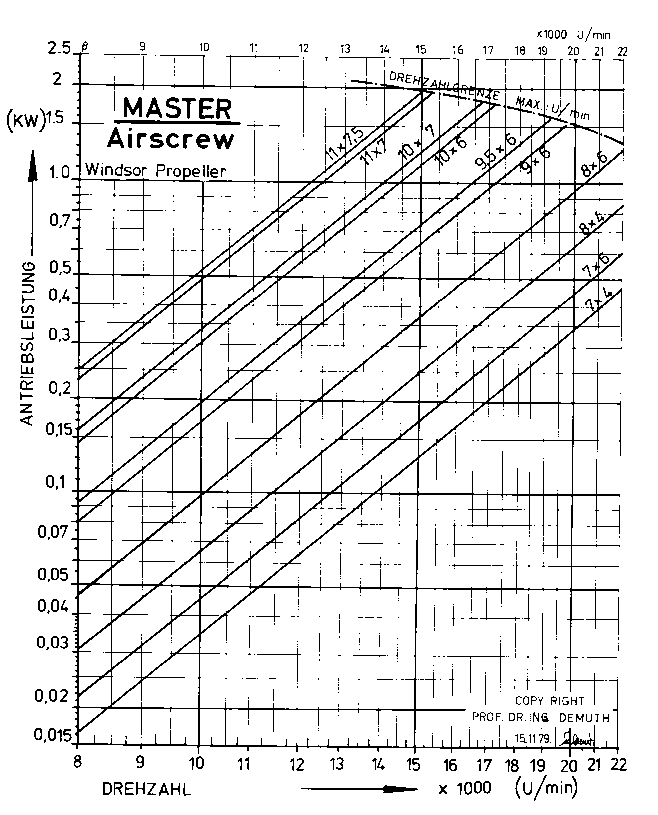
Here I attach prop power absorption ON GROUND.
igor

Leonard Neumann
C*x props in the gray series were all scale ups from the same master, so the above formula applies. Makes it easy!
Larry Renger
think S.M.A.L.L.
Leonard Neumann
Larry says it is power of three. It is very close to true. The derivation is simple. If you turn it twice as much, then drag (means torque) is power of two, and we speak about power so it is +1 – means power of three. So it would be 0,2kw at 18000 if it is 0,025kw at 9000.
But problem is, that it is STATIC absorption, so with higher rpm you have also higher AoA and thus also drag coefficient and also tip induced drag is higher, so in reality the load is little more than expected. It will depend on prop and so 0,25 instead of 0,2 look OK for me.
Somewhere on my page http://www.netax.sk/hexoft/stunt/notes.htm are several other props. You can see it depends on prop, but it is every time close to power of three.
igor
Note in Larry's (Designman's) post that pitch is not an engineering factor for prop performance or load. Near as I can figure, engineers using the cube/fifth power relationsships assume pitch and RPM will pretty closely match the plane's airspeed...
Also, remember that we run our props from 3 to 10 times the RPM of anything that flies with the people inside. All kinds of funny flows become more important, plus, that old Reynolds' Number is a few galaxies away from "full-scale, people lifter" charts and equations.
And, even the finest CF props from Kiwis or Oz are only approximately precise for the various work we put them to. It's a secret art. We've learned a lot about how to select and tune props, but precise predictions may still be beyond our hopes.
\BEST\LOU