Stuka Stunt Control Line Forum
Archive, 2000–2021 · recovered from the Internet Archive
Forums › Stuka Stunt Main Forum

First electro thoughts

Stuka Stunt Main Forum · 30 of 30 known posts recovered

Igor Burger · Jan 12, 2004 02:33 PM

#0 source
LAST EDITED ON Jan-12-04 AT 02:38 PM (CDT)
 
In passed time did little research in electric power train. Here are some thoughts. I do not know if good or wrong (comments welcome), but I do more soon.

1/ I think the best idea to cut off is timer. My nephew did first test with PIC (single chip programmable computer). It looks very simple to make short program for generating impulses for standard R/C equipment like brush or brushless engine (1 or 10 does not matter), for servos for retractable gears or even pilot signal for my favorable R/C gyro unit. It can include also 20 seconds of time delay allowing to run to the handle before flight (for alone flyers). I can imagine to do it also with two NE555 timers.


2/ I already wrote the NiCd and NiMh is not the best way. I got serious data for Kokam Lipoly. Here is one useful cell 1500mAh useful at 10A discharge time. It is for 6 min capacity 1Ah. It means the cell is after fly discharged only to 2/3 of its NEW capacity. Deep discharging is not recommended for LiPoly and the output voltage at end is still almost constant so there is no need to regulate it too much. Additionally partial discharge allows something called quick charge which results in only ~80% of capacity after charging. I will attach a discharge picture clearly showing the early cut off gives almost constant power delivery up to 100W. The voltage dropps only 0.2V for cell (we need 3 or 4)

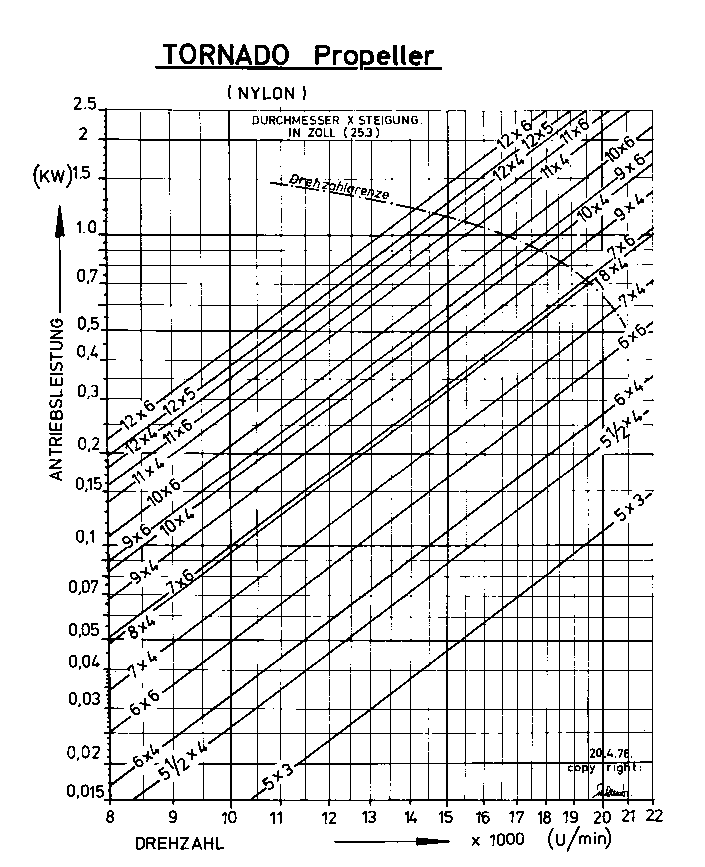
3/ Small start up setup can be 3oz heavy brush less engine with 8to9x4 prop at 10 000 with brush less regulator and PIC generator (<1oz including cabling) and 3 cell Lipoly 1500mAh battery at 4 oz. It is 8 oz for power train. (with full tank )

4/ Electric engine does not shake too much and has very uniform torque. It does not need too strong fuselage. I see big chance for foamy models I did some first test for full foam model (no covering). I believe it can be up to 8 oz. The wing test shows 3oz heavy wing at span of 40” under the weight of 55oz. (supported at tips only!!!)

What you think?

I work hard to have serious regulator with constant rpm, I believe it will come soon. In that case I see real chance to have 350W power train with 4 cell battery with 3 parallel cells which can use 12x4 prop at weight of 6 oz for engine and 12oz for battery it is 18oz for good power train.


igor

dirtydan · Jan 12, 2004 03:22 PM

#1 source
Igor,

Thanks for doing all the research.

Thanks for letting us know that there appears to be the possibility of decent performance from an electric-powered CL model.

No thanks for the most depressing news I have heard since PW said he liked his Saito 56/Impact combination.

Dan

Swordsman18 · Jan 12, 2004 03:34 PM

#2 source
>
>4/ Electric engine does not shake too much and has very
>uniform torque. It does not need too strong fuselage. I see
>big chance for foamy models I did some first test for full
>foam model (no covering). I believe it can be up to 8 oz.
>The wing test shows 3oz heavy wing at span of 40” under the
>weight of 55oz. (supported at tips only!!!)
>
>What you think?
>
Igor,

AWESOME foam work! How did you cut the fuselage parts? And the loading test is most impressive...

Nice Work!


Andy

"Real Engines Have Black Cylinder Fins and Red Heads"

Igor Burger · Jan 13, 2004 03:55 AM

#8 source
It consists from 4 parts - front and back and left and right (it is 4 isn’t it? ). If you put it together, you will get corners at join (as the wire is straight), but it needs only little sanding and the corner is hidden. The front side under the spinner is thicker, so it allows better shaping. Do not be confused the front and backside does not meat each other well. It is on place where wing will need cut out. The middle templates are done the way that the wing can be either on top of fuselage or on the bottom. It enough invert the template before cutting. The yellow fuselage has wing on bottom and will have landing gears, while the white one is dedicated for flying on grass without landing gears and with wing on top. The final fuselage shows it better. So far for profile view.

The nose is little bit tricky. After cutting I cut little vertical cut out which later allows to make thinner rounded nose. It is visible on picture where one nose is open and another is already joined together.


Dave Shrum · Jan 12, 2004 03:51 PM

#3 source
Igor; Thank you for VERY good research and showing it to us. (?) the 4th picture from bottom--Do I see a carbon fibre to support the load on the wing? If that is what it is--good for you! In times past we did this on our foam winged R/C planes, but only on the bottom. It was "strapping" tape. (simple, but it worked) I'm going to leave this conversation to more qualified people--I Hope you have a very good discussion on this.
Dave Shrum

Igor Burger · Jan 13, 2004 03:36 AM

#7 source
Yes, it is CF. But unlike regular R/C usage it is INSIDE. The wing consists of 4 pieces. First I join left and right upper and than lower side. That allows applying CF whenever I want INSIDE the skin. I applied one string to every corner of semi spar. Only then I join top and bottom of wing together by slow water based glue like Ponal express. It dries slowly getting more and more viscosity, so it gives time few minutes to make really straight wing while not need any helping tool like pins, rubber or so. Keeps immediately but still allows adjusting.

BTW the CF does not run to the tip. It goes only to 2/3 of span on front spar and to ½ on back spar. This picture clearly shows how far it goes. The middle of wing is relatively straight, while tips are round:

[photo not recovered: 4003048b617224cc.jpg]

jmmroz · Jan 12, 2004 04:20 PM

#4 source

Wow, great foam cutting. So it seems there's a bigger intrest in electrics then generally portrayed...

Larry Cunningham · Jan 12, 2004 06:25 PM

#5 source
Beautiful work, Igor!

Your foam cutting work looks extremely innovative to me. Wow.

You realize, of course, that your foam techniques could be applied to conventional alcohol powered stunt models, to produce superior lightweight structures?

(Ooopps, you say you've been doing such all along, and beating us all with the results? )

Lovely stuff.

I'll look forward to your data and conclusions.

[photo not recovered: 3e69bb3870f12ad5.jpg]

"When I turned two I was really anxious, because I'd doubled my age in a year. I thought, if this keeps up, by the time I'm six I'll be ninety." -Steven Wright

Igor Burger · Jan 13, 2004 03:16 AM

#6 source
Larry, the problem is oil. I think the wing could be done this way, but must be covered by film. That is useful, but I afraid the fuselage will be problem. Not only because of oil, also because of strong shaking. But may be I can imagine balsa mainframe and foam turtle deck covered by iron on foil.

If not else then it could be useful for short life beginner trainers.

I already did some successful tests with beginners wing, using foam LE combined with very simple “triangular” backside of airfoil covered by iron on foil. The guy was able to cut the foam and do model “by wire”. However he did several mistakes, but we solved them while building, and the result was his first succesfully flying model. (that uncovered on pictures) The rick is, that the beginner without a help typically cannot keep proper shape of LE and straight wing. All mistakes are payd by all kind of stalling rolling and so. While this construnction could be done on flat dest without any tools and LE is determined by templeate.

igor

Jim T. · Jan 13, 2004 11:19 AM

#9 source
Ron StJean, well known free flighter, had considerable success builing freeflights out of foam and covering them with silkspan. I think if you cover your fuselage with silkspan put on with a thinned-down titebond-type glue, you will be impressed by the added strength. This also works fine on wings. Your profile trainer is neat.

Jim Thomerson

Igor Burger · Jan 15, 2004 03:42 AM

#10 source
Here is the device generating 6 min program. It is first quick and dirty board, but already prepared to use some inputs from engine to stabilize in-flight RPM.

dirtydan · Jan 16, 2004 04:39 PM

#11 source
Igor,

More progress, huh?

This continues to be a most depressing thread, to the point where I am having second thoughts concerning the overall value of the internet.

Glow fuel and gunky models forever!

Dan

Swordsman18 · Jan 16, 2004 09:42 PM

#13 source
>Igor,
>
>More progress, huh?
>
>This continues to be a most depressing thread, to the point
>where I am having second thoughts concerning the overall
>value of the internet.
>
>Glow fuel and gunky models forever!
>
>Dan

Yeah, this level of inventiveness and engineering prowess does kind of take your breath away. I think I'll go bang some rocks together...

Andy

P.S. Nice going Igor. Let me know when I can send you a check for a complete outfit, ready to fly

AT

"Real Engines Have Black Cylinder Fins and Red Heads"

Igor Burger · Jan 18, 2004 05:11 AM

#15 source
Dan, try it, you will change the mind

Larry Cunningham · Jan 16, 2004 08:35 PM

#12 source
Geek alert: that little PIC controller chip is pretty amazing; 8 pins and just packed with capabilities.

For those interested in the details, here's a link to a detailed data sheet for this part: http://www.microchip.com/download/lit/pline/picmicro/families/12f6xx/41190c.pdf

[photo not recovered: 3e69bb3870f12ad5.jpg]

"Thought is action in rehearsal." -Sigmund Freud

Igor Burger · Jan 18, 2004 05:02 AM

#14 source
Yes Larry, it is really great. It even works without external oscillator, but biggest idea is, that internally you have full computer and you can say what of your functions should be plugged that limited number of pins. Combined with in-circuit programming and flash memory with parameters programmable on field, you have very flexible unit “for everything”.

Shall I mention 4 units communicating by one pin, measuring 4 engines rpm and controlling them for optimal run by simple r/c servo and r/c carb by measuring the in-flight speed by R/C gyro unit and everything combined with automatically controlled retractable gears?

igor

dirtydan · Jan 18, 2004 03:58 PM

#16 source
Dan, try it, you will change the mind


Igor,

You have no idea, nor any way of knowing, how many years ago I first tried electric power, how many hundreds of sub-C nicad cells I have consumed, motors fried, etc.

Let's just say that at one time 1/12 scale RC cars were *all* powered by either Cox reed-valve or front-intake (TDs) .049 motors. My family and I--four of us--raced these as a sidebar to 1/8 scale cars for three or four years before electrics came on the scene.

As the bandwagon drove by, we jumped on, rode along for several more years.

As a result, I would never consider electric-powered models of any sort when it comes to competition and the resulting competitive atmosphere. Not even CL Stunt.

As a sport-flying option? Of course. No problem.

I wish you well in your research and development.

Dan

Igor Burger · Jan 18, 2004 05:30 PM

#17 source
Dan, we fly on one field with R/C flyers and they also often say that the electro is wrong way, piston forever or so. But many of them, evening after “serious flying” take a small or crazy, easy to fly electro models. It is not for learning, competition or laziness, it is FOR FUN. Just to have something else, something what you can fly ”after”, or put some leds on and fly in night. I mean something for fun. I never fly more than 3 flights per session, may be with new model when I trim it, but normally not. And I just want something for fun, but “some” or “average” model does not satisfy me, it must be something excellent some way. I did several models for 2.5ccm or 4ccm engines because I knew they are able to fly more stupid things then serious large models and next year I saw several others stunt competitors to do similar models.

I have really no idea how it looks at you, but if I remember well then for example also Claus Maikis got the same idea – he presented his small stunter in some thread here. He is also experienced flyer, builder, contestant and still playing with “other” models. For me it is way how to do “something” on weekend and not invest several months of effort. I do not think the “magic” is in electricity, I think the magic is in simplicity.

igor

dirtydan · Jan 18, 2004 05:40 PM

#18 source
Igor,

I think you and I are on the same page, as I can be found to be flying some sport FF (CO2-powered models or HLG or something similar) while out with serious Stunt equipment.

Again, electrics for sport flying are fine. But when one mixes electric power with a competitive event, things can get really ugly very quickly. To the point where I simply would not be interested.

I continue to enjoy you and your erudite approach toward comments you make on this site. Most enjoyable.

Dan

Swordsman18 · Jan 18, 2004 06:06 PM

#19 source
> But when one
>mixes electric power with a competitive event, things can
>get really ugly very quickly. To the point where I simply
>would not be interested.

Dan,

I'm not quite on the same page here. If you level the playing field so the intent of the event is for everyone to compete with electric-powered models where is the "ugliness"? I'm not sure if you are referring to the technology (cumbersome? inadequate?), or the human interactions (IC Chauvinism?) as being "ugly". I'm just dense I guess...

The utopian (definition "Utopia": "Nowhere") vision I have is for electric models to attain a level of performance sufficient to allow "serious" competitors to practice for competition and compete, and "sport" flyers to have fun, and both to have the option of using electric power for their purpose. The dream is to have models so clean, and so quiet, that everybody from Walker Cup winners to Soccer Moms can appreciate their grace, and tolerate them in the maximum number of venues (parks, ball fields, big back yards). No more fleeing civilization to the outer wastelands to fly. To be welcome and accepted. I must be nuts...

Andy

"Real Engines Have Black Cylinder Fins and Red Heads"

Igor Burger · Jan 18, 2004 06:28 PM

#20 source
I already heard the story about that ”collision” of electric and piston power train in cars. It was not only technology battle it was also problem of human interactions. However I never did cars so I now about it only from second hand. But fortunately we can learn from R/C stunt F3A event. They fly electric models together with piston engines successfully. I know – you say until now still …

But I do not afraid too much of such problems. Our models are not based on power train (even less than R/C). I think until we see Jurassic 4-2-4, pipe and 4C engines successfully compete together, I do not see too much problems. But you have good point, we should watch F3A carefully. Especially if actual draft of new FAI rules allows electric power plants.

dana wall · Jan 19, 2004 04:26 AM

#21 source
How hard is it to learn to program the chip. what language do you program in? how much is a setup (compiler and pc interface). i wanted to use one the make an analog to digital, n-1 mutiplexer, with internal counter. i guess it would consist of many loops and an external ADC. Dana

Igor Burger · Jan 19, 2004 06:07 AM

#22 source
>>>How hard is it to learn to program the chip.<<<
Difficult to answer. If you have some experience with hardware oriented programming then not so difficult, just another dialect. If not, you should learn several tricks, but basically not “difficult”, jut it needs some time to invest for learning. If you search on that microchip home page, you will find lot of examples, tricks and stuff also for first time users (of that chip) but it is definitely not for beginners of hardware programming.

>>>What language do you program in?<<<
It depends on chip. I do not want to invest lot on money, so we use free compilers. There are compilers for native assembler, Basic and also for C. It depends on chip type, which you must choose first depending on your application.

>>>How much is a setup (compiler and pc interface).<<<
You can have trivial parallel port programmer which you can build yourself (for one time job – you can find plenty on web) and you can have also professional device for quick duplication. It also depends on chip type – especially if it has flash memory (expensive – good for one piece), you can have in circuit programmable chips and you can have very cheap versions but you need special programmer. But I think the limiting feature is debugger/emulator. If you want make better than trivial program, you will need a way to trace the program or full debugger. It is always disappointing if you write a program, you start it and it does not do anything and your black box is still black

>>>i wanted to use one the make an analog to digital, n-1 mutiplexer, with internal counter. i guess it would consist of many loops and an external ADC.<<<
You can have also internal ADC and external multiplexer, of if n is small enough it can be pin by pin but I think if n>2 then the multiplexer is better.


I probably did not answer your questions, but I think the proper way for you is to look to that home page, to choose proper type and then search on web for its name. You will get tons of price offers, but you will also find some “how to” pages for that your type, compilers and programmers/emulators.

ferocious · Jan 19, 2004 12:44 PM

#23 source
Igor, have you done enough flying with a brushless electric to determine that some sort of speed control is needed? I know straight DC motors sag tremendously in maneuvers. My understanding is that the brushless motor is essentially an AC synchronous motor and should stay fairly close to its set speed as the load increases, just drawing more and more amps- at least until it gets so overloaded that the controller can't keep the speed up.

I also saw Mike Palko fly his AXI powered Twister. Although he didn't pull really hard maneuvers, the motor had very little speed variation. It just churned along with no perceptible change in pitch other than the prop making wowing noises. He used NiMh cells, so it was a little heavy. With what we are seeing now from the LiPoly batteries, an electric should be a pretty decent performance setup(if you don't mind the initial cost)

Phil C

Igor Burger · Jan 19, 2004 02:08 PM

#24 source
Yes Phil, the brushless engine is theoretically 3-phase synchronous engine (typically star, but sometimes also delta). But the operation of the engine with typical controller is EXACTLY the same like the typical DC engine with permanent magnet and comutator.

The typical synchronous AC engine rotates and thus make on winding sinus wave. Feeding comes from another sinus wave. If those waves are in coincidence, the engine does not make too much power, does not have too much consumption. If you load it, you get a phase shift, so those waves are not in coincidence, what makes voltage difference on winding and thus also makes current giving lot of power. But the rpm in allowed range of load is always equivalent to the feeding current frequency.

But brushless engine works different way. You have permanent magnet and winding. It also makes similar wave from rotating. Until now the same, but now comes different feeding. Now I expect it is a star. The controller does electronic comutator. It feeds two of three input wires and as the rotor (magnet) rotates, the third wire changes its polarity as the pole crosses the winding. It gives information to the unit what is the position of winding to the magnet and the unit rotates “virtual comutator” inside the program and under its position synchronized with the rotor feeds winding EXACTLY same way as comutator does – by rectangular pulses.

The result is, that is works same way as DC motor does. The biggest advantage is, that there are no loses of improper contact on comutator, and efficiency is higher thanx easier timing regulation regarding actual rpm – that is not possible on DC engine, you can make only constant timing. It is also reason why the rpm is more stable – loading does not force the engine out of optimal efficiency, but certainly not constant. But the comtation handled by computer, so that is the way how I am trying to control it – I would like to use device developed for Heli application with collective head. It already exists it just need little change of firmware in unit, but it needs cooperation of producer … it will take some time.

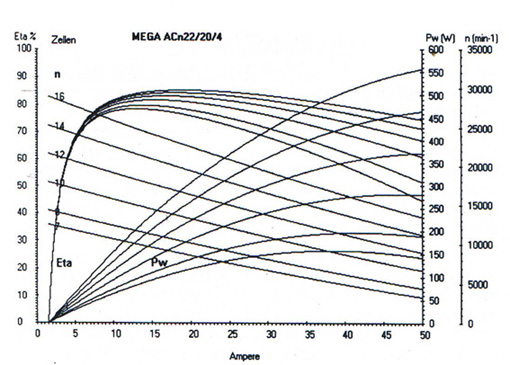
But back to engines. Producers typically give no load PRM and resistance of winding. So you can easily calculate how you must load the engine at known shaft loading to reach wanted current. The current depends on engine, they always provide max current - giving thermal loading of winding (resistance of wire * current ^2), and max efficiency current where you have to keep. The second number is typically not very important, as the efficiency is relatively good in wide range. It is 70% in worst case and typically 80%. It means 10 cells NiXx gives say 8V (average under load), at current 30A you have 240W on engine and it gives 180W on shaft (at 75%) what is enough to handle 10x4 prop at 10 000. On 165g heavy engine. Unfortunatelly the battery for 6 min comes to 20oz.


More info is here:

http://www.megamotor.cz/en/motor_detail.phtml?prod_id=42


Mel Duval · Jan 19, 2004 07:59 PM

Electric Analysis Program#25 source
LAST EDITED ON Jan-19-04 AT 08:02 PM (CDT)
 
May I suggest that you take a look at http://motocalc.com/ for a VERY good tool for doing power loading analysis? It has almost all of the most current motors, batteries and speed controls including several kinds of brushless motors and lithium poly batteries. I am not sure of how to correct the output for use in U/C, but the RPM, current and weight calculations should be very close. Based on the experience with electric R/C 3D planes I have had, I would start with a Hacker motor, Thunder Power lithium polymer batteries and a Castle Creations electronic speed control. Others are likely as good (such as the AXI, which needs no gearbox), but these would be a good place to start. Of course, be sure to bring a full wallet.

later,
Mel D.

P.S. Here is a sample output..............

Static Analysis - TEST
Sea Level, 29.92inHg, 59°F

Motor: Hacker C40 11S; 3818rpm/V; 1.7A no-load; 0.0175 Ohms.
Battery: Thunder Power TP2100; 3 series x 2 parallel cells; 2100mAh @ 3.7V; 0.022 Ohms/cell.
Speed Control: Castle Creations Phoenix 45; 0.0026 Ohms; High rate.
Drive System: Gearbox Efficiency Curve for 10x6; 10x4 (Pconst=1.31; Tconst=0.95) geared 1:1 to 4:1 (Eff=95%).
Airframe: Accord Rock & Roll; 770sq.in; 33 oz w/o powertrain 47.9oz with; 9oz/sq.ft; Cd=0.045; Cl=0.15; Clopt=0.42; Clmax=0.98.
Filter: 35A max; 45A max (ESC).

NC Gear Diam Pitch Weight Batt Motor Motor Input InPLd Loss MGbOut OutPLd MotGb Shaft Motor Prop Thrust PSpd RofC Time
Ratio (in) (in) (oz) Amps Amps Volts (W) (W/lb) (W) (W) (W/lb) Ef(%) Ef(%) RPM RPM (oz) (mph) (fpm) (m:s)

3 3.20 10.0 4.0 47.9 34.5 34.5 9.9 340.2 113.7 51.7 288.5 96.4 84.8 75.4 35394 11061 51.5 41.9 579 7:19
3 3.30 10.0 4.0 47.9 32.3 32.3 9.9 321.5 107.4 48.6 272.9 91.2 84.9 76.1 35830 10857 49.7 41.1 468 7:48
3 3.40 10.0 4.0 47.9 30.3 30.3 10.0 303.8 101.5 45.8 258.0 86.2 84.9 76.7 36233 10657 47.8 40.4 360 8:19
3 3.50 10.0 4.0 47.9 28.5 28.5 10.1 287.2 96.0 43.3 243.9 81.5 84.9 77.2 36606 10459 46.1 39.6 255 8:51
3 3.60 10.0 4.0 47.9 26.8 26.8 10.1 271.7 90.8 41.1 230.6 77.0 84.9 77.6 36951 10264 44.4 38.9 155 9:25
3 3.70 10.0 4.0 47.9 25.2 25.2 10.2 257.1 85.9 39.2 217.9 72.8 84.8 77.9 37271 10073 42.7 38.2 58 10:00
3 3.80 10.0 4.0 47.9 23.7 23.7 10.3 243.4 81.3 37.4 206.0 68.8 84.6 78.2 37567 9886 41.2 37.4 -36 10:37
3 3.90 10.0 4.0 47.9 22.4 22.4 10.3 230.6 77.1 35.9 194.8 65.1 84.4 78.4 37842 9703 39.7 36.8 -125 11:15
3 4.00 10.0 4.0 47.9 21.1 21.1 10.3 218.7 73.1 34.5 184.2 61.5 84.2 78.5 38096 9524 38.2 36.1 -211 11:56

Note: Motor performance calculations do not take ambient temperature and heating effects into account.

Generated by MotoCalc 7.00, 1/19/2004 7:40 PM.

Igor Burger · Jan 20, 2004 04:39 AM

RE: Electric Analysis Program#27 source
Looks like nice program, I did not try it yet, but looks it will save lot of time.

However, regarding engine selection, I would really go the way of no gerabox. It means it will need a producer givig wide range of types (number of winds) giving chance better match the battery voltage and the prop. The example can be that Mega from my sheet upper, but also Phasor or your mentioned Axi or PJS has that chance. But there is one problem. Types with outer magnet like PJS and AXI can make problems in tight turts because of gyro moment of rotating magnet - also bushing is not the best in that construction. On opposite side the Phasor and Mega has magnets "inside" and long shaft. It is better I think.

jmmroz · Jan 19, 2004 08:29 PM

#26 source

I was wondering if some kind of amperage measuring device connected to a relay to cut power was used.


The measured amperage gets adjusted to a certain amount, enough to keep the plane aloft. If it drops below the motor stops.

How long are the average flights per battery pack?

Igor Burger · Jan 20, 2004 04:44 AM

#28 source
I think you should watch for Volatge. If you check current, it can happen you switch off if you fly downhill - motor unloads, current drops and you cut off with full battery.

slewin · Jan 20, 2004 11:04 AM

#29 source
If you use the simple relay circuits described in http://www.rcgroups.com/forums/showthread.php?threadid=9642 it will automatically cut power as the battery voltage reduces. It seems crude but it works very well for relatively small motors i.e. low currents.

I agree with Igor. Current is more difficult to measure and less useful in this case. The main reason the current decreases is because the battery voltage drops and voltage is much simpler to use.

Steve