>Here's a quote from the web page:
>
>>Next you need to understand that a certain surface area of platinum
>>is required to generate a sufficient catalytic reaction to keep the
>>internal combustion process going. Also it is necessary to allow
>>extra surface area for the reaction to be great enough when it
>>diminishes with the available methanol dropping as in the case at
>>motor idle. Simply put, cold plugs are manufactured using a thicker
>>wire to give greater surface area to facilitate a greater reaction
>>and thus the required catalytic reaction where less methanol is
>>present in the fuel mixture.
>
>>So! More nitro means less methanol which in turn means a greater
>>surface area to platinum will be required to generate a sufficient
>>catalytic reaction. Suddenly it all makes sense! To work out which
>>temperature plug to use, you need to know how much methanol is in
>>your fuel, not how much nitro or oil.
>
>This doesn't make sense to me. A hotter plug is one which
>causes the fuel to ignite earlier.
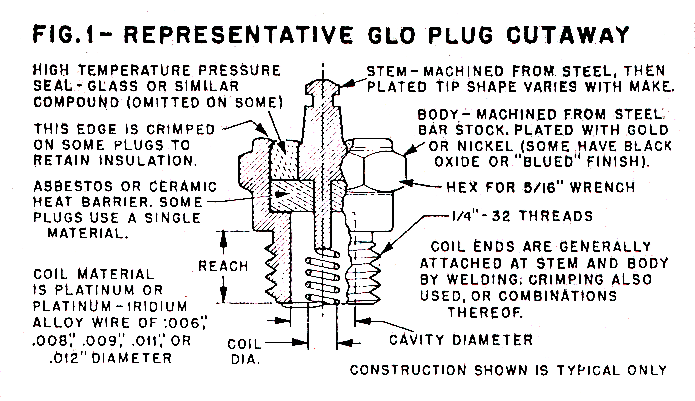
I think where our friend has missed the boat on his reverse analysis (always take anything posted on the Internet with a grain of salt) is that the heat range of a plug, if using the same alloy, is determined by the diameter of the wire. A .06 wire will be hotter than a .12 wire. "Yet the .12 wire has twice the surface area and will thus produce a better combustion", he says. "Ah, but we need to look at one thing more. That coil not only has to react with the methanol, it has to get hot in doing so," says I. It is not the reaction, it is the heat.
When we start our engines, we are not using the catalytic reaction of the methanol with the coil wire at all. We heat it with our little batteries. It is only as the engine begins to fire that there is sufficient catalytic action to maintain this heat. The combustion is not taking place because the methanol reacts with the platinum alloy. The combustion takes place because the methanol ignites because of the hot wire which maintains its heat through the catalytic reaction. So the surface area is only a matter of keeping the wire hot, not a matter of igniting the fuel.
If you have two wires, a .06 (hot) and a .12 (cold) the hot plug will generally work better in our applications (like the Fox 35, with its 29% oil, etc.) "But it only has half the surface area!" he cries. "Yes, but it is hotter," I reply, "and heat is what fires the fuel."
The simple answwer is this: The amount of surface area is in direct proportion to the circumferance of the wire. The amount of wire to be heated is in direct proportion to the cross section area of the wire.
Circumferance is calculated as Pi times Diamater.
Area is calculated as Pi times Radius Squared.
Since we are multiplying both by Pi, we can eliminate it from our calculations in determining ratios.
If one wire has a diamaeter of 6 (simpler than saying .06) and one has a diameter of 12 then:
The "6" wire has diameter of 6 and area of 3 x 3 = 9.
The "12" wire has a dimater of 12 and area of 6 x 6 = 36
So the larger wire has twice the area to react with the methanol, but four times the amount of wire to heat. That is why it produces a colder plug, and it is the heat of the wire, not the catalytic reaction that fires the mixture.
End result: The above cited article is all wet. Sorry, but its author just used poor logic.
 Steve
Steve