There have been several examples of painted on exhaust stacks on semi-scale airplanes which are very realistic. for me, I'll stick with 3 dimensional stacks. Here is Bene Rodriguez's 4 stroke F-51 and Keith Trostle's Bearcat.
Al
Stuka Stunt Main Forum · 13 of 13 known posts recovered
Al
Ron B.
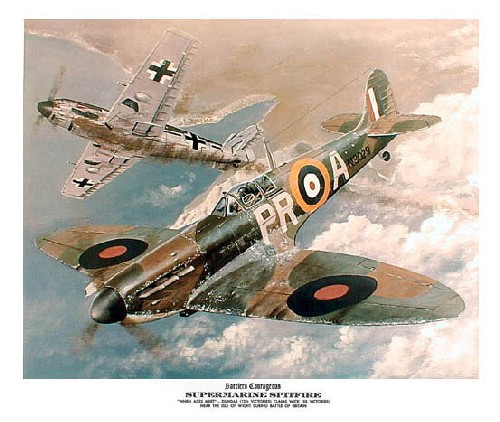
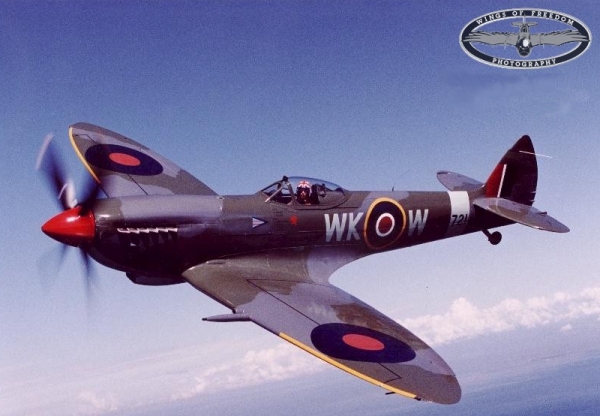
The later Marks got a useful amount of additional thrust from the rearward facing funnels,and by reshaping them,a reduction in frontal area and parasitic drag,or so I'm told.
Ron B.
F4Fguy
I flew warbirds for a while and was puzzled to hear people ask why this airplane had that piece of equipment, or didn't. I told them I was busy keeping what we had operational so we could get the airplane to the show so they could ask me that question! Trying to keep it good natured of course.
As historical correctness becomes more important, the restorations will become more correct. A lot of Mk.II Spitfires have 4 bladed props because they are available. Hoffman could probably make the blades for a composite type like a Rotol, but you must have a serviceable hub and blade shanks. Props are expensive now days, a Hamilton Standard cuffed four blade for a Mustang will cost over 75,000 dollars outright. The Mustangs you see on the ramp with the non-cuffed round shank Hamilton Standards will most likely be some form of cut and shaped Convair or Northstar airliner blades.
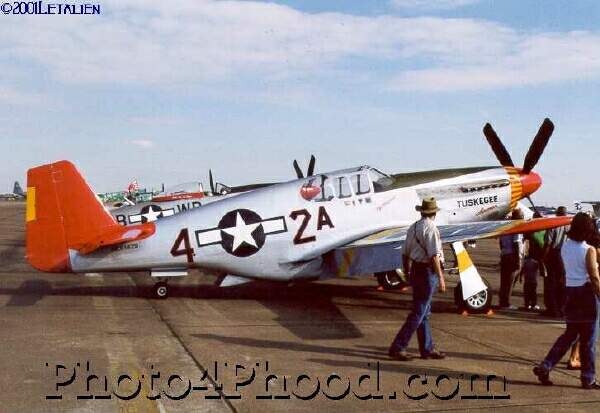
As for exhausts on the Mustang, the big straight angle jobs are from late model F-51D series airplanes. These are the stacks you see at Reno on the speedy ships. They are able to process a lot of exhaust with out failure. In the sixties, guys experienced a lot of failures of the older wartime P-51D stacks of the necked down variety while using high power settings. These high power settings were way above the factory limits, and so the exhaust temperature and velocity would overtax the stacks structure. During racing at Reno these type failures in present day do not occur, at least I cannot recall one in a long time.
Ron is correct about the Spitfire exhaust, the grouped type gave way to the single ejector type like on the Mk.16 he has pictured because it was superior in jet thrust to the grouped type.
An interesting note; The Mk. 16 has a low altitude Merlin 266 built by Packard. Side by side, at the same power setting, the Spifire will walk away from a D model Mustang at 10,000 feet.
Sorry to go on,
Chris...
 Steve
SteveYou can see the bladder hole in that photo.
I'd heard about the exhaust thrust, but I didn't know if that was the reason they changed to the single stacks. RR was developing a 2 stroke engine during the war (the Crecy) that was supposed to be a drop-in Merlin replacement, and planes powered by this engine were supposed to get 30% of the thrust from the exhaust. Very, very loud engine - like most 2 strokes, the exhaust port opened while the pressure in the cylinder was still high.
Interesting that they don't use some form of rear ejector exhaust on the Reno racers, since there's more thrust that can be recovered from the exhaust when you have a higher gas flow at high power settings!
I came across an account written by the wing commander of a wing where one of the squadrons was equipped with Mark VIIs. Uncommon Spitfire! I think the other two squadrons in the wing had Mark XIVs at the time. This was 1944, I think, southern or eastern England.
I can't recall much about the Mark VII, the VIII was a revised airframe, with additional tankage, and I think a bigger tail and a few other improvements including tropicalization. They didn't fly these in the ETO, most were sent to the Far East and elsewhere. This airframe also became the basis of the Mark XIV. The IX was actually a stopgap measure - they fitted the Merlin 60 series engines to what was essentially a Mark V airframe, and IIRC, many Mark Vs were converted to the IX. This was the main type used in the ETO in 1943 and onwards.
That's an interesting observation. Were all Mk. 16s fitted with the low altitude Merlins while P-51Ds were all fitted with the high altitude one (presumably the Packard version of the Merlin 61)? The Brits made three versions of the Mark IX (which is supposedly the same thing as the XVI) with low, medium and high altitude engines.
Trouble with these comparisons of all these airplanes is the modifications done to them through the years. The museum Mustang was the famous Jay Dee, owned by Dale Fulton and flown by George "Wheaties" Welch in the 1946 Thompson, and then sold to J.D. Reed, owner and co-conspirator of the infamous Beguine. It was flown by Ken Cooley, Charles Walling and Ken Hagerstrom for J.D. through 1949. This airplane had a long career of racing and modification. When I was familiar with it it had an airline version, fuel injected, "highway gears" Merlin 700 series engine that made about 2000 hp dry. At 24,000 feet in high blower it would true out at high power over 400 and that was not wide open. It was never flown to max power at critical altitude that I know of so I don't know how fast it would really go. But it was fast.
Chris...
To me it seems to "cheap out" on an otherwise fine ship. JMNSHO.
[photo not recovered: 3e69bb3870f12ad5.jpg]
"Yesterday is but today's memory, and tomorrow is today's dream." -Kahlil Gibran