Handles
Stuka Stunt Main Forum · 70 of 70 known posts recovered
The post on Fancher handles got me thinking, what kind of handles do you all use?!! Here's mine, an old HotRocks!! Still works great!!
Dwayne
Keep a handle on em!
[photo not recovered: 29180.jpg]
 Attachment
#1, (jpg file)
Attachment
#1, (jpg file)
Well yeah...
The Hot Rocks were the first handles that were about the right size, fit well, and offer easy neutral adjustment(1950s technology).
Problems: No adjustment for line spacing or overhang. Plastic wears rapidly where the cables exit the handle. Cables offer a lot of "spring action" in the control feel.
My humble opinion is that the Fancher style is the most modern and best handle. It's what I use and have for several years. Try it you'll like it!
Randy C

Here is what I use a large Ted Fancher Handle.
[photo not recovered: 29181.jpg]
Attachment
#1, (jpg file)
Carl
Hot Rocks plus wooden one. Don't know who made it, but it works good.
Howard Rush used to love them ol' Hot Rock handles. Come to think of it, so did I. At least until GMA came out with Magnum handles. At the time I was an independent sales rep, one of the firms I worked with was a hobby distributor and so being able to get these handles at a wholesale price I once had lots of them...
Back to Hot Rocks, Howard once lost a beautiful Impact to one of these handles. He had the perfect setting, the handle was only used with the one model, thus the cable was never out in the open where one could have seen the result of years of wear and tear.
Even if Carl were not making what we still refer to as "Ted" handles it would take a butt load of cash to get me to use a Hot Rock on any model I wanted to keep around for the next flying session.
Dan
>Howard Rush used to love them ol' Hot Rock handles. Come to
>think of it, so did I. At least until GMA came out with Magnum
>handles. At the time I was an independent sales rep, one of
>the firms I worked with was a hobby distributor and so being
>able to get these handles at a wholesale price I once had lots
>of them...
>
>Back to Hot Rocks, Howard once lost a beautiful Impact to one
>of these handles. He had the perfect setting, the handle was
>only used with the one model, thus the cable was never out in
>the open where one could have seen the result of years of wear
>and tea
>
>Even if Carl were not making what we still refer to as
>"Ted" handles it would take a butt load of cash to
>get me to use a Hot Rock on any model I wanted to keep around
>for the next flying session.
>
>Dan
>
FWIW, if you look closely at the "Fancher" Handle (and even more specifically lay one on top of an old Hot Rock) you'll see a distinct family resemblance. In fact, you'll find the basic Fancher handle was originally "designed" by tracing around my last remaining Hot Rock and proceeding to "improve" it with the adjustable hard point multi-hole line attachment clips.
IMHO, the basic Hot Rock handle is the perfect foundation for the perfect stunt handle. It is symetrical, has no "angle bias" and is very close to most useable line spacings. Eliminating the cables while retaining and improving the adjustability were my only contributions to a basically terrific tool.
Having said that, the changes -- properly utilized -- do, in fact, make a very definite improvement in the pilot's ability to fly with precision. I encourage any stunt flyer that wants to make a substantive improvement in their patterns through simple and inexpensive technology to give one a try.
Ted
No "angle bias" ??
Why is that considered a negative.
When I first started flying stunt, and decided to make my first handle, I measured the incline of my grip with wrist in a natural neutral state. It was 12~13 degree. So I built that into my handle thinking it would give me equal deflections up and down.
If I used a zero bias handle I would have to rotate wrist in up direction to get controls back to neutral, and would not have as much up input available as down.
I know a lot of flyers at the expert level are using zero bias handles, so what is it about the zero bias handles that I am not seeing. My custom fit bias handle seems perfectly natural to me..
Allan Perret
>No "angle bias" ??
>Why is that considered a negative.
>When I first started flying stunt, and decided to make my
>first handle, I measured the incline of my grip with wrist in
>a natural neutral state. It was 12~13 degree. So I built
>that into my handle thinking it would give me equal
>deflections up and down.
> If I used a zero bias handle I would have to rotate wrist in
>up direction to get controls back to neutral, and would not
>have as much up input available as down.
> I know a lot of flyers at the expert level are using zero
>bias handles, so what is it about the zero bias handles that
>I am not seeing. My custom fit bias handle seems perfectly
>natural to me..
>
>Allan Perret
You have obviously extended your hand out straight with the elbow unbent to measure your hand deflection. Now bend the elbow and bring your hand in close to your body. Take a look at it again. Most of the top flyers do not fly with their arm out straight, but bring it in and work it back and forth a bit with the maneuver. We will exclude Paul from this discussion. Don't look at Paul. His arm is extended out straight and he watches the flight with one eye sighting it straight down the arm. He'll never make a good flyer. (Just joking, Paul. I said "most", didn't I?)
It all depends on your style of flying and what works best for you. But there are reasons most of the good flyers fly the way that they do.
Leonard Neumann
Indianapolis, Indiana, USA
Nope.. I measured the angle with my arm in its normal flying position. Forearm pretty much horizontal and a comfortable bend in the elbow, around 45 deg..
Allan Perret
>Nope.. I measured the angle with my arm in its normal flying
>position. Forearm pretty much horizontal and a comfortable
>bend in the elbow, around 45 deg..
>
>Allan Perret
Forearm horizontal? Do you fly with your hand down by your belt line? Bend your elbow and raise it up. Point it at the airplane while it is flying and follow the flight path. Now see if it is still angled or getting more straight (compared to the flight path).
I have a lot of fun watching other people fly. I watch good ones. I watch not so good. You learn things to copy. You learn things not to copy. Try it sometimes. Forget about watching the airplane. Watch the flyer and see what he does during various parts of the pattern. Each person has his own unique style. I mentioned Paul already. I am not sure even he would recommend you copy it. But it sure works for Paul. Ted stands there like a statue. Doesn't seem to put a lot of effort into what his hand is doing (or move out of popsition that much while he is flying.) Billy Werwage is more like a ballet dancer. He is in and out with his hand and his feet, moving around all over the place. Pull the arm in at some points, let it out at others (adding speed and bleeding it off). Those who fly stiff armed will have a bit of bias in the handle. Those who fly with the hand closer to the body and up where they can see it, following the airplane, will fly with little or no bias at all. Watch others. See how they fly. Then try it (copying the good ones, that is). You might be surprised.
Leonard Neumann
Indianapolis, Indiana, USA
Well for all us "normal people"...if you hold your hand in the relaxed "normal" position (angled about 10 degrees) it will severely limit the wrist angular movement in the down direction.
I've watched several people who fly with angled handles and they invariably use their arm as well as wrist to produce down elevator, much more than they uses their arm to produce up elevator.
Certainly some very good flyers fly this way but it has to be more work to maintain precision.
Randy C


>Nope.. I measured the angle with my arm in its normal flying
>position. Forearm pretty much horizontal and a comfortable
>bend in the elbow, around 45 deg..
>
>Allan Perret
Hi Allan,
I encourage you to do some searches here on SSW for threads on handles. There's been a lot of discussion about handle design and configuration.
Let me give you just a couple of points that you might want to consider regarding the pros and cons of biased handles. I will point out right up front that I'm speaking from the point of view of serious precision aerobatics where it is essential that the airplane response be uniform and predictable in both directions. Consider the following.
The handle is actually a component in your control system. Builders go to great lengths to insure that the angular relationships of their bellcranks and control horns are symmetrical (nominal 90 degree relationships between all the drive and output arms) so that a given amount of leadout motion in both up and down directions will produce identical deflections. I go so far as to angle the output arm of my homemade bellcranks three degrees off of 90 from the leadout arms to allow for the fact that the leadouts sweep nominally three degrees aft to allow for the necessary sweep of the leadouts to account for line drag.
You would be very unlikely to mount your bellcrank (or flap or elevator horn) angled 10 or more degrees from the nominal 90 between the output arm of the BC and the input to the control horns. Any angular deviation will result in different deflections up and down for a given amount of line deflection.
Your handle is the primary "output" lever in the entire control system. Biasing it significantly will result in different deflections for a given amount of handle rotation just like having a misaligned BC.
To give you a feel for the problem, take the bias to an extreme. Make the "down bias" 90 degrees so that the handle is literally parallel to the ground at "neutral" elevator. It is immediately obvious that you will have essentially "instant" up control and "NO DOWN ELEVATOR MOVEMENT AVAILABLE AT ALL"! This is a very real phenomenon and a lot of fliers have built in a lot of variability in response by employing significant amounts of bias.
Let's see how this can get to be a very big deal with only a modest amount of bias. Say you've got a very sensitive control system that you've tamed down by narrowing the line spacing to 2.5 or three inches. Now say you bias the handle down 15 or more degrees. You can quickly see that you will get rapid up control and very little down. If too extreme you can reach the point where you can't apply enough down control to do the outside "tricks". You simply can't displace the lines enough to get the control deflection that the airborne parts of the system are capable of providing.
I've seen numerous examples of exactly this case in my years of flying; including a very good flyer (the late Bill Fitzgerald, David's dad, who had a very nice Banshee that he said wouldn't turn outside. He wanted to rebuild the controls to get more down control. I asked to take a flight on the plane first and, because he used a lot of down bias I chose to use a Hot Rock handle of my own. Bottom line, with my standard essentially vertical handle setting the ship flew outsides just dandy. Bill couldn't bring himself to go vertical but realized he had to modify his neutral at least enough that he could get full down control of which the airplane was capable. This was probably 25 or more years ago.
Much more recently an excellent stunt flyer from the Pacific Northwest was having an obvious hard time flying good outsides, often yanking the handle downward with his whole arm to avoid crashing in outside squares and the square eights. It was difficult watching the flight because the airplane was beautiful and appeared to be destined to rekit itself at some point.
After the plane landed and was returned to the pits I picked up the handle and was not the least surprised to discover the handle had "significant" down bias at neutral elevator. Rotating the handle parallel to the ground produced only modest down elevator. Pulling on the down line produced at least twenty degrees more down.
This flyer was, like Bill, unwilling to go "vertical" but did do as Bill had by reducing the bias until he could gain all the down available. An imperfect fix in my estimation but certainly better than nearly crashing in outsides.
There are a lot more less obvious problems associated with a biased neutral but these are the most important. Once again, this is important primarily if optimizing your maneuvers for competition is important. If you fly for fun and don't worry about the outsides it probably isn't worth worrying about.
Ted Fancher
There are handles with a "bar" in front that can compensate for what Ted is mentioning here. If the bar is vertical and the handle portion is biased, then the control inputs will be equal so long as you can rotate the same up and down. Or, if you have a handle like Ted's, if the bottom attachment lug (better term?) is longer than the top one, then you, again, can bias the handle portion downward while maintaining equal input to the plane.
That still leaves us with the question of whether or not your hand is biased in the downward direction when you hold it normally (as you should). If you bend the elbow and bring the hand up so you can follow it through the maneuver (or see it follow the plane through the maneuver), you should find that your hand is near vertical at "neutral".
Try it.
Leonard Neumann
Indianapolis, Indiana, USA
Hey Ted:
Appreciate very much you taking the time to reply on this issue.
I'm not sure I/we have the same understanding as to what a "handle with bias" is. Take a look at my picture. Is this what you refer to as bias??
When I first designed my handle, I checked the range of movement in my wrist. Turns out it was around 48 deg. But the middle of that 48 range is when my grip line is tilted forward around 12 deg., with arm in flying position.. So I built in a 12 deg tilt between the cable bar and the grip. That puts the cable bar vertical with my wrist in its tilted neutral position. As I see it, this is the only way to get equal up and down travel. The bold x lines behind the cable bar are the range of up and down I have. Last thing I do before each launch is check controls, and I am confident I have full up and down deflection.
On my next flying session I will take a test ride on one of my buddies standard Hot Rock style handles just for comparison. That is what I used as a teenager, but when I got back into stunt 10 years ago this is what I came up with. Was supprised when I learned most of the experts use zero bias..
Allan Perret
[photo not recovered: 29204.jpg]
Attachment
#1, (jpg file)
I did what Leonard suggested, watched some good pilots, and I tried it myself, flying a .60 model. What happens, is that you roll your forearm to give handle input, not bend the wrist. I liked it. The other thing it does is makes you use your biceps to take the line tension, which eliminates elbow or shoulder pains. Most of us let our tendons take the load...not good.
For myself, hearing about Howard's misfortune, I changed to hardpoint handles, both Tom Morris and TED types. Tom Morris now produces a no-rake version, but I haven't tried them yet. Tom's price is difficult to beat, tho. Realize that both Tom and Ted handles are
kits, which I think is a great thing. You make it fit your hand, easily done with wood...not so easy with Hot Rocks and the like.

Steve
Steve Helmick
Renton, Washington
USA
(snip)
>
>Allan Perret
>
>[photo not recovered: 29204.jpg]
>
Another consideration here, Allan, is overhang. There is a lot of overhang on your handle. I have got to admit that my first custom made handle had a lot of overhang. I never thought too much about it. I had one fit for my hand, Matt had one fit for his. Then someone (probably several people) mentioned the excessive overhang. It makes the airplane want to go back to neutral, but also makes you have to add excessive pressure to get it to turn. We cut down the overhang on Matt's handle and a dremendous difference there was. (I sound like Yoda on that sentence.) I cut mine down, too. Next problem was weight. Yup, they were heavy. I, in my infinite wisdom, (which means I sometimes don't think about things) had crafted beautiful handle grips out of walnut. Now pine grips would have been half the weight. And balsa--whoever thought about using balsa grips? That stuff is for the plane. Well, we had a lot of "machinery" in our handles plus the heavy wood grip and the handles were excessively heavy. Along came the "Ted" handle. Matt tried it, and that was the end of the story. We always had hard points. But the new handle was much lighter, had minimal overhang, all the things you want in a handle, except, perhaps, for infinite spacing. The numerous hole choices, however, along with a slight amount of "adjustment" in being able to move the arms up or down, makes this a moot question.
I am sure it can be imporoved on. Anything can be improved on. Even my DNA can be improved on. But, for now, this is what we have, and highly recommended.
Leonard Neumann
Indianapolis, Indiana, USA
Just a sport flyer here. Been using E-Z Just Hot Rock handles since the 1950's. Love 'em! Often say "If you ain't flying with a Hot Rock, you ain't flying!"
Was afraid of running out of Hot Rocks until eBay came along. Now I have a lifetime supply!
Of course I don't fly precision stunt. I just go out to the flying field and have fun doing whatever maneuvers I feel like doing on any given flight. Fun is the name of the game!
chanlau1
Here's the Will Hinton handle that I make/sell.
[photo not recovered: 29196.jpg]Here's the mechanism inside
[photo not recovered: 29197.jpg]Bill Lee
Attachment
#1, (jpg file)
Attachment
#2, (jpg file)
Ted's handles that Carl Shoup sells are very good, so are the Kaz handles that Randy Smith sells.
Love the Will Hinton handle, I have two and every new bird gets its trim flights with a Hinton handle.. Once I decide the spacing and neutral are good I duplicate the settings with a hard point.
Wow, I like the design of that one!
[photo not recovered: 28987.gif]
"All persons, living or dead, are purely coincidental, and should not be construed." -Kurt Vonnegut
>Here's the Will Hinton handle that I make/sell.
>
>[photo not recovered: 29196.jpg]
>
>Here's the mechanism inside
>
>[photo not recovered: 29197.jpg]
>
>Bill Lee
This is a nicely crafted handle, and like the Bob Hunt handle of yore, it can be adjusted for neutral while flying. But...
Here are the negatives that I see. And this is not a criticism, as such. Every handle design has some compromises that become negatives.
It is a cable design. With this you can adjust for neutral even with unevenly cut lines and keep the bar vertical (that is good). But the cable, in itself, leads to a bit of loss in sensitivity.
It is heavy (at least heavier than the handle without the mechanism, and the added weight does make a difference.)
It has a large degree of overhang--especially as the spacing gets narrower. This feature, alone, is one of the oddities of the design, because overhang does affect the steering (like when the power steering goes out on the car. You may not think about it if you don't have it, but once you have it, well...) And that becomes a real concern of mine. Whenever you narrow the spacing, the feel of the handle will change. Keep it wide, and you are OK. But if you have to narrow it up, you increase the overhang. Maybe it will force you to learn to fly with a quicker response (and that is good.)
Leonard Neumann
Indianapolis, Indiana, USA
>>Here's the Will Hinton handle that I make/sell.
>>
>>[photo not recovered: 29196.jpg]
>>
>>Here's the mechanism inside
>>
>>[photo not recovered: 29197.jpg]
>>
>>Bill Lee
>
>This is a nicely crafted handle, and like the Bob Hunt handle
>of yore, it can be adjusted for neutral while flying. But...
>
>Here are the negatives that I see. And this is not a
>criticism, as such. Every handle design has some compromises
>that become negatives.
>
>It is a cable design. With this you can adjust for neutral
>even with unevenly cut lines and keep the bar vertical (that
>is good). But the cable, in itself, leads to a bit of loss in
>sensitivity.
>
>It is heavy (at least heavier than the handle without the
>mechanism, and the added weight does make a difference.)
>
>It has a large degree of overhang--especially as the spacing
>gets narrower. This feature, alone, is one of the oddities of
>the design, because overhang does affect the steering (like
>when the power steering goes out on the car. You may not
>think about it if you don't have it, but once you have it,
>well...) And that becomes a real concern of mine. Whenever
>you narrow the spacing, the feel of the handle will change.
>Keep it wide, and you are OK. But if you have to narrow it
>up, you increase the overhang. Maybe it will force you to
>learn to fly with a quicker response (and that is good.)
Have to disagree a tiny bit with Len on this one. I think the concept of increased overhang with reduced line spacing is at least theoretically of value. The only reason one generally goes to very narrow spacing is because the on board control set-up is too sensitive (this statement assumes the airplane is properly trimmed aerodynamically ... which many aren't). A given amount of leadout travel produced too rapid a response. The most basic response to such a situation is to reduce line spacing at the handle.
This does, indeed, reduce airplane response for a given pilot/handle rotation. This is the underlying reason for adjustable line spacing.
Another thing happens when you reduce line spacing. Because you get less control deflection for X amount of handle rotation the "load" the pilot feels when giving that input is reduced. Another way of saying this is he loses "feel" of the inputs which, for precision flying, is quite a big deal.
As Len has pointed out, the length of the handle "overhang" also changes the load or amount of effort required to produce the desired response of the airplane. Will's handle very cleverly increases overhang as the spacing is reduced replacing "feel" lost to the narrowing of the line spacing with "feel" gained by increasing overhang. I've no idea what the variation change of one versus the other is but I've no doubt that Will's handle abates the change.
I wrote a series of articles a bunch of years ago in Model Aviation that looked at a lot of these parameters which included some very rough numbers and graphics. It wasn't a perfect article and there are probably a couple of things I would change were I to do it again ... but nothing very major in terms of the concepts of handle design. These articles should be available through PAMPA Products if somebody wants to track down the issues.
One of the issues discussed is the effect of overhang on the feel. Again, I like to think of things like this in extremes because it is easier to visualize (like making the handle bias 90 degrees ... immediately obvious that "NO" down control would be available).
In terms of overhang the control load ("feel") one perceives is largely the result of how far forward of the "hinge" point (think of it as the wrist for easiest visualization) the lines attach to the handle. If, for instance, the overhang was say 20 inches and the wrist five or six inches aft of that; and if the airplane is pulling 25 or so pounds it will take probably more muscle than the pilot owns to deflect the controls enough to fly a simple loop. The load/feel would be enormous because to deflect the elevators you'd have to literally pull that 25# of airplane toward you on a 25" arm. The inch/pounds of force required to do so would be huge. Yeah, it would self center to neutral "very" aggressively. In fact you probably won't be able to get it out of level flight.
If, on the other hand you built a handle with "reverse" overhang, the lines attached aft of the grip and directly above and below the hinge point (wrist) the only feel you receive will be the differential in pull between the two lines which will amount to the load it takes to deflect the flaps/elevators.
Take it a step further and extend those line attach points behind the hinge point/wrist and the control system will become "unstable" (for want of a better word) because up control, for instance, will shorten the arm between the hinge and the up line and the down line will move further away. Such a handle will result in a handle that wants to increase the control inputs the pilot puts in and he/she will literally have to put more force into returning the controls to neutral than it took to start the input in the first place.
This, again, is a real phenomenon and one you can approximate by making a simple dowel base handle where the lines attach immediately above the grip, i.e. no overhang on the handle. You'll still be able to fly it comfortably because of the "arm" between the attach points and the wrist hingepoint. You "WILL", on the other hand, find the controls much more sensitive, almost as though you increased the line spacing. This happens because the load you feel is reduced as outlined above.
Enough.
Allen, I'm in no way trying to tell you what handle you need or should use. You asked for my input on these things and that's what I'm providing. I think it was important enough that I've used nothing other than hard point handles since I built my first modified Hot Rock rip-off which is exactly what Carl is selling now (I sold them for a year or so but some hassles with another handle builder made it not worth the aggravation for me to continue to do so).
It is also worth noting that I got the basic idea from Paul Walker who has about a dozen US Nats Championships and a WC to his credit, clued in David Fitz who has, I believe, five Nats Open victories and now uses nothing else, Brett Buck who won a Nats after switching and even yours truly who has a handful of Walker Cups as well. My favorite phone call while I was selling the things came from none other than Bob Gieseke who advised me that the first flight he flew on his was the best flight he'd flown all year.
In the interest of complete honesty, I don't think Bob uses them routinely any more. Not sure why, but he was a happy camper that day.
My only reason for mentioning the above is to try to convince others that there is merit in at least giving this handle configuration a shot. No, it isn't the reason these guys have won a lot of big meets (they didn't win them all with them, but made the decision to fly with them after determining they worked better) but it is an important part of their arsenal now.
Ted
p.s. Allen, to answer your question about bias; yes, we are talking about exactly the same thing.
Here's what I'm using.
 [photo not recovered: handle.jpg]
Jim
A very interesting thread!
Instead of writing a long story, may I point you to my website
www.clacro.de Click on "Workshop" then "My handle" . That's what I use. Since I don't have muscles like Schwarzenegger I cannot fly a large overhang; thus the handle shape.
I'd like to mention one aspect: I feel it very important to have the handle grip ( what you actually hold in your hand )very flat and "deep" ( = wide in the direction of the lines ). The palm can hold such sections much better and easier than thick ones ( like HotRock ). You need less force to hold it tight. Also I feel that the handle shape should fit your palm as good as possible ( therefor the "finger cutouts"). I hate the straight "bars".
Oh - and I miss some high value, tasteful finishes on handles and reels

Regards, claus
[photo not recovered: 29207.jpg][photo not recovered: 29208.jpg][photo not recovered: 29209.jpg]
Attachment
#1, (jpg file)
Attachment
#2, (jpg file)
Attachment
#3, (jpg file)
Hey Claus:
Looks like the grip of your handle is about 10~12 deg from vertical. How did you come up with that??
Allan Perret
Allen,
I did it by the same considerations as you did !
I put a sheet of paper on the wall, then mounted a lamp to shine the paper, I grabbed a wooden stick about 12" long, held my arm in a position as I normally fly, moved my wrist from full up to full down, marked the positions of the shadow on the paper, and Voila - I had the neutral position of my hand. Not very scientifically, but close enough. I don't know what angle it is, I just feel well with my handle.
I don't hold my arm fully stretched, but not bent very much either. As Leonard said, it depends on your hand position during flight. I accept that the top flyers know better how to hold the hand. But I'm not on this level, so I do what I feel is comfortable for me. After all this is also a habit we have become accustomed to.
A question to Leonard:
quote " the cable in itself leads to a bit of loss in sensitivity".
I've heard this before, but I don't understand it. Why?
As I see it, the point which matters is the point where the cable leaves the handle. From here on it's part of the lines. Why does it make a difference whether it's a cable or a line? Is there something too much for my little grey cells?
Thanks for an answer.
claus
[photo not recovered: 29212.jpg]
Attachment
#1, (jpg file)
Hey Claus:
Thanks for the reply. I'm glad to see I'm not the only one who thinks it makes sense to compensate for the neutral point of the wrist with handle design.
On the loss of sensitivity due to cables versus hard point issue, I think it stems from the stiffness of the handle cable relative to the lines. I think it could be measured, but I think it would be so small that it would be insignificant. I think there is more than enough line tension under normal conditions to keep them pulled straight. As long as they are straight (inline with the lines) I don't see how they could affect sensitivity..
Allan Perret
(snip)
>A question to Leonard:
>quote " the cable in itself leads to a bit of loss in
>sensitivity".
>I've heard this before, but I don't understand it. Why?
>As I see it, the point which matters is the point where the
>cable leaves the handle. From here on it's part of the lines.
>Why does it make a difference whether it's a cable or a line?
>Is there something too much for my little grey cells?
>Thanks for an answer.
>claus
With your handle the cable comes straight out the two ends, so that helps. Where the cable has to come around a bend as it does with most that have adjustable spacing, it is the worst. It gives a spongy effect when you are flying instead of the true positive turn. However, even with yours the cable has to flex. When you give "up" or "down" input the cable has to flex because it is no longer coming straight out towards the plane. The thicker, stiffer cable does not flex as well as the lines do and there is always a little big of give there. If you can get hold of a hard point handle with the same spacing and then switch for back to back flights you will see (or feel) the difference. Many people, having tried the hard point handle, would never go back. We had a hard point handle from the beginning, but, as noted elsewhere, it had its failings (heavy, too much overhang). You are correct with the limited overhang. You want a little so there is a positive feel there, but very little so that it does not interfere with your ability to make minute adjustments and instant changes.
Leonard Neumann
Indianapolis, Indiana, USA
>Hey Claus:
>Looks like the grip of your handle is about 10~12 deg from
>vertical. How did you come up with that??
>
>Allan Perret
I used to dabble in reloading and target-shooting, plinking (pistols) and I remember reading somewhere the grip angle on a Colt 1911 is 15 deg. Pretty much every other manf. uses this spec.
I have a Tom Morris angled grip.
I once watched a guy fly with his elbow at waist level and keep it there during manuevers??? To each his own, whatever works, I say.
-Doug
>>Hey Claus:
>>Looks like the grip of your handle is about 10~12 deg
>from
>>vertical. How did you come up with that??
>>
>>Allan Perret
>
>I used to dabble in reloading and target-shooting, plinking
>(pistols) and I remember reading somewhere the grip angle on a
>Colt 1911 is 15 deg. Pretty much every other manf. uses this
>spec.
>
>I have a Tom Morris angled grip.
>I once watched a guy fly with his elbow at waist level and
>keep it there during manuevers??? To each his own, whatever
>works, I say.
Doug,
If I were shooting a handgun, that's probably what I'd use as well.
Form follows function, as they say and I can think of one enormously good reason for a gun grip to be angled thusly (other than the obviously more comfortable grip to which you allude). That reason would be to align the recoil more closely with with the structure of the human arm and wrist to minimize the tendency for the arm to jerk up when the gun fires. A powerful handgun with handle alignment vertical to the recoil plane would likely cause serious damage to the wrist after not too many firings.
Probably an ideal location from a total accuracy standpoint would be to align the barrel in the same plane as the arm/wrist/elbow shoulder structure in which case the recoil would be on the same plane as the joints thus essentially eliminating the "jerk up" tendency.
Of course, a half dozen rounds from your .357 would probably destroy all those joints for life. Some displacement from equal plane is probably absolutely necessary for the arm structure to act as a shock absorber for the recoil. IOW, the "jerk up" result is probably an intended consequence of handgun design for the well being of the shooter.
Just a guess, but it makes sense to me. I'd be curious to learn from gun enthusiasts if this is a design consideration; and if designers work diligently to optimize the "jerk up" versus accuracy.

Ted Fancher
>Of course, a half dozen rounds from your .357 would probably
>destroy all those joints for life. Some displacement from
>equal plane is probably absolutely necessary for the arm
>structure to act as a shock absorber for the recoil. IOW, the
>"jerk up" result is probably an intended consequence
>of handgun design for the well being of the shooter.
>
>Just a guess, but it makes sense to me. I'd be curious to
>learn from gun enthusiasts if this is a design consideration;
>and if designers work diligently to optimize the "jerk
>up" versus accuracy.
>
>
>
>Ted Fancher
Yes, pistols are designed with both natural hand/grip angle, and, especially in modern times, efforts at reducing perceived recoil and muzzle flip. There are two areas of emphasis, one being the gun's natural ability to point (one of the reasons the Colt .45 SAA, German P-08 and Colt M-1911 are beloved by so many). The other being consideration of how to manage recoil so the shooter might reacquire his target as soon as possible after firing-and, as you point out, still have an arm that works in order to operate the weapon.
Overall weight, as well as the amount of weight in the muzzle area, height of the slide and grip size and angle all come into play. And, like stunt handles, much of the perception of the ideal weapon comes down to personal preference. Modern gun designs are all as much redesigns of the original "Hot Rock" as are stunt handles, and generate considerably more argument since there are millions more handgun shooters compared to Stunt flyers(!) New designs come out almost monthly, all promising to make you blast your way through a horde of paper targets or bowling pins faster than Rambo through a squad of NVA. Look at one of the hundreds of gun nut forums and you will quickly be overwhelmed by millions of posts, like the SSW forum expanded by several orders of magnitude!
Having spent three years firing hundreds of rounds a week from a High Standard .22 among other weapons, I can attest that it took a long time for me to stop holding a handle like a pistol and start holding my arm and hand the way I saw the Expert flyers doing it! One area that shooting helped was in the way I could easily take my eyes off the plane in flight without disturbing it, so I could check to see if my handle was straight up and down. I used to routinely shift my gaze from target, to front sight, to kind of a "wide angle" to encompass the whole weapon/hand and then back, repeating the cycle like an instrument scan. I've been working on that shifting of my eyes alot recently, as I was just coached about letting my handle roll sideways in inverted flight, and I noticed that I rolled it the other way in upright flight. One more thing to try to keep track of while flying!
Oh, and for the record, I mostly use an old Windy handle, and the rest of my handles are Kaz ones. I have not tried a hard point handle yet....
Steve
>>Of course, a half dozen rounds from your .357 would
>probably
>>destroy all those joints for life. Some displacement
>from
>>equal plane is probably absolutely necessary for the arm
>>structure to act as a shock absorber for the recoil. IOW,
>the
>>"jerk up" result is probably an intended
>consequence
>>of handgun design for the well being of the shooter.
>>
>>Just a guess, but it makes sense to me. I'd be curious to
>>learn from gun enthusiasts if this is a design
>consideration;
>>and if designers work diligently to optimize the
>"jerk
>>up" versus accuracy.
>>
>>
>>
>>Ted Fancher
>
>Yes, pistols are designed with both natural hand/grip angle,
>and, especially in modern times, efforts at reducing perceived
>recoil and muzzle flip. There are two areas of emphasis, one
>being the gun's natural ability to point (one of the reasons
>the Colt .45 SAA, German P-08 and Colt M-1911 are beloved by
>so many). The other being consideration of how to manage
>recoil so the shooter might reacquire his target as soon as
>possible after firing-and, as you point out, still have an arm
>that works in order to operate the weapon.
> Overall weight, as well as the amount of weight in the
>muzzle area, height of the slide and grip size and angle all
>come into play. And, like stunt handles, much of the
>perception of the ideal weapon comes down to personal
>preference. Modern gun designs are all as much redesigns of
>the original "Hot Rock" as are stunt handles, and
>generate considerably more argument since there are millions
>more handgun shooters compared to Stunt flyers(!) New designs
>come out almost monthly, all promising to make you blast your
>way through a horde of paper targets or bowling pins faster
>than Rambo through a squad of NVA. Look at one of the hundreds
>of gun nut forums and you will quickly be overwhelmed by
>millions of posts, like the SSW forum expanded by several
>orders of magnitude!
>
> Having spent three years firing hundreds of rounds a week
>from a High Standard .22 among other weapons, I can attest
>that it took a long time for me to stop holding a handle like
>a pistol and start holding my arm and hand the way I saw the
>Expert flyers doing it! One area that shooting helped was in
>the way I could easily take my eyes off the plane in flight
>without disturbing it, so I could check to see if my handle
>was straight up and down. I used to routinely shift my gaze
>from target, to front sight, to kind of a "wide
>angle" to encompass the whole weapon/hand and then back,
>repeating the cycle like an instrument scan. I've been working
>on that shifting of my eyes alot recently, as I was just
>coached about letting my handle roll sideways in inverted
>flight, and I noticed that I rolled it the other way in
>upright flight. One more thing to try to keep track of while
>flying!
> Oh, and for the record, I mostly use an old Windy handle,
>and the rest of my handles are Kaz ones. I have not tried a
>hard point handle yet....
>
Steve
Thanks, Steve. I appreciate the expert opinion and I'm pleased that I was more or less "on target" with my assessment.
Re the "hard point" handle idea. The best description of the difference between it and the very good Bob Baron adjustable style I used for years (modified so the grip looked like a Hot Rock -- I'm nothing if not consistent)was that going to the hard point was roughly the equivalent in terms of airplane response to flying with solids vice cables -- without the problems associated with the solids. I think that difference is worth investing a few bucks on a handle (or borrowing one from a friend) just to try it out and see if you like it. There have been a lot of converts who've done very well competitively with one.
Thanks again for the handgun info, Steve.
Ted Fancher
>I once watched a guy fly with his elbow at waist level and
>keep it there during manuevers??? To each his own, whatever
>works, I say.
"Works" is a relative term, however. The big problem with "do whatever feels good" is that you get used to it on some level and are then almost incapable of appreciating the issues it causes. You can compensate to some degree for the problems, but since you are doing that, you are handicapping yourself and aren't even aware of it.
It's no different from any other trim setting- most people fly grossly out-of-trim airplanes and think they are wonderful. And sometime get mildy offended if you suggest they might could do better.
Brett
Then again, maybe it's just not that big a deal, in the grand scheme of things. Stunt is highly subjective, and the esoterics of handles is another aspect. I'd wager that John Wright or Bart Klapinsky could pick up almost ANY handle (I've watched Bart do it!) and fly the dickens out of any model airplane. Once the basic requirements of a good design are met, the finer points get more and more subjective.
During the Tri-Cities Nats, I watched a guy fly a model with a handle mounted on top of a helmet. No, he didn't do a stunt pattern. But I suspect none of the hot shots here could do much better than he did with the Helmet Handle (tm). ;->
In the grand scheme of things, a nice handle is nice, but there really are only two lines on the "stick". If I dreamt otherwise, I'd build a Maikis replica, but I'd one up him with a tortoise shell inlay. Mike Nelson could teach me how:
[photo not recovered: 29223.jpg]
Arguably, it wouldn't provide any "technical" advantage, but if it made me feel any better, so that I might enjoy the experience a little more, that would be completely adequate justification.
[photo not recovered: 28987.gif]
"I told you homeboy you can't touch this
Yeah that's how we're livin' and you know you can't touch this
Look in my eyes man you can't touch this
You know let me bust the funky lyrics you can't touch this " -M. C. Hammer
snip ...
> I'd wager that John
>Wright or Bart Klapinsky could pick up almost ANY handle (I've
>watched Bart do it!) and fly the dickens out of any model
>airplane. Once the basic requirements of a good design are
>met, the finer points get more and more subjective.
Larry,
Which is a large part of the reason details like handle design are really really important if Ted Average wants to compete against the Barts and Johns of the world. When I optimize all the details of my airplanes I "can" compete against guys like Bart who seem to have almost super-human talents with airplanes I couldn't even start to fly decently.
I think -- in terms of neural muscular skills -- I'm more like the vast majority of fliers that want to compete at the top level than I am like Bart. If us guys want to compete with him (Billy Werwage and Bob Whitely are other great examples) we can't afford the handicap of less than optimum equipment. If our handle configurations are holding us back, we don't have the skills to overcome the handicap.
IMHO (and I know mine is worth no more than the next guy's) I believe the handle configuration (and its settings) is a lot more objectively important than, for instance, whether you use a PA,a RoJett, an ST or an LA on an otherwise sound airplane. The handle is the only connection between the airplane and the pilot. Ergonomics is a very big deal for optimum performance.
This, of course, assumes performance is important to the pilot; and I don't intend that as a pejorative.
>Arguably, it wouldn't provide any "technical"
>advantage, but if it made me feel any better, so that
>I might enjoy the experience a little more, that would be
>completely adequate justification.
>
No way I can argue with that, Larry. If enjoying the experience is the primary goal (and I have no argument with that approach to flying stunt) I say go for it and I'll enjoy the craftsmanship and beauty of Claus' and Allen's handles as much as the next guy.
If you have an unquenchable desire to fly stunt with a delta flying wing or a canard or a triplane, I'll watch with great joy your attempts to do so and wish you well (as well as learn something new if you win with it). Our friend Paul nearly did pretty much exactly that with the B-17s.
As I told Allen, whatever it takes to make you enjoy flying stunt is what you should do. For a lot of us that includes refining the tools of our trade not only for beauty but for performance as well. Some leaning one direction and some the other.
The masters fill all the squares. They're the guys I've always wanted to emulate but never had the requisite talent or stick-to-it-iveness to match.
My hat's off to them.
Ted
Very true, Ted. But the flaw in the argument is your wanting to emulate others. You've done quite well flying Stunt as Ted Fancher.. ;->
And (apologies to Freud) sometimes a handle is just a handle..
[photo not recovered: 28987.gif]"If you ain't the lead dog, the scenery never changes." -Edmund Wilson
>Very true, Ted. But the flaw in the argument is your wanting
>to emulate others. You've done quite well flying Stunt as Ted
>Fancher.. ;->
Well, thanks Larry. I've done OK for sure. The truth, however, is that I haven't 10% of the drive in me that's necessary to compete with guys that burn fuel by the case. The lifetime dedication of guys like Paul, Billy, Windy, David, Bear and a handful of others is simply mind boggling. I'm more than happy to say I beat them once or twice in the long ago past, but today I'm more or less back to being a wannabe... and pretty much happy with it.
>
>And (apologies to Freud) sometimes a handle is just a handle..
>
>
Or not, as that Chinese flyer who flew with lines attached to rings on a couple of his fingers proved.
Ted
>
[photo not recovered: 28987.gif]>
>"If you ain't the lead dog, the scenery never
>changes." -Edmund Wilson
>In the grand scheme of things, a nice handle is nice, but
>there really are only two lines on the "stick". If I
>dreamt otherwise, I'd build a Maikis replica, but I'd one up
>him with a tortoise shell inlay. Mike Nelson could teach me
>how:
>
>
[photo not recovered: 29223.jpg]>
>Arguably, it wouldn't provide any "technical"
>advantage, but if it made me
feel any better, so that
>I might enjoy the experience a little more, that would be
>completely adequate justification.
Abalone or MOP inlays are always worth trying, but it would be difficult on anything not perfectly flat, like this beautiful F5 headstock. I heard one of Mike's A-5s on his website and it sounds at least as good as my Gibson A5-L. And no, they don't 2/4 stroke....
Mandatory CL content: there is a next in my 'Bluegrass' series in the making, this one being the first electric. While the development of the powertrain for that one is still in process, you'll see me with the 2006 plane on the upcoming WC (albeit with some significant improvements to the powertrain, of course)

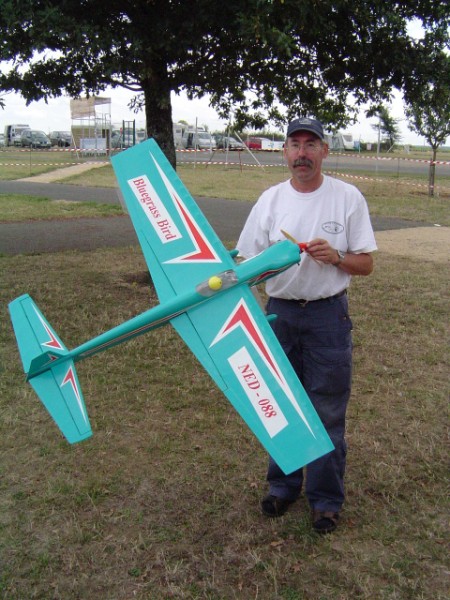
'If you think there's something about my English, you're right. I'm Dutch...
'
But I DO play Stunt and I DO fly Bluegrass.
>
>>I once watched a guy fly with his elbow at waist level
>and
>>keep it there during manuevers??? To each his own,
>whatever
>>works, I say.
>
> "Works" is a relative term, however. The big
>problem with "do whatever feels good" is that you
>get used to it on some level and are then almost incapable of
>appreciating the issues it causes. You can compensate to some
>degree for the problems, but since you are doing that, you are
>handicapping yourself and aren't even aware of it.
>
> It's no different from any other trim setting- most
>people fly grossly out-of-trim airplanes and think they are
>wonderful. And sometime get mildy offended if you suggest they
>might could do better.
>
> Brett
>
Someday maybe Uncle Jimby will loosen up from his usual totally personal uptightness (that's a joke, guys) and write a few paragraphs of the approximately three years he spent remanufacturing his considerable but inappropriately applied flying talents.
It took him that long to overcome some pretty devastating poses and postures in the center of the circle in order to fly moderatelly good advanced level flights to become a very competitive expert flyer in some pretty tough company. Very prominent in that rebirth was the change from arm waving and dramatic bodily displacement to match the way he turned is hand over to a pretty stout vertical presence in the center with a vertical handle held pretty darn well in one position.
By the way, he had been flying since Orville was a lad and had a "lot" to overcome. Pretty dedicated guy now more than likely destined to fly pretty much as good as he wants to.
Ted
And Claus' handle, I like the best of all; like all his work, it is a piece of art. I'm convinced I could win the Nats with a handle like that! ;->
[photo not recovered: 28987.gif]
"My grandfather invented Cliff's Notes. It all started back in 1912...Well, to make a long story short..." -Stephen Wright
Can I weigh in on this one?
Thanks.
Read the statement below until you understand it, know it, live it, and love it. It is a true statement and really shows ONE of the limiting factors of using a "relaxed" position handle.
>>>>Well for all us "normal people"...if you hold your hand in the relaxed "normal" position (angled about 10 degrees) it will severely limit the wrist angular movement in the down direction.
I've watched several people who fly with angled handles and they invariably use their arm as well as wrist to produce down elevator, much more than they uses their arm to produce up elevator.
Certainly some very good flyers fly this way but it has to be more work to maintain precision.<<<
Thank you so much Randy C!!
You actually have less downward motion in the handle simply because only your wrist can produce the input needed. For the upward motion you can pull with your wrist and curl your arm at the same time in its natural motion. Most everyone does it a little and they probably don't even know it. Watch the flyers and you will see it.
Truth is when we are flying our hand, wrist, arm, body, brain and all of it are NOT relaxed. And we are not simulating pointing at something like we are when we hold a gun. We are flying a plane. It takes equal inputs from the up and down lines to get equal turns throughout the pattern.
I spent a couple of years trying my hardest to get my brother off of that dreaded pistol grip handle he had been using for ever! YUCK!!
I used several approaches like a soft subtle suggestion, "Looks like you have some variation in your inside outside response. I can see it in your exits. The insides are sharp and effortless. Your body language would suggest you are doing all you can on the outsides and they are still soft. Maybe try a straight bar handle?"
Answer, "Naw, I think something is out of adjustment."
Later after a couple of years of frustration of watching this happen with virtually every plane I was down right blunt, a tactic he seems to respond to with much more acceptance in some cases, "Hey! That flight sucked! Get off that stupid handle!"
In those cases I would at least get a thought and then a no. ARRRGGGHHH!!
Then out of the blue TF brings out the TF Hard point handle. We both thought it would be cool to have about 10 of these things and use them exclusively as there was no other top notch handles on the market. Either plastic things or starter handles and that was about it. He ordered 4 and I ordered 4. Secretly I was jumping up and down because he would get away from the handle that was hampering his performance.
Our handle kits came and we built them and loved the light weight. The line tension will be transferred to the hand and not wasted in on the handle. That is key by the way. He put one on his Impact and it was on! Took some getting used too and he was able to fly so much better pretty much over a weekend. His body language calmed down on the outsides and his scores went up accordingly. He changed because it would be convenient to have all his planes on the same handles.

Side effect was an improvement in performance and no more listening to me pester him about it. He still uses them today and is flying better than ever and when I fly his planes I can actually fly a pattern.
My experience was a tad different. I put one of these new TF handles on a plane I liked to call "ole' blue". It was a '97 bear with a blue and yellow chevy paint job and had taken me as high as 2nd place in ADV at the nats. It was a work of art and a work horse at the same time. I could bring that pup out and pretty much be ready for anyone in about 2 flights. Is there a better rig to try out the TF handle on? None that I can think of. WOW it was like having my hand on the bellcrank. I was blown away be the response and how much better the plane flew. I had that plane on solids and a bar handle before and it was not the same as cables and the hard point. Not even close to the same. The cable and hard point was head and shoulders above. I entered a contest with it and won. YEAH!! I thought too myself they better look out now!!
I couldn't wait to get one on my "nats" plane. The same plane that took me to the top5 in 2002. Pulled the solids off and got new cables and hard point and went to work. Flew like a banshee for weeks and never could get it to come in. I just could not get two maneuvers in a row. I was missing angles and intersections. Several people saw this happening and noted it as such so I knew it wasn't something I cooked up in my head. Another guy I know who flys my same exact plane said he felt the same thing. I tried mine on the solids just for seeing sake and it was not any better. Went back to the bar handle and the NON stainless solids and it was back on.
So in that case it wasnt a better fit. But I have built planes since then where it was an outstanding choice of handle.
ONE thing through all this that was and is the same, is the handle is straight up and down. It cant be biased and or relaxed and give you same input. It just cant. It causes one line to be longer than the other, or the over hang on the down line is way TOO LONG. Both situations will cause quick insides and slow outsides.
Please see and read Randy C's comments above about the actual motion as well.
If you have made it this far thanks for reading and sorry it went so long.
See a pic of my current handles below. You will see my hard points and my bar handle. The bar is used with NON stainless lines I get from Mike Scott. They are awesome and you can fly them in high humidity situations with no sticking and they last forever. I have two of the bar handles that I made at the same time in 2000. I like to think of them as "The Guns of the Navarone!"
[photo not recovered: 29241.jpg]
Attachment
#1, (jpg file)
Doug Moon
Doug - I think you will find if you slide both hard point attatchments out to the third hole, giving you more overhang like the bar front handle, it will give you a similar feel and work better on your Nat's plane.
It's just a WAG, cause in your pic's I see you have all your hard point handles pulled way back. I'd guess from this that if those new handles work good on your newer planes that you have started building lighter, or at least less tail heavy or more "groovy" planes since you built your old Nats plane...
EricV
Eric,
The newer planes I have built that worked with the hard point were in fact more groovy type planes. Like the Bear 4660 it has a smallish tail. I did build a super profile (a beast .75" wide with a 72 on it) with a composite wing a few years ago and it worked best with the bar handle. It had a huge tail and long tail momeent, 21".
I did try the hard point with the "hooks" out further to try to get the plane to calm down it still didnt work as well. The more I messed with it the worse I flew. I didnt see the point in chasing it down as it was hampering an already very good performing setup.
Doug Moon
Doug,
Thanks, for a long while I thought no one had noticed my comments.
Your comments were interesting and humorous regarding your brother's conversion.
Is there a story behind the handle in the picture with the ends "sanded down" to an angle?
Randy C
>Is there a story behind the handle in the picture with the
>ends "sanded down" to an angle?
>
>Randy C
It is from dragging it across the circle as I wind up the lines. When we fly the lines stay out on the circle while the other is flying. So when it is time to go I stand off circle and wind up. The handle gets dragged and the soft balsa wears off. Makes it lighter along the way...

Doug Moon
>
>>Is there a story behind the handle in the picture with
>the
>>ends "sanded down" to an angle?
>>
>>Randy C
>
>It is from dragging it across the circle as I wind up the
>lines. When we fly the lines stay out on the circle while the
>other is flying. So when it is time to go I stand off circle
>and wind up. The handle gets dragged and the soft balsa wears
>off. Makes it lighter along the way...
Well....maybe you could put some wheels on it!!!
Randy C
>>
>>>Is there a story behind the handle in the picture
>with
>>the
>>>ends "sanded down" to an angle?
>>>
>>>Randy C
>>
>>It is from dragging it across the circle as I wind up the
>>lines. When we fly the lines stay out on the circle while
>the
>>other is flying. So when it is time to go I stand off
>circle
>>and wind up. The handle gets dragged and the soft balsa
>wears
>>off. Makes it lighter along the way...
>
>Well....maybe you could put some wheels on it!!!
>
>Randy C
Dave Eyskens used to put large headed screws on the sides to keep them elevated as the lines are reeled in, easy and simple.
Chris...
Chris McMillin
>>>
>>>>Is there a story behind the handle in the picture
>>with
>>>the
>>>>ends "sanded down" to an angle?
>>>>
>>>>Randy C
>>>
>>>It is from dragging it across the circle as I wind up
>the
>>>lines. When we fly the lines stay out on the circle
>while
>>the
>>>other is flying. So when it is time to go I stand
>off
>>circle
>>>and wind up. The handle gets dragged and the soft
>balsa
>>wears
>>>off. Makes it lighter along the way...
>>
>>Well....maybe you could put some wheels on it!!!
>>
>>Randy C
>
>
>
>Dave Eyskens used to put large headed screws on the sides to
>keep them elevated as the lines are reeled in, easy and
>simple.
>Chris...
>
but lacking in character by comparison. Like an good "old" pair of jeans.
Ted
>It is from dragging it across the circle as I wind up the
>lines. When we fly the lines stay out on the circle while the
>other is flying. So when it is time to go I stand off circle
>and wind up. The handle gets dragged and the soft balsa wears
>off. Makes it lighter along the way...
That is precisely why my handles come with an unfinished wood grips. I EXPECT the handle to be drug across the pavement, and I EXPECT the handle to be filed and sanded and ground upon to get "just the right feel". You sure aren't going to do either of those with a beautiful inlaid polished grip!
Regards,
Bill Lee
I'm sure glad I don't make handles any more.
I still have one that Bill Huang gave me years ago, Dick. It's a gorgeous handle, with fine inlays, I love the workmanship, but it is not my style. I probably should have tried it long enough to get used to it, but by that time I was trained into my Lou Crane handle, with the butt ugly hand-rasped-to-shape, greased up, nasty grip.
But I'll hang onto my Dick Bryon handle, as a reminder of my fine friendship with Bill Huang. (Wonder what he's up to? Last time I heard, years ago, he was making his own golf clubs.. Anyone know?)
I have sympathy for the folks who have been or are now in the handle business. It seems like a lot of work for not much profit, always with someone to complain about it..
[photo not recovered: 29334.gif]
"The great thing in this world is not so much where we stand as in what direction we are going". -Oliver Wendell Holmes
Randy,
You think this will work?!?!
Mag wheels are always cool!
[photo not recovered: 29256.jpg]
Attachment
#1, (jpg file)
Doug Moon
>Randy,
>
>You think this will work?!?!
>
>Mag wheels are always cool!
>
>
>
>
>
>
[photo not recovered: 29256.jpg]>
I see you are using high quality needle bearings for your wheels!
Steve
Steve,
Good call!!!! That is funny!!!!!!!!!!!!!!!
Doug Moon
The handle gets dragged and the soft balsa wears
>off. Makes it lighter along the way...
Dragging?? are you not concerned about damage to the lines
No not really. Never had a problem with it damaging the lines. The surface we fly off of is in great condition. Lines are very light weight and when you roll up they just very easily slide across the ground. And we are sliding them lengthwise. Plus I also clean the lines before every single flight so there is no left over junk on them.
Doug Moon
Hi Doug,
Sorry to come into this so late.
One difference between your bar handle and the hard points you didn't address. You might want to think about the following.
Your bar handle (a Bob Baron clone, it appears) has essentially no "extensions" above and below the grip. The hard point (Hot Rock clones) have the identical extensions to the original.
One of the things I disliked about my first Baron handle (built by Gene Martine) was that all of my control inputs had to be made by manipulating the handle by the grip using "big muscle" inputs. When I gave up on the Baron because of the sort of things you mentioned you experienced with the Hard point on your nats plane, I went back to an old Hot Rock and all the problems went away.
The second thing I noticed was that all of a sudden I was feeling the tiny inputs (mall muscle) I was inputting with the top of my index finger and the bottom of my pinky on those "extensions". Almost all of my "minor" corrections were accomplished simply by flexing one finger or the other rather than having to move my wrist, or elbow or arm. These inputs weren't possible with the extentionless Baron handle.
My immediate fix was to glue some balsa extensions onto the Baron handle and all of my complaints disappeared. I could now fly the airplane the same way I was used to flying with the Hot Rock, plus I had all the adjustable features.
I used that handle for years.
In your case, I suspect if you put the extensions on your bar handle it would all of a sudden feel like the TF hard point and you'd have similar complaints to those you have toward the TF on your nats plane.
My suspicion is that ultimately you could retrim your nats plane to match it with the more subtle inputs available from the hard point and/or the bar handle with the added extensions. In the final analysis, I suspect you would prefer the modified bar handle over the unmodified one and the hard point (with extensions) over either of the others.
Or, maybe not. That was my experience. The thing that was different was that, unlike you, I was never at a point with the Baron handle without the extensions that I found satisfactory. Thus, I had no "muscle memory" keyed to that sort of response. I never had an airplane trimmed to my satisfaction that didn't include the pilot interface (the handle) that allowed those subtle inputs.
Just FWIW.
Ted Fancher
A question if I may.
I understand how the handles with a cable winding through some guides on a bar to obtain line spacing and line length adjustment can feel very soft.
I've never used a Hot Rock or any of the copies but the Hot Rock seems like it may be rather more like a hard point handle with the way its line length adjustment works.
What do those who use them think?
Cheers, Geoff
>A question if I may.
>
>I understand how the handles with a cable winding through some
>guides on a bar to obtain line spacing and line length
>adjustment can feel very soft.
>
>I've never used a Hot Rock or any of the copies but the Hot
>Rock seems like it may be rather more like a hard point handle
>with the way its line length adjustment works.
>
>What do those who use them think?
>
>Cheers, Geoff
>
>
I have flown the same model back-to-back first using a favorite Hot Rock and then switching to what we still call a "Ted Handle," even if Carl is now making them.
It is my opinion that the latter handle was superior. Not to mention being tremendously more reliable.
Dan
Breaking News: Gov. Schwarzenegger, after reading Dan's post proclaiming that "Ted Handles" are "tremendously more reliable", has order that the Golden Gate must give up it's cables by next summer. Hard points will be installed for public safety.
Later
Richard
[photo not recovered: 29287.jpg]Here are some of my handles. Obviously, I like the weight and feel of EZ-Just Hot Rock 4" handles. I modify them as necessary to get optimum feel for the flight characteristics of individual airplanes. These handles vary in size from 4" line spacing to 6 1/2" line spacing.
Line spacing and control sensitivity are related. Pitch sensitive airplanes need smaller spacing. In general, I use larger line spacings than most flyers because my semi-scale airplanes have restricted wing area and depend on full 30 degrees of flap deflection for their tightest corners, buffet free. When other characteristics are satisfactory, I tend to add noseweight, moving the CG forward, and use wider line spacing when corners need to be tightened.
Generally, I make up a specific handle for each airplane after its flight characteristics have been determined. This includes a dedicated set of lines which are in adjustment for that specific airplane.
Often I change handles and line spacing. This year I changed the Snaggletooth line spacing from 6" down to 5 1/2. the Mustunt IV from 5" to 5 1/2", and the Millennium Cavalier from 5" to 5 1/4".
[photo not recovered: 29288.jpg]My handles are considerably reinforced with many wraps of thin string and CA. Bare handles worry me when they "creak" noticeably under high line tension. The handles also have "skids" on them because I only fly from hard surfaces and winding the lines in when through wears the handles without protection. Of course thongs are added to handles for airplanes which might be flown where thongs are required. And finally, its a small thing, but on my handles, on the lines near the handles, there are black markers of thread and CA. These markers permit very accurate adjustments of the lines for airplane flight neutral. With a small ruler, accurate adjustments of 1/32" are easily made.
Al
Attachment
#1, (jpg file)
Attachment
#2, (jpg file)
I wondered what you were doing with the EZ-Justs I sent you..
Scientific and completely engineered, as always!
[photo not recovered: 28987.gif]"Unless a man undertakes more than he possibly can do, he will never doall he can do. -Henry Drummond
Larry,
Thanks again. The handles have found a good home and a purposeful future.
Al
Okay, I read all the posts, looked at all the pictures including those featuring Al's truly mangy assortment of modded Hot Rocks. Ewww, yuck!!
Some of the thoughts put forth justifying a "relaxed," or "biased" handle position are the same ones I made. For years and years, despite all the very best advice from folk such as Ted and others, the examples set by Howard and Norm McFadden.
Look, I know some of you--possibly even many of you--see the use of a (perfectly) vertical handle position at neutral elevator as being way-wrong. As way-wrong as a single-sided swingarm on a high-perf motorcycle. Neither look right to your eyes and so they can't be right.
No problem, but if one merely reviews Ted's comments surely those words are enough to convince an unknown number of you to at least give it a try.
Incidentally, and speaking to Ted's comments about a certain flyer at the NW Regionals flailing about while flying outsides, I know **for certain** who this individual is and I wasn't even at the NWR contest this year! Point of fact, I am known to call attention to his antics during competition flights and just about the time for the square eights. Yes, he is a good friend. And he may never change his ways, which is fine, but so many of his flights are a fabulous object lesson in how **not** to set a handle to neutral that I simply cannot resist pointing it out to others, especially to those making a beginning in CL Stunt.
But I am telling y'all that during some of his flights in Expert PA one can easily see 20 to 30 points being left on the table, this in a class and a region where just another 5 or 10 points can be hard to come by.
Back to giving Ted's advice an actual try with an actual model, this is what (finally) worked for me: First, I chose a junker to fly when getting serious about my efforts. It happened to be Dirtmobile I, a nicely updated Flite Streak ARF, 21FP for power. It was a more than decent effort--since meeting its end in a friend teaching his son how to fly CL--but it was regarded as disposable even prior to being disposed of.
I also used a Magnum handle--GMA's design and production--'cos I like 'em and changes to cable leadout lengths are quick and easy. One can even adjust these handles in flight, although a fellow must be a little careful in so doing.
Setting the handle to dead-nuts vertical with neutral elevator **did not** work for me. Just as it had not worked in the past. Gave it six flights. Still did not feel right.
No problem. I cranked in a fair bit of bias but this time I went **the other way,** the top of the handle closer to my chest than the bottom of the handle.
Oh yeah, that felt very strange; but us humans having an amazing ability to adapt and after a few flights I was comfortable enough with the setting to put up patterns that were recognizable even if far from my best efforts.
At that point I reverted to the zero-bias setting which had been so problematic earlier in the day...
And I was **instantly** comfortable with that setting within three or four laps, putting up a full pattern with nary an Ooops! or scaring myself silly.
From there I became one of the faithful, even going to some relatively goofy extremes (described in another recent thread on the subject of handles) in getting the perfect setting the first time around, this including making big wads of line clips in varying lengths. Derek Moran designed a near-perfect tool for the forming of line clips from stainless steel wire, they are in increments of 1/16", are easy to make and work wonderfully.
So. If you are having trouble coming to grips--chuckle, snort--with this zero-bias thing, the above procedure might work for you. If not, try something else because the benefits to making the switch are just too good to leave untapped.
Dan
Here is my handle. It features:
- Instant in-flight neutral trim adjustment w/o tools.
This is a very neat feature when flying a new airplane and/or another set of lines. By rotating the down bar in flight neutral is typically adjusted with a couple of laps of level and inverted flight. One full turn of the bar is equal to a length change of 0.8 millimeter or 1/32"
- accurate and repeatable handle trim for different airplanes by recording of down bar extension (neutral) and line attach point numbers (sensitivity, turn rate).
The grid on the image is 25 mm or 1in.
Kind regards,
[photo not recovered: 29595.jpg]
Attachment
#1, (jpg file)
Peter D. Germann
And there's the old "Mercury" brand handle from the UK. Very basic in adjustments but was a comfortable handle (for right handers!!) Looks like Claus Makis' handle is closely related.
HH
[photo not recovered: 29596.jpg]
Attachment
#1, (jpg file)
Dan Banjok always advised us to adjust the handle so it was vertical with the bird flying level. He will check this with his own bird if he senses something amiss or if any adjustment has been made. The handle is held slightly to the side at eye level when checking for vertical alignment in relationship to level flight. The important relationship here, is the position of the handle as it relates to the plane as it flies. Dan uses a Windy handle with a very short overhang and wire when flying his PA61 powered Mustang. I believe tho, he prefers a hard point handle for his Saito 72 powered Vista. The hard point TF handles are used by Jack Weston and others in out club. Mike Palko, I believe, uses one with his knew purty electro Mustang. Many in our club prefer the hard point. Jack even bought a high zoot beauty of a hard point from Randy Smith. $50, I believe. Although I've made two or three TF handles for Jack I've yet to assemble one for myself. Using either a knock off EZ Just Wood sold by Brodak or a borrowed plastic combat handle. I felt my flying and plane craft did not merit something more exacting. I plan to try a hard point handle now, having solved, for the moment, various engine run weirdnesses and what nut that plagued me last season. Ron (the Deli Man) Testa needs to watch out.
Note: Jack Weston has his own infamous and eccentric methodology for adjusting for our hand/wrist differential in up down movement. Having learned the CL boogie in a pre-history era, he came to his own style for manipulating the stab. Jack holds his handle horizontal and upside down. Pulling his fingers towards the elbow gives him up and visa versa. Feels comfortable, actually, as I try this in my living room. Eases my carpal tunnel syndrome... Always thought outside squares easier to corner than inside... Experimenting with the Jack Weston hold seems a sure way to wrack up a few birds. The Devil.
The post on Fancher handles got me thinking, what kind of handles do you all use?!! Here's mine, an old HotRocks!! Still works great!!
Dwayne
Guess I'll have to hang up my old U-Reely!
Just kidding. Haven't used it since the fifties.
Need to repair the elongated holes on my "Hot Rock". Currently use one of Tom Morris's biased handles.
Here are a few handles: First is U-Reely, second shows two Sullivan handles (left one from fifties) Full-size E-Z JUST, Morris
George
[photo not recovered: 29619.jpg][photo not recovered: 29620.jpg][photo not recovered: 29621.jpg][photo not recovered: 29622.jpg]
Attachment
#1, (jpg file)
Attachment
#2, (jpg file)
Attachment
#3, (jpg file)
Attachment
#4, (jpg file)