Does anyone have any links to the Rutan space flight?
Rutan flight
Stuka Stunt Main Forum · 56 of 56 known posts recovered
Cy
Doesn't look like much room in the nose. Most of the fuselage is oxidizer tank, fuel tank, and engine.
Yeah, Project Mercury was really complicated compared to Spaceship One. One of Rutan's strengths is getting the most bang for the buck from materials and systems. After all, most of his homebuilt designs are blocks of foam slathered with fiberglasss. This is a terrific achievement! A reporter who was at the public annoucement of the project a few years ago said that many in the crowd were from NASA.....
The nose fits three people, the basic requirement to win the 10 million.
After seeing 3 years worth of the bad news on TV, it was a great boost to see that America set the stage for a new industry once again. SpaceShipOne was designed and built right here in the USA!
I heard they had to carry 3 people or the equivilant weight of three people twice on two successful flights within two weeks. I can't verify that though.
Yep you got. If they do it, which they will, they get the 10 mil!
And to think Rutan did this (development, construction and several flights) for about 20 million dollars. Heck, that wouldn't even pay a small portion of the fuel bill for a single shuttle launch.
For those interested: http://www.xprize.org/
You can read about Rutan and other developer competing for the X-Prize.
Personally, I like the guy with the balloon idea.
At the risk of replying to myself, here is a page with some great photos of the event:
http://www.richard-seaman.com/Aircraft/AirShows/SpaceShipOne2004/
The FAA has it listed as a Glider which would be partially accurate. It has a bit larger performance envelope than your average "Tow it up and let it go" sailplane. Wow. A Mach 3+ glider!
Serial Number 001 Type Registration Corporation
Manufacturer Name SCALED COMPOSITES LLC Certificate Issue Date 03/20/2003
Model 316 Status Valid
Type Aircraft Glider Type Engine None
Pending Number Change None Dealer No
Date Change Authorized None Mode S Code 50706357
MFR Year 2003 Fractional Owner NO
Got a tour of the hanger and vehicles about two weeks ago during a business trip. They were preparing the ship then with everything exposed. Think of the crew cabin as an egg, with three across seating with the pilot in the center and slightly forward. The vehicle itself was elegant simplicity. (Perhaps a merger of KISS and Aircraft Spruce.) Very interesting project to observe....
Dave
LA_Flyer
All I know is that it ws one brave dude piloting that thing! What a ride!
I'd like to find a link to some of the inflight pictutes taken during its last flight a few weeks ago. I saw one in Aviation Week that was awesome.
I think they had several video cameras running throughout the flight. I caught a few snippets on the TV at work. I'd love to see all the in flight video footage.
What I think is sooo cool is that the motor is essentially a very big high powered rocket hobby motor, then to get it back down he Dethermalises it just like his old free flight models. Lets hear it for modelers! (I was at Scaled back in the early 90's for TI and when I said to the engineer that was showing me around that Burt used to be a modeler his reply was he still is he just builds bigger ones now)
>What I think is sooo cool is that the motor is essentially a
>very big high powered rocket hobby motor, then to get it
>back down he Dethermalises it just like his old free flight
>models. Lets hear it for modelers! (I was at Scaled back in
>the early 90's for TI and when I said to the engineer that
>was showing me around that Burt used to be a modeler his
>reply was he still is he just builds bigger ones now)
>
>very big high powered rocket hobby motor, then to get it
>back down he Dethermalises it just like his old free flight
>models. Lets hear it for modelers! (I was at Scaled back in
>the early 90's for TI and when I said to the engineer that
>was showing me around that Burt used to be a modeler his
>reply was he still is he just builds bigger ones now)
>
Yeah.. I remember when the hybrid (nitrous oxide - solid fuel) HPR motors first came out. All sorts of people started experimenting with them. Some used compressed wood logs as fuel, some used plexiglass. One of the few that made it to commercial sales used molded PVC motors that burned from the inside out, if I recall correctly. The nitrous oxide was fairly easy to get, from race shops. The pressure bottles came off a paint gun (liquid CO2 and liquid nitrous oxide have similar vapor pressures at room temperature).
>Yeah.. I remember when the hybrid (nitrous oxide - solid
>fuel) HPR motors first came out. All sorts of people started
>experimenting with them. Some used compressed wood logs as
>fuel, some used plexiglass.
Some used a sausage! No kidding, a regular old Kielbasa cored out down the middle.
Brett
Didn't come across the kielbasa, but I wouldn't doubt it.. The exhaust would have smelled very interesting...
Actually got to help a couple people prep a Hypertek(?) powered rocket that year at a Dayton launch. It was an interesting time, but also a very annoying one - that's more or less when Jerry I****e started showing up on r.m.r.
Nasty as Dan over here may get now and then, all I need do is recall what Jerry was like... Phew.
>Didn't come across the kielbasa, but I wouldn't doubt it..
>The exhaust would have smelled very interesting...
>
>Actually got to help a couple people prep a Hypertek(?)
>powered rocket that year at a Dayton launch. It was an
>interesting time, but also a very annoying one - that's more
>or less when Jerry I****e started showing up on r.m.r.
>
>Nasty as Dan over here may get now and then, all I need do
>is recall what Jerry was like... Phew.
>The exhaust would have smelled very interesting...
>
>Actually got to help a couple people prep a Hypertek(?)
>powered rocket that year at a Dayton launch. It was an
>interesting time, but also a very annoying one - that's more
>or less when Jerry I****e started showing up on r.m.r.
>
>Nasty as Dan over here may get now and then, all I need do
>is recall what Jerry was like... Phew.
Was? I don't know why you think Irvine is referred to in the past tense. RMR is basically a dead forum, unless you want to go back and forth over the merits of Jerry "I invented Everything First" Irvine, AKA poster boy for the BATF. You know, "Homeland Security Prevents This..." superimposed over a picture of Irvine shipping explosives marked as something else. Jerry invented HPR in the same sense that Al Capone and Bugs Moran invented the liquor distribution industry.
Brett
Heh.. I don't doubt at all he's still like that. I wonder if anything's come of his schemes to revive US R*****s. Kosdon sent me some really interesting stuff about him at the time.
I wonder how all the old r.m.r. crowd are doing - Tavares, Kaplow, Bunny, etc. It used to be a real fun place to hang out. I am really glad the people involved in the business end of CL get along a lot better than the HPR business people did. Pretty much lost track of who was suing who - the list changed every week.
>I wonder how all the old r.m.r. crowd are doing - Tavares, Kaplow,
>Bunny, etc. It used to be a real fun place to hang out.
>Bunny, etc. It used to be a real fun place to hang out.
I live near Kaplow, have met him a few times.
Bunny still posts occasionally on r.m.r.
Jerry Irvine has been renamed "Skippy the rabid roo" on r.m.r.
I lurk on r.m.r. but rarely post there anymore.
>
> Was? I don't know why you think Irvine is referred to in
>the past tense. RMR is basically a dead forum, unless you
>want to go back and forth over the merits of Jerry "I
>invented Everything First" Irvine, AKA poster boy for the
>BATF. You know, "Homeland Security Prevents This..."
>superimposed over a picture of Irvine shipping explosives
>marked as something else. Jerry invented HPR in the same
>sense that Al Capone and Bugs Moran invented the liquor
>distribution industry.
>
Oh! That brings back some memories!!!!
> Was? I don't know why you think Irvine is referred to in
>the past tense. RMR is basically a dead forum, unless you
>want to go back and forth over the merits of Jerry "I
>invented Everything First" Irvine, AKA poster boy for the
>BATF. You know, "Homeland Security Prevents This..."
>superimposed over a picture of Irvine shipping explosives
>marked as something else. Jerry invented HPR in the same
>sense that Al Capone and Bugs Moran invented the liquor
>distribution industry.
>
Oh! That brings back some memories!!!!
I have not laughed that hard in a long time...the good old days of high power.
Steve
>All I know is that it ws one brave dude piloting that thing!
> What a ride!
>
>I'd like to find a link to some of the inflight pictutes
>taken during its last flight a few weeks ago. I saw one in
>Aviation Week that was awesome.
> What a ride!
>
>I'd like to find a link to some of the inflight pictutes
>taken during its last flight a few weeks ago. I saw one in
>Aviation Week that was awesome.
The pilot is 63 years old! (In a few years, can *I* pilot one of these?) 
What I also found very interesting is that the ship has no heat shielding, at least nothing similar to the Shuttle. It's not clear how they manage that - the energy has to be dissipated somewhere. (It did have a distorted area on the aft portion of the fuselage.)
The "mothership" is a pretty awesome critter in itself.
Another magnificent effort by Rutan and his team!
[photo not recovered: 3e69bb3870f12ad5.jpg]
"There is no sadder sight than a young pessimist." -Mark Twain
Brett, among others, is probably better qualified to answer this, but the heatshielding issue is a simple matter of a small light object not going very fast (Mach 3 at 328,000 feet is not very fast, relatively speaking) compared to a large heavy object coming in at mach 25 and carrying that speed all the way to lower (200,000 or so) altitudes. Somewhere I read that the equivalent airspeed (I don't know how that is calculated at under those conditions, maybe as dynamic pressure rather than speed), at any rate the equivalent airspeed would be in the 350 mph catageory.
Steve,
A little closer look at its wing leading edge shows some sort of dark strip, which I suspect is some sort of dissipative/protective material.
(I see they are now talking about the Shuttle flying again next spring, it will be interesting to see what changes have been made since Discovery.)
As tempting as it might be to compare this effort to a Shuttle flight, it is clearly a mouse to elephant. Throw weight of 3 people and life support for a few hours is tiny, as space flights go.
But someone noted that only when something becomes available in a portable, fractional horsepower (and maybe hand held) version does it become commercially viable. This vehicle is a "fractional horsepower" spacecraft!
It's a fabulous accomplishment.
[photo not recovered: 3e69bb3870f12ad5.jpg]
"You cannot teach a crab to walk straight." -Aristophanes
>Brett, among others, is probably better qualified to answer
>this, but the heatshielding issue is a simple matter of a
>small light object not going very fast (Mach 3 at 328,000
>feet is not very fast, relatively speaking) compared to a
>large heavy object coming in at mach 25 and carrying that
>speed all the way to lower (200,000 or so) altitudes.
>this, but the heatshielding issue is a simple matter of a
>small light object not going very fast (Mach 3 at 328,000
>feet is not very fast, relatively speaking) compared to a
>large heavy object coming in at mach 25 and carrying that
>speed all the way to lower (200,000 or so) altitudes.
Simply a matter of kinetic energy dissipation. When comparing one to the other, the mass more-or-less cancels out. But 3000 mph is a far cry from 18000 mph required for orbital flight - a factor of 36 times as much energy per unit mass required to launch it, and 36 times as much energy per unit mass to re-enter it.
Re-entering from orbital velocities is just a completely different ball game. Extrapolating SS1 to orbit will not work - it just won't scale up to orbital flight in any sense, and will require a completely clean sheet of paper.
I would also note well the attitude control problems they appeared to have on the way out. I have no idea what their problem might have been. But in my very limited interaction with the various X-prize contenders, I have gotten a very bad feeling about their, shall we say, "casual" consideration of basic attitude control issues. I don't know about Scaled Composites (by far the most competent of the potential contenders), but I do know that some of the others are ignoring or pooh-poohing things based on running a bunch of computer simulations that they really should be considering. The mere fact that they are designing some of the systems "by simulation" concerns me, as it's a classic way to delude yourself in to thinking you really understand it. When in fact you don't and you could easily be .001 dB or 1 degree of gain or phase margin away from an instability, and never know it! Simulations have their place, but the fundamental analysis still has to be done.
>Somewhere I read that the equivalent airspeed (I don't know
>how that is calculated at under those conditions, maybe as
>dynamic pressure rather than speed), at any rate the
>equivalent airspeed would be in the 350 mph catageory.
Dynamic pressure is the parameter you are seeking. But that's a different issue from heating. The Columbia began melting and coming apart at a *very low* dynamic pressure. I did some calculations at the time (might be here, too, in the archives) but the number that sticks in my mind is something like a sea level equivalent velocity of ~30 fps or less.
Brett
p.s. 35 mph - http://www.clstunt.com/cgi-bin/dcforum/dcboard.cgi?az=read_count&om=3973&forum=DCForumID1
While the pursuit of the X-Prize is fun and exciting, the comparison to the SSTS program really isn't valid. And the SS1 capability doesn't even come close to the Mercury hardware. Perhaps one comparison is valid, and it emphasizes Brett's comment about attitude control. If you modified an F-104 for research purposes and flew parabolic trajectories to go for altitude records, would a great pilot be able to nudge the edge of space and survive? Ask Yeager if they made him pay for the plane he used.... Wonder if that data was useful for the X-15 program?
Not sure if the AMA rules prohibit rocket attitude control. We could could go to three line control with attitude jets and finally break the 5-foot-radius-corner barrier....
Dave
LA_Flyer
Here in New Mexico there is much excitement about the X Prize competition, and many folks are convinced it is only a short matter of time before this program has fabulous commercial success.
When I think about it, I'm concerned that there is a high probability of someone dying in this pursuit. In spite of how enthusiastic and optimistic large numbers of people can become, this venture is not trivial and potentially very dangerous. And MANNED. Amateurs attempting such on a shoestring budget is likely to get someone killed.
Massive amounts of research and testing work are required for successful space flights, and it remains quite dangerous.
Brett makes a major point about simulation - it's a wonderful and necessary tool for modern design work, but ultimately things have to be tested. And tested, and tested, and tested.
Unbridled optimism is a dangerous thing.
[photo not recovered: 3e69bb3870f12ad5.jpg]
"Truth: n. An ingenious compound of desirability and appearance." -Ambrose Bierce
Then again, the path of progress in aviation has been marked by many a death, especially in the early years. I can't say it's not been worth it, all in all. Still, I see what you mean.
Now I can't say too much about what I saw during my visit to RutanWerks (they made us sign a non-disclosure agreement), but I think faif2d would have gotten a kick out of one air vehicle that I MAY have seen in a remote part of the assembly area: a classic control line stunter! More proof that the employees live and breathe all things aeronautical....
Stunt Lives!!!
LA_Flyer
I can't remember a non disclosure agreement but I imagine things were looser back then. My escort had on shorts, sandals, and a Hawaiian shirt! One thing I did ask about was the report that Burt had flown a CL model in a 3 dimensional sphere. I was told yes he did something like that strapped to a roof post at one end of the hanger, that gave him 3/4 of a sphere. I also noted a RC Nobler under a bench, what is so unusual? it was powered by a dyna jet! VERY COOL PLACE!
. . .that FOX was the ONLY network to cover the event?! ABC, CBS, NBC and PBS were toatlly absent!
FOX could have sent a better-prepared reporter, but by the end of the day he was up-to-speed.
Saw it on CNN and BBC, myself. Close to midnight, here.
Rutan and his 63 year old pilot were on Jay Leno's show last night. Go Burt.
Saw it real time on MSNBC myself.. CNN also had coverage..
[photo not recovered: 3e69bb3870f12ad5.jpg]
"If a little dreaming is dangerous, the cure for it is not to dream less but to dream more, to dream all the time." -Marcel Proust
The thing that impressed me about this flight is the fact that is was scheduled and took place without any long delays we have grown accustomed to with NASA. The other thing that impressed me was the team admitted they had some control issues and Burt said it would not fly again until everything has been repaired. It was nice to see the open honest approach and the commitment to make it right before the next flight. I truly hope that NASA was listening and maybe can use the same approach to space flight in the future.
>The thing that impressed me about this flight is the fact
>that is was scheduled and took place without any long delays
>we have grown accustomed to with NASA.
>that is was scheduled and took place without any long delays
>we have grown accustomed to with NASA.
There's just no comparing to two. I'm sure Rutan would be the first to note that the level of complexity required to do his mission is fantastically smaller than to do a shuttle mission - by 2-3 orders of magnitude.
>The other thing that
>impressed me was the team admitted they had some control
>issues and Burt said it would not fly again until everything
>has been repaired. It was nice to see the open honest
>approach and the commitment to make it right before the next
>flight. I truly hope that NASA was listening and maybe can
>use the same approach to space flight in the future.
I don't see why you think they are different. They could fly another shuttle flight in a month if NASA didn't care about fixing the identified problems - under exceptionally intense public scrutiny.
SS1 is a neat airplane. But it's got about 10 seconds of spaceflight time, total. I'm far from a NASA apologist, but you can't make any valid analogies with NASA projects, particularly the shuttle, and SS1. Even Mercury or X-15 were much more demanding missions with associated much more complexity, and the time and money required were not vastly out of bounds.
Brett
Here's the program that I get a kick out of.
Where is Phineas Phogg when you really need him?
>Here's the program that I get a kick out of.
>
>http://www.jpaerospace.com/
>
>Where is Phineas Phogg when you really need him?
>
>http://www.jpaerospace.com/
>
>Where is Phineas Phogg when you really need him?
Rokoons (rockets lofted by balloons) were a moderately hot topic in the 50s for sounding rockets. The widespread and very economical availability of Nike missile booster stages, plus the fairly significant uncertainy in their launch parameters, made them drop by the wayside.
Brett
Brett,
Well, apparently, they're back. I love the idea of a balloon space station (well, upper atmosphere station anyway) hovering at around 100,000 feet. Ride the balloon up, dock and take the space bound transit from there. NASA has been saying for years that SSTO is unfeasible. Well, perhaps so, but hey, what a kick. Just ride the balloon up.
>Well, apparently, they're back. I love the idea of a balloon
>space station (well, upper atmosphere station anyway)
>hovering at around 100,000 feet. Ride the balloon up, dock
>and take the space bound transit from there. NASA has been
>saying for years that SSTO is unfeasible. Well, perhaps so,
>but hey, what a kick. Just ride the balloon up.
There were plans to loft a manned Mercury capsule on a balloon to test the environmental controls system. And as recently as 2000 there was a proposal to replace the lost MILSTAR DFS-3 satellite communications capability (which got dropped off in the wrong orbit at fantastic rates due to a database error in the booster - I managed to figure out how to despin it, but it was still too low to use) by lofting a MILSTAR EHF payload on a giant balloon.
To go from 100000 feet and stationary, to orbit, will take an incredibly large rocket, almost as big as if you launched it from the ground. It takes an astonishingly large balloon to loft something the weight of a fully-fueled Delta-II, far, far bigger than anything yet proposed.
Brett
Brett,
Well, much like a lot of the contenders for the X-Prize, I guess we'll see. A lot of folks said Rutan would absolutely fail when he made his initial proposal. I read pages and pages at places like Space.com when Rutan first proposed the basic idea that contended that even his pretty basic attempt simply wasn't possible.
While I certainly agree that just taking a flyer on oddball ideas is fine if you have the money to waste, most serious developers should follow tried and true approaches. On the other hand, many scientists (read dreamers) believe that, in the words of Gordon Dickson, "Nothing is impossible; only a thing, the doing of which is not yet understood."
But whatever the case, the whole process should be fun to watch. Think the Armadillo will make orbit?
I don't think it is reasonable at all - in fact, I don't think that incredible sized balloon even exists.
The National Scientific Balloon Facility in Palestine, TX launches the largest research balloons in the world. The largest payloads seem to be about the weight of an automobile - in the 3500 lb region. To give you an idea of the size of such a balloon, the balloon package (including parachute and gondola) is over 400 feet tall. The cost of such a launch is in the millions of dollars. The balloon and helium alone is a major expense. Solar power systems are another.
These balloons are for long duration flights (more than 30 days aloft) and every winter they launch from Australia and Antarctica. They often circumnavigate, and their altitudes can be up to 135,000 feet. Fairly massive amounts of data are acquired, about everything from atmospheric chemistry to xrays, gamma rays, and solar flares. The instruments have to survive temperatures as low as -85C as they pass through the troposphere - then they have to survive self-heating effects for extended periods in near vacuums. And polar zone radiation.
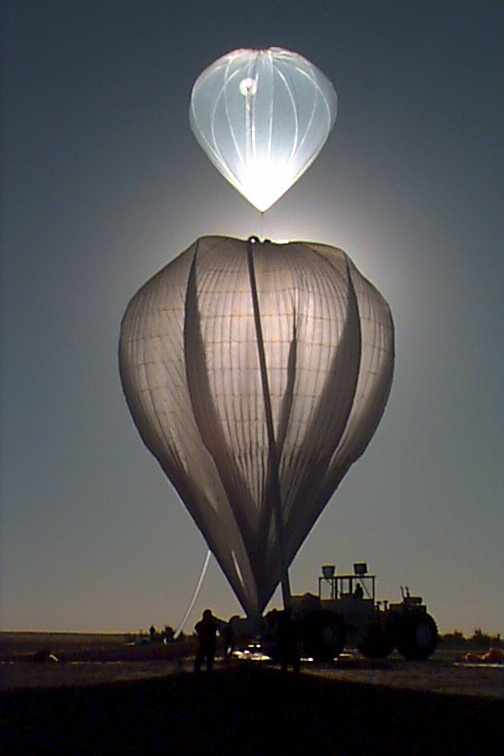
Here is a photo of a test launch I attended from Fort Sumner, New Mexico a few years ago. This was a much, much smaller balloon (tiny, actually), but it was a "super pressure" test - that is, the balloon is pressurized to try to maintain its volume a little better. Otherwise, there are diurnal shifts in altitude of several thousand feet due to heating and cooling effects.
The small (bright) balloon at the top is a "tow", which holds the balloon up while it is inflated prior to launch. (I worked on the instrument package on top of this balloon - it worked fine, but the balloon itself burst about 7 hours into flight).
I'm quite familiar with these balloons because I have designed both hardware controllers and software for instrumentation and telemetry systems for them, and reduced their data.
[photo not recovered: 3e69bb3870f12ad5.jpg]
"Most human beings have an almost infinite capacity for taking things for granted." -Aldous Huxley
Larry,
Beats me. A lot of these ideas "sound" plausible, but until someone actually does it (like Rutan), it's just that: a somewhat plausible idea.
How about this in your backyard:
>>Governor Announces that Starchaser First to Move to New Mexico Spaceport
Santa Fe, NM—Governor Bill Richardson today announced that England-based company, Starchaser Industries, which is one of the contenders for the $10 million dollar Anasari X Prize purse, plan to open offices in Las Cruces, and begin launch operations from the nearby Southwest Regional Spaceport (SRS) as early as 2006.
“When we announced that New Mexico won the bid to host the X PRIZE Cup, we promised that economic opportunities and high wage jobs would follow. I’m pleased that we are seeing those opportunities begin to materialize so quickly,” said Governor Richardson.
Starchaser Industries is committed to developing reusable affordable space travel and tourism and is currently focused on winning the Anasari X PRIZE. Founded in 1992 by current CEO Steve Bennett (Director of Space Technology at Salford University), the company now employs 10 full time staff at its assembly and integration facility in Hyde, Cheshire. UK<<
Hey, at least they are trying. Apollo started as someone's off the wall idea.
Randy,
Please don't construe my comments as taking anything away from the achievements of such individuals as Rutan. They are brilliant, and I admire them greatly.
As for our local "regional spaceport", I'm well aware of it too, in fact I helped prepare technical studies about it a few years ago - I plotted elliptical shaped impact areas for various re-entry contours in the areas north and east of Las Cruces (including parts of White Sands Missile Range). People were rightly concerned about the trajectories of such things around population centers - like Albuquerque.
I truly believe some innovative applications of high altitude balloons (like launching glider vehicles, lifting bodied balloons (not quite?) a la John McPhee's Deltoid Pumpkin Seed) remain to be developed. But serving as launch platforms for large rockets? Hmmmmm..
Manned "commercial" space flight, even a suborbital hop, is quite a different critter. I'm afraid I remain a skeptic.
Was it Chad and Jeremy who had the song lyrics "everyone's gone to the moon"?
[photo not recovered: 3e69bb3870f12ad5.jpg]
PS
Randy - today's Las Cruces Sun-News headlines:
Air Service to Las Cruces in question
..wherein we find that in spite of Las Cruces' matching grant of $200K last November to the Taos-based Rio Grande Air to provide scheduled services to Crawford International Airport, service has been delayed.
Turns out that Rio Grande Air has grounded its fleet, halted its Alburquerque and Alamogordo flights, with "issues of finding lease funding" to upgrade its fleet of single engine Cessnas to twin-engine models.
Las Cruces currently hasn't a regularly scheduled air service. So I'm not really expecting a spaceport around here for some time..
"Everyone has talent at twenty-five. The difficulty is to have it at fifty." -Edgar Degas
>Larry,
>
>Beats me. A lot of these ideas "sound" plausible, but until
>someone actually does it (like Rutan), it's just that: a
>somewhat plausible idea.
>
>How about this in your backyard:
>
>>>Governor Announces that Starchaser First to Move to New Mexico Spaceport
>
>Santa Fe, NM—Governor Bill Richardson today announced that
>England-based company, Starchaser Industries, which is one
>of the contenders for the $10 million dollar Anasari X Prize
>purse, plan to open offices in Las Cruces, and begin launch
>operations from the nearby Southwest Regional Spaceport
>(SRS) as early as 2006.
>
>“When we announced that New Mexico won the bid to host the X
>PRIZE Cup, we promised that economic opportunities and high
>wage jobs would follow. I’m pleased that we are seeing
>those opportunities begin to materialize so quickly,” said
>Governor Richardson.
>
>Starchaser Industries is committed to developing reusable
>affordable space travel and tourism and is currently focused
>on winning the Anasari X PRIZE. Founded in 1992 by current
>CEO Steve Bennett (Director of Space Technology at Salford
>University), the company now employs 10 full time staff at
>its assembly and integration facility in Hyde, Cheshire.
>UK<<
>
>Beats me. A lot of these ideas "sound" plausible, but until
>someone actually does it (like Rutan), it's just that: a
>somewhat plausible idea.
>
>How about this in your backyard:
>
>>>Governor Announces that Starchaser First to Move to New Mexico Spaceport
>
>Santa Fe, NM—Governor Bill Richardson today announced that
>England-based company, Starchaser Industries, which is one
>of the contenders for the $10 million dollar Anasari X Prize
>purse, plan to open offices in Las Cruces, and begin launch
>operations from the nearby Southwest Regional Spaceport
>(SRS) as early as 2006.
>
>“When we announced that New Mexico won the bid to host the X
>PRIZE Cup, we promised that economic opportunities and high
>wage jobs would follow. I’m pleased that we are seeing
>those opportunities begin to materialize so quickly,” said
>Governor Richardson.
>
>Starchaser Industries is committed to developing reusable
>affordable space travel and tourism and is currently focused
>on winning the Anasari X PRIZE. Founded in 1992 by current
>CEO Steve Bennett (Director of Space Technology at Salford
>University), the company now employs 10 full time staff at
>its assembly and integration facility in Hyde, Cheshire.
>UK<<
Starchaser is a scam, or self-delusion, simple as that. Bennett's level of sophistication is far less than at a typical HPR launch. No chance.
Brett
Brett,
Yea, I imagine. Most of the organizations registered for the X-Prize are probably all talk and no go. But that's the fun of it. We get to see who puts up and who has to shut up. So far, 3 or 4 groups have had successful test fights, though Rutan is the only one even close to making orbit and he isn't that close yet. As we approach the January 2005 deadline, it will be fun to see if anyone makes a serious attempt within the stated X-Prize parameters. Seems Rutan is the only one that has a real chance, but you never know.
Randy,
Does he have ANY plans to orbit?
Dave
LA_Flyer
Fly,
Well, according to his long term plans (on the web site), the current effort is to develop technology. Rutan says (or at least the pundits that cover Rutan say) that this is a step toward an SSTO. While I have a lot of reservations about the feasibility of SSTO (like my opinion matters), Rutan has made a career of doing what others don't think will work. We'll see, I suppose.
>Well, according to his long term plans (on the web site),
>the current effort is to develop technology. Rutan says (or
>at least the pundits that cover Rutan say) that this is a
>step toward an SSTO.
I would note that pundits say A LOT of things. There are some guys on sci.space.policy (Ed Wright) who potnificate about Rutan like they were his propoganda minister. When in fact they are just hangers-on.
There's a lot of reasons to think Rutan is a great guy *without* having to imbue him with deific capabilities.
Super-low performance hybrid motors and shuttlecock reentries are not on the path to orbit, even with as many stages as you want. SSTO - no way in hades. Even Rutan can't overcome the basic laws of physics.
There have been stages capable of SSTO - but they used very highly optimized (i.e. expensive) construction and liquid Hydrogen and LOX.
> While I have a lot of reservations
>about the feasibility of SSTO (like my opinion matters),
>Rutan has made a career of doing what others don't think
>will work. We'll see, I suppose.
It's possible, but not practical, if you can tolerate expendable SSTO. But that's pointless - there's absolutely no advantage to launching and throwing away such a sophisticated/expensive rocket. Much more economical to make relatively low-performance stages and get the necessary mass ratio by staging. That's what the russkies have been doing for years. Acceptably reliable performance with steam locomotive technology, robust enough to build on a production line for dead cheap.
The holy grail, Resusable SSTO, is so far out of consideration that only the "true believers" can talk about it with a straight face.
Brett
>>Acceptably reliable performance with steam locomotive technology, robust enough to build on a production line for dead cheap.<<
Well, that's a lot of the point. It costs a fortune to put a shuttle up. Dependable and cheap access to space is about the only way that any real development (mostly commercial) will ever happen. The dream, of course, is to have trips to orbit run like airlines. It has seemed to some that the only way to have that is to have an SSTO that runs like an airliner. Perhaps not. But cheap, reliable transportation to orbit is the goal of most of these guys...however they do it.
Of course, we could always go with Orion
>
>I'm quite familiar with these balloons because I have
>designed both hardware controllers and software for
>instrumentation and telemetry systems for them, and reduced
>their data.
>I'm quite familiar with these balloons because I have
>designed both hardware controllers and software for
>instrumentation and telemetry systems for them, and reduced
>their data.
Small world! I have flown seven balloon payloads in my career. My thesis experiment, PBAR, was launched from Prince Albert SK in 1988. You may recognize experiment names like PBAR, SMILI, and HEAT. All cosmic ray experiments using superconducting magnet spectrometers, which I built. Are you an NSBF employee? A university researcher? Have we met?
I've wanted to fly CL on the nice flat parking lot by the hangar in Fort Sumner, but never got to. Just played with small FF stuff and rockets in the wide open spaces. Toyed with the idea of modifying one of Carl Vick's flying wings with a bell crank and leadouts.
Our final HEAT launch attempt was from Ft. Sumner in Fall of 2002.
We'll have to go to dinner at Fred's sometime...
Andy (Mr. Cosmic Antimatter) Tomasch
Edit: Given that you are in Las Cruces, I would guess you are associated with NMSU, probably the Physical Sciences Lab (PSL). You would have known our late friend and colleague Bob Golden. Bob lent us the swivel from his payload for my thesis flight, to ensure that we didn't tangle our parachute during recovery.
AT
Hi Andy,
We should know each other, but we must not have met. I work for PSL, in Las Cruces, and have been to Palestine and Ft. Sumner several times to support launches. I'm currently working at WSMR, for our Electronic Warfare Support group.. I've been out of balloon work now for about 4 years, but occassionally still get contacts with NSBF folks.
Hey, Fred's was definitely MY choice (what, there were 4 restaurants?) in Ft. Sumner! And, no doubt, you've been to the drugstore for an old fashioned chocolate soda as well. ((Folks, you have to go to Clovis <55 miles east> to see a movie in Ft. Sumner - it's either that, or drive south to Roswell <further!> to visit the UFO Museum!))
Yes, I knew Dr. Golden very well, remember his particle experiment, visited his work area at NMSU several times. He also had a Honda 250 Six and a 289 Shelby Cobra, he would occasionally drive them to work. Bob was a character and a great guy.
I considered taking my CL stunter to Ft. Sumner but never did. It you have been to the Palestine launch area, now THERE's a huge CL circle! For some reason, I was always "under the gun" doing mission support, so I barely got to take any time off - you remember going out at 1:30 AM for a 5:30 AM launch, working 16+ hours days and such! We had a lot of fun out of it just the same.
Best regards!
[photo not recovered: 3e69bb3870f12ad5.jpg]
"I always wanted to be somebody, but I should have been more specific." -Lilly Tomlin
>To go from 100000 feet and stationary, to orbit, will take
>an incredibly large rocket, almost as big as if you launched
>it from the ground. It takes an astonishingly large balloon
>to loft something the weight of a fully-fueled Delta-II,
>far, far bigger than anything yet proposed.
>an incredibly large rocket, almost as big as if you launched
>it from the ground. It takes an astonishingly large balloon
>to loft something the weight of a fully-fueled Delta-II,
>far, far bigger than anything yet proposed.
I browsed briefly through the site. Apparently, they're talking about a vehicle that takes several days to go from 140,000 feet (the altitude of their Dark Sky Station) to orbit. Don't know what they really have in mind, I'll have to go back and check.
The Pongsat concept is interesting. I'll have to look at those, as well. Might be something to do with the local schoolkids besides control line.
Iskander,
Well, that's the true point of most of the X-prize folks. True, some are looking at more conventional means. But some are trying to be creative in finding some other way to orbit besides a roman candle.
I just like watching it. A lot of stuff in history has been accomplished by people that didn't listen to convention. And a lot have just crashed and burned because they didn't. Watching the process is half the fun.
Rockets, Balloons, SSTO, that's all old tech.
The TRUE future to space is the
SPACE ELEVATOR!!
http://news.yahoo.com/news?tmpl=story&cid=624&u=/ap/20040625/ap_on_sc/space_elevator_3&printer=1
a feller can dream, can't he?
From somewhere near Parkville, Mo.
William Crane
AMA 6733
Clean,
Well, yea. The idea of the Quito skyhook has been around in science fiction writing since the 50s along with a Dyson Sphere and Niven's Ringworld. All are at least theoretically possible (very theoretically). But if you think single stage to orbit is a fantasy? This stuff is all very, very, very far away. I do love Heinlein.
Everyone,
The guys proposing the whole balloon idea (though from the description, "balloon" probably isn't really what they're talking about) are farther out there on the edge than, say, Rutan or John Carmack. An interesting idea, but likely not very feasible. But it's their time, effort and idea. We'll see if they can come up with something...or not.
There are 26 teams registered to compete for the Ansari X-Prize. Some of them are pretty speculative (to say the least), others are pretty serious, but all of them are trying to stretch the bounds of what we know and accept. It's been a maxim that access to space takes monster budgets and big government. They say no; all it takes is a dedicated team, some decent but not outrageous funding and the willingness to pursue an idea. As has been said, NASA is pretty atrophied. It takes more than a half a billion dollars to launch a shuttle flight and in spite of the claim that the boosters are re-usable; we've never (as far as I know) actually reused one. There are thousands and thousands of people needed for ground crew, tracking and administration to support a shuttle launch and as we've seen, they still fail occasionally in spite of a huge amount of effort to make them just a routine bus ride. As long as it's that way, the commercial interests will only be those that put up comsats and such. We're a very long way from exploiting the resources available out of earth's orbit. Maybe I've spent too much time reading scientists and futurists that talk about what we could do now with off the shelf technology, what is known to be feasible with just a little R&D and what seems at least theoretically possible, but it seems that the people doing the real research as far as stretching our bounds of knowledge are these teams and other's like them. Governments can't take these sorts of chances.
The Chinese don't seem to much care what the West is doing and will very likely be back to the Moon and on to Mars while we in the West dither. To bad, too. At least the X-Prize teams are trying to find other (read cheap) means to get us into space. As Brett said, there are already other, cheaper means to do this. Look at the Russians and Chinese. But these guys want to find even easier and cheaper means. A lot of them are looking at space tourism as a way to fund better and cheaper means to do this. Not a bad idea. But the overall idea is to come up with some sort of means that allows easy and inexpensive access to space for (most) anyone that wants to get there.
OK, I've mouthed off enough. Soapbox over and my last word on this, I promise. It's just a pet peeve of mine, I guess. I'm always listening to people talk about what's not possible. How this can't be done and that's just a waste of time. But how do we know what's not possible until we've actually experimented with various approaches and tried different things? Maybe they're right and it can't be done. Maybe not. But it will remain speculation with each side arguing about it until it's been experimentally proven.
I'm just enjoying the ride.