Congradulations Mike Palko!
Electric Revolution at the NATS?
Stuka Stunt Main Forum · 89 of 89 known posts recovered
bob Z
It must be collective imagination, because I saw it also, and I am just waiting until FAI rules allows it too
... everything is already on my desk, including constant RPM regulator, waiting for assembly 
Scott(if I only had a brain)Riese
Scott Riese
Pretty easy 
>it (electric stunt) just can't be done!!! At least, that's
>what the experts say!
>bob Z
Did anyone tell Dan?
The City Smasher
>it (electric stunt) just can't be done!!! At least, that's
>what the experts say!
>bob Z
Bob,
I must have missed that. Which experts said it couldn't be done?
Ted Fancher
Jim
>Mike Palko just flew to 6th place in advanced using an
>electric controline plane of his own design.
Indeed. Congratulations are in order to Mr. Palko!
We've had this discussion, but I doubt it is over...
ElectroSport Stunt: A matter of time?
Welcome to the future.
You may now quit arguing about the BOM.
Cy.
The Cat Whisperer
Ya know a stinkin picture now and then wouldn't hurt!
From somewhere near Parkville, Mo.
William Crane
AMA 6733
And a listing of the equipment too!!! As an aside, when reading Igor's post in the referenced thread, there are now plenty of 10C and even 12C batteries. I recently bought some Thunder Power Li-Polys that can source 10C-12C and one 2000mah will easily source 20 amps. I attended the Southeast Electric Flight Festival for 2004 and there were quite a number of new brushless motors and some very light speed controls. I agree with Currell's assessment in the previous thread: Electric C/L is something whose time has come. I have been looking at an ARF Nobler and my stash of brushless motors/speed controls/li-po batteries...
Mel D>
Here are a couple of images. Equipment was:
Plettenberg Orbit 15-18
Castle CC35 speed control
Thunderpack 4S2P 4200 mahr Lithium polymer pack
There was also some sort of custom timer circuit to arm the speed control, go to full power and then off after a period of time set by a trim pot.
Second image. In the first round Mike flew just before the round was called off due to high winds. The plane handled the wind quite well, but it looked pretty scary in the overhead and clover.
Pat MacKenzie
Pat Mackenzie
Now if one of you gurus gould just identify what we're looking at...
Thanks,
Bigs
>Now if one of you gurus gould just identify what we're
>looking at...
>
>
>Bigs
Jeeze, Bigs.
Go read the first post in the thread.
Then come look at the stinkin' pictures...
It's not rocket science to follow a train of thought.
Cy
The Cat Whisperer
>OK!
>
>Now if one of you gurus gould just identify what we're
>looking at...
>
>Thanks,
>
>Bigs
The black blocks under the wing are the Thunder Power lithium-poly battery packs. Note that there are two of them, also that he uses velcro and a hatch under the wing where the pipe tunnel usually is to house them. Under the image with the equipment list, he specifies a 4S2P which is 4 2100mah (milliamphour) cells in series, with 2 in parallel. This gives the 4200mah stated.
The circuit board you see is a Castle Creations Phoenix 35 electronic Speed Control (ESC). It is a three phase motor controller which is why the relatively large number of parts on the board.
The motor is a Plettenberg Orbit 15-18 and is called an outrunner because the magnets are outside of the windings. This way, it has greater torque and will turn a larger prop without a gearbox. Most brushless motors require a gearbox and some will turn up to 50,000 RPM(!!). Typical gearings are in the 5 to 7 to 1. A good brushless motor (and the Orbit is a VERY good one) has a very high efficiency which is why they are desired highly and worth the big $$ they cost. A quick guess on prices BTW, is that this is about $350-$400 worth of equipment including the li-poly charger.
later,
Mel D.
P.S. It is also interesting that he has room for another set of cells in the battery area. This translates either to more time or more power at a slightly increased all-up weight-mhd
P.P.S Thanks for the correction, Pat!!
Mel,
the pack was a 4S2P. The actual configuration was 2 separate 2S2P packs in one heat shrink package. A total of 4 wires came out. They were charged I think as 2S4P and discharged as 4S2P on the advice of Thunder Power. Mike mentioned about 10 minutes of available power. He only had one pack (partly due to the cost) and when I spoke to him he had only flown the plane 7 times, so his 6th place is all the more impressive.
Jim,
he was aware that it was not technically legal under the rules. The contest directors were willing to let him fly anyway, but mentioned that there was the possibility of a protest.
Pat MacKenzie
"2. Model Requirements and Contestant classification. Engines shall be of the reciprocating internal combustion type or of the jet type. No combination jet-reciprocating installation will be allowed."
I.e. you cannot legally fly an electic powered model in any of these events, including Advanced, 325. There is event, 608 Electric Control Line Precision Aerobatics, which specifies 19th century technology. It needs to be terminated and electric CLPA integrated into CLPA.
Until we can get the rules fixed, civil disobedience seems appropriate.
Jim
>Aerobatics rules which needs an immediate rules change. This
>rule applies to events 322, 323, 324, 325, and 326.
>
>"2. Model Requirements and Contestant classification.
>Engines shall be of the reciprocating internal combustion
>type or of the jet type. No combination jet-reciprocating
>installation will be allowed."
>
>I.e. you cannot legally fly an electic powered model in any
>of these events, including Advanced, 325. There is event,
>608 Electric Control Line Precision Aerobatics, which
>specifies 19th century technology. It needs to be
>terminated and electric CLPA integrated into CLPA.
>
>Until we can get the rules fixed, civil disobedience seems
>appropriate.
Gee and I thought CD'S knew the RULES....
Scott Riese
Seems like I remember that if the deviation from the rules to add this type of plane is advertized in advance, it can be flown at the event. Comments?
Mel D.
>to add this type of plane is advertized in advance, it can
>be flown at the event. Comments?
>
>Mel D.
OK. didn't know
Scott Riese
Cyber, that was really rude and uncalled for.
Mel, thanks for the info. Now I underatand a bit more about what Mike has been working on for these last several years.
Heres to Mike and the rest of the Philly fiiers! My hats off to you!
Bigs
>Ya know a stinkin picture now and then wouldn't hurt!
Follow the links on my previous post.
Cy.
The Cat Whisperer
Bob Smiley
Bob
Gary Weaver [email protected]
>airplane myself. I have a 600 size electric motor, a 7 cell
>battery pack, prop, on/off switch, including the unbuilt kit
>it all weights 4 lbs. The finished airplane will probably
>weigh about 4.5 lbs. That seems a bit heavy to me. You
>mention the airplane weight of 44 oz how in the world is
>that done??? I must have the wrong motor and battery pack.
>
>Gary Weaver [email protected]
A typical 7 cell pack weighs about 415 grams (14.6 oz), the 4S4P 4200 pack would weigh about the same ( the 2S 2100 pack I have weighs 98 grams ) The Orbit motor weighs 175 grams (6.2 oz), probably a bit heavier than a 600 motor. The 600 motor would probably also need a gear box so it would end up heavier. The 600 motor would only be able to output approx 120 watts ( 7 volts at 30 amps, 60 percent efficiency )for only 4.5 minutes .
The Orbit will output more like 280 watts.(14 volts at 25 amps , 80 percent efficiency)for a full 10 minutes. Lithium packs also have a more constant voltage as they discharge. The 7 cell pack would be losing power just when you need it towards the end of the pattern.
This leaves only 24 ounces for everything else. I doubt it is possible to build most kits that light. It would be equivalent to a 31 ounce airplane with a Fox35.
Pat MacKenzie
>>airplane myself. I have a 600 size electric motor, a 7 cell
>>battery pack, prop, on/off switch, including the unbuilt kit
>>it all weights 4 lbs. The finished airplane will probably
>>weigh about 4.5 lbs. That seems a bit heavy to me. You
>>mention the airplane weight of 44 oz how in the world is
>>that done??? I must have the wrong motor and battery pack.
>>
>>Gary Weaver [email protected]
> A typical 7 cell pack weighs about 415 grams (14.6 oz), the
>4S4P 4200 pack would weigh about the same ( the 2S 2100 pack
>I have weighs 98 grams ) The Orbit motor weighs 175 grams
>(6.2 oz), probably a bit heavier than a 600 motor. The 600
>motor would probably also need a gear box so it would end up
>heavier. The 600 motor would only be able to output approx
>120 watts ( 7 volts at 30 amps, 60 percent efficiency )for
>only 4.5 minutes .
> The Orbit will output more like 280 watts.(14 volts at 25
>amps , 80 percent efficiency)for a full 10 minutes. Lithium
>packs also have a more constant voltage as they discharge.
>The 7 cell pack would be losing power just when you need it
>towards the end of the pattern.
> This leaves only 24 ounces for everything else. I doubt
>it is possible to build most kits that light. It would be
>equivalent to a 31 ounce airplane with a Fox35.
>
> Pat MacKenzie
This is SO WAY KEWL......I want to see it fly...NO WAIT I want to fly it!
Scott(love this that are NEW)Riese
Scott Riese
Bill
I have no claim to fame, I build more planes than I fly, collect more kits than I build. That about says it, right?
Nice Job with the Electric Airplane. I bet you would have finished even higher than sixth if you had more flights and experience with the particular airplane! I watched you flights and know that you were being fairly conservative. Keep up the great job with the electrics - I know that i'm interested. You are truly a control-line model aviation technology pioneer.
Jim Pollock
"SAVE ALL THE PIECES"-Phil Brown
Phil Brown
Congrats to the electric flyer at the NATS, you done good.
This is just a phase in the evolutionary chart that control line flyers will be traveling through, in the comming years. Some of the flyers will tout the electric means of flight as the greastest thing since peanut butter and jelly. While some will bemoan it as sad chapter in the evolutionary trail, others like me will sit back and not worry because I have seen this all happen before. I know fads run in phases and there isn't a darn thing you can do about it.
First came gas R/C cars, the came Electric R/C cars and guess what, Yep, back to Gas cars again. Ron Paris, where were you when I needed you?
I believe I'll sit this one out, wake me up when it's over.
PS: If any of you electric flyers have any PA engines that youi want to get rid of, please send them to me.
Mike Clark
Like many of you, I’m not well and would miss all of that.
I’m scared, somebody hold me.
Chris
DITO.
Mike Clark
I know some of you may feel the Silencer still lacks something. I would agree with you. I showed up at the NATS with only 3 flights on the airplane and the timer had never been flight tested. My last official flight on Friday was my 15th flight on the airplane. I still need to do some trimming along prop testing, handle spacing, CG shifting, and maybe change the line length. I know there is a lot left in this airplane, but it already speaks for itself.
The power system has been mentioned already, but just for the record it is a Pletenberg Orbit 15-18, Castle Creations Phoenix 35 ESC, 2 Thunder Power 2S2P packs wired in series, and a timer by Sergio Zigras. This setup was tached at 11,800 with an 11x4 prop (don't remember what brand prop). I also tached it at 11,500 with a 10x5 APC-E prop. The 10x5 prop gave me 4.4sec laps on 60' lines eye to eye. My officials were flown with a repitched 11x4 Graupner CAM prop at a lap time of 4.9sec on the same 60' lines.
The biggest surprise of the week was when Bob Hunt presented me with the James A. Hunt Technical Innovation Award. That is something that I never expected to recieve. I guess at that moment it really struck me how significant my accomplishment was. Thank you Bob.
I know someone mentioned this as being just another fad that will fade away. I don't agree with that and plan to persue electric power for use in competiton and sport flying. I also remember someone saying that electric power would never be able to be used in competiton and I think I showed that it could be done fairly successfully. Right now we are just begining to see what electric power has to offer. I think in a couple years we will see if it is really feasible or not. I guess those people were just making predictions and I hope they don't come true. It's just to early to tell what will happen. Just think of the possibilities with electric power!!!
I look forward to seeing some of you working on your own electric projects. Whether or not they are sport ships or competition ships. Mike Palko
When I look at that ship at 44 ounces, I just can't help but imagine how great it might fly with a .25 LA or similar! If you can build that fine and light, and fly electric power to 6th place, you are a very impressive pilot as well.
Great work. Don't let old humbugs like myself hold you back.
Very best regards!
[photo not recovered: 3e69bb3870f12ad5.jpg]
"Cliches should be avoided like the plague."
I've been eyeing those outrunner motors for a little while now, ever since someone showed up at the local (RC) field with one. Funny little thing - the outer casing of the motor was attached to the prop, and the whole thing spun while the inside of the motor was attached to the mounts. Sort of the equivalent of those WWI rotary engines. Attach dummy cylinders to the outside of an outrunner and you have.. a scale rotary!
The INTERESTING thing is that there are web sites that talk about salvaging motors out of old CD-ROM drives. They'll even run with standard RC brushless speed controllers. Yup, these darned things (outrunner brushless motors) have been in existence for years and years, we just didn't know it.
There's something downright righteous about turning a CD drive into a model airplane motor!! 
[photo not recovered: 3e69bb3870f12ad5.jpg]
"My idea of an agreeable person is a person who agrees with me." -Benjamin Disraeli
Why are the batteries in the plane rather than in the pilot's pocket? Batteries are very heavy. Granted, 20-25 amps flowing in 0.015 inch steel lines would be dicey, but a switching power supply could be used to step-up the voltage (and hence lower the current) followed by an inverter/ESC in the plane.
What do you think?
Best regards,
Lawrence Williams
Yorba Linda, CA
Gary
P.S. I think this flight achievement is impressive considering that batteries are, and have been the limiting factor for neat ideas like electric cars.
Garygorf
You must have overlooked the part about stepping up the voltage to lower the current.
Regards,
Lawrence Williams
Yorba Linda, CA
>or no stepped up voltage. 25 amps through .015 lines isn't
>just "dicey", it'll heat them red hot. You'd need insulated
>wire, which means bigger diameter for the same strength.
>With LiPos the weight penalty is a great deal less than with
>NiCds or NiMHs, and putting them on the plane is the logical
>thing to do.
Iskandar and grzly23:
I am NOT suggesting sending 25 amps up the control lines. How about 2.5 amps at 140 Volts?
You are right about the control lines and the required increase in diameter. I measured the resistance of one 60 foot stainless, braided line. Yikes, 180 Ohms (multiply x 2 to include both lines). A larger, solid core of 0.027 stainless line would be only 7 Ohms for 120 feet. You'd have a voltage drop of 17.5 V due to the wires and hence the supply at the pilot would have to be increased by this amount in order to deliver the same power to the plane. The wires would dissipate a little over 40 W total. Distributed over 120 feet of cable is only 1/3 of a Watt per foot. I calculate that the temperature of this amount of stainless wire would increase roughly 20 degrees Fahrenheit per minute before stabilizing due to heat lost to the air.
I still contend that it is possible to put the power source at the pilot if one is willing to increase the voltage (notwithstanding the increase in wire diameter, mass, insulation, and wind drag).
Regards,
Lawrence Williams
Yorba Linda, CA
>How about 2.5 amps at 140 Volts?
Nice idea! Do it. Use even higher voltages to reduce the losses.
Remember to only insulate 1 line.
Preston
140 volts is also far into electrocution territory. In F5B competition (seriously overpowered very high wing-loading RC electric gliders) there was a limit of 27 (NiCd) cells (approximately 30 volts). I was told the rationale behind this was the electrocution danger of voltages not much higher than this.
>at one time (I use steel guitar strings now). Even at 2.5
>amps, the I-squared-R losses will be tremendous.
Perhaps his math is wrong in some detail, but he did
do the measurements and the calculations and his point
holds: By raising the voltage, he can lower the current and
reduce the losses to an arbitrarily small value.
>you'd need a motor wound for 140 volts at the other end -
No, he was proposing to use a switching convertor on each end,
one up and one back down again. You can use an off-the-shelf motor.
>140 volts is also far into electrocution territory.
Zap, zap!! I give!
Preston
>>2.5 amps is enough to cut foam! I even used CL wire to do it
>>at one time (I use steel guitar strings now). Even at 2.5
>>amps, the I-squared-R losses will be tremendous.
>
>Perhaps his math is wrong in some detail, but he did
>do the measurements and the calculations and his point
>holds: By raising the voltage, he can lower the current and
>reduce the losses to an arbitrarily small value.
No, he's right, but you'd need to raise the voltage another order of magnitude to get losses down to where it's acceptable. And then, no reasonable dielectric will work for line insulation when you've got it up to 1400 volts!
>>you'd need a motor wound for 140 volts at the other end -
>
>No, he was proposing to use a switching convertor on each
>end,
>one up and one back down again. You can use an
>off-the-shelf motor.
I suppose that could work. You could even make the switching convertor put out three phase, which makes the speed controller redundant..
(or you could use three control lines, and send the three phase up the wire..)
>
>Why are the batteries in the plane rather than in the
>pilot's pocket? Batteries are very heavy. Granted, 20-25
>amps flowing in 0.015 inch steel lines would be dicey, but a
>switching power supply could be used to step-up the voltage
>(and hence lower the current) followed by an inverter/ESC in
>the plane.
>
>What do you think?
>
>Best regards,
>
>Lawrence Williams
>Yorba Linda, CA
I = V/R or Ohm's law is the reason. It isn't practical to run current along 60 plus feet of thin steel cable even at high voltage and low current with a transformer. The cable would have to be insulated and stiff and that would make the cable heavier and even more impractical.
Tom McClain
Ty Marcucci
You don't need to charge in flight unless you want one flight to last all day! Just carry a couple of extra charged battery packs with you and have a converter so you can charge packs between flights with you car battery. I saw the flights and they were awesome! Even when he was flying through a 20-23 MPH wind with an inferior prop to what he used in the top 20 fly offs. You like road trips. Make a trip to Philly and check his setup out.
Jim Pollock
See Ya
Peabody
>I also remember someone saying that electric power >would never be able to be used in competiton and I think I >showed that it could be done fairly successfully.
Mike,
Above the mantel in the Teddy Roosevelt room at the White House there is a saying in Latin. "ILLEGITIMI NON CARBORUNDUM" Translation in English..."Don't let the bastards grind you down!"
Your accomplishment is scintillating and certainly a progressive thing for control line flying and modeling in general.
You keep on KEEPING ON!
Hawk
This definitely is a major step in a direction possibly bring back stunt where it came from: your neighborhood schoolyard.
Please carry on and encourage your national aerosports organisation to support your efforts.
It was not without reason that the F2B Work Group has made related provisions in the projected new rule for FAI F2B, planned to be set in force by January 2006.
Here is an extract, related to electrics in F2B
Peter Germann, F2B Work Group Coordinator
---------------
„4.2.2. Characteristics of an Aerobatic Model Aircraft
ELECTRIC POWER SHALL BE LIMITED TO A MAXIMUM NO-LOAD VOLTAGE OF 42 VOLTS.
e)Controls
................WIRELESS REMOTE CONTROL (ELECTRICAL, OPTICAL, OR ANY OTHER) OF ANY CONTROL FUNCTION OF, AND/OR OF ANY SYSTEM IN THE MODEL AIRCRAFT SHALL NOT BE PERMITTED...........
............FOR OTHER POWER SOURCES THAN PISTON ENGINES, ENGINE POWER CONTROLLING SYSTEMS, WHETHER PILOT-OPERATED OR AUTOMATIC, SHALL BE PERMITTED, SUBJECT TO THE RESTRICTION AT PARAGRAPH E ABOVE...........
--------------
Peter G.
control lines to provide power to the plane is going to cause problems, unless the flight consists of sport flying.
Gary
Garygorf
>
>„4.2.2. Characteristics of an Aerobatic Model Aircraft
>ELECTRIC POWER SHALL BE LIMITED TO A MAXIMUM NO-LOAD VOLTAGE
>OF 42 VOLTS.
>
Too bad they decided to limit the voltage. Seems short sighted to me. A high efficiency switching power supply could easily jack up the voltage and lower the current to where powering through the flying wires would be practicle. Yes, the insulated wires would be larger diameter but still it could be effective. Current limiter for safety might be a good idea...
Mike Palko · Jul 20, 2004 04:05 PM
RE: Electric Revolution at the NATS? FAI's Point of View#47 sourceSolar cells as a means of recharging the batteries is not needed. It would add more weight, complicate the power system, effect reliability, and raise the cost of the system. Right now there is no need for it. The batteries available today already have enough capcity as it is.
Mike Palko
> have never tried it, but like so many say, ohms law does not lie.
Think instead about the power law, P = VI = I^2 R = V^2/R
Your plane consumes about 14V x 25A = 400W.
So somehow we need to get 400 watts down the line.
The suggestion of using a higher voltage is plausible.
Imagine 140 volts. Implies we'll need 2.5 amps.
Power lost in the lines = I^2 R.
If the line diameter is fixed, then R is constant.
Reducing the current by a factor of 10 implies a 100-fold
reduction in power losses. Going to 280 volts would knock it down
by another factor of 4. Etc.
No lie.
Preston
When conductors get hot (in general), their resistance increases. More resistance means more power lost in transmission. It gets pretty serious, even in the motor windings.
Meanwhile, know that 3A is more than enough current to drive a foam cutter, using braided steel leadout wire.
We've been down this road before - it's deja-vous, all over again.
[photo not recovered: 3e69bb3870f12ad5.jpg]
"The innovator is not an opponent of the old, but a proponent of the new." -Lyle E. Schaller
Jim
That being said, I would not like to hold a 100+ Volt handle to run my toy airplane. You would need to keep it at a safe working voltage of < 50 volts. Heck I can hurt myself with 5V. (I have proof!)
I'm not sure cranking the voltage up will help power down the lines theory, unless there are some super thin insulated conductors to use.
Also grounding will always be an issue. It' real important to keep the human body out of the path of a ground fault.
dave ( a drives - motors engneer)
Using even a hundred volts down weak, fragile, mishandled lines in not a good engineering decision. The potential hazard far outweighs any benefits, since there don't seem to be any when you balance the cost an complexity of power down the lines vs. LiPoly batteries in the plane.
Even LiPoly batteries are not fool proof. There have been enough problems already that the AMA is issuing safety bulletins. The problem is that in addition to the electrical energy in the battery there is a significant quantity of metallic lithium, which can spontaneously burn when the battery breaks open. The methanol used if fuel is actually pretty safe stuff. It will burn, but it takes quite a bit of work to get all of it to go up at one time, and then it is usually a big "Whuff" instead of a bang or intense fire. The batteries are much more concentrated fire, when it happens. Singed eyebrows and a few blisters from a methanol fire are a lot less traumatic than melted metal from a battery fire burning a hole into you hand. Handle with CARE until we get a good idea of the best way to use them.
Phil C
Iskandar Taib · Jul 21, 2004 12:17 AM
RE: Electric Revolution at the NATS? FAI's Point of View#57 source>Too bad they decided to limit the voltage. Seems short
>sighted to me. A high efficiency switching power supply
>could easily jack up the voltage and lower the current to
>where powering through the flying wires would be practicle.
>Yes, the insulated wires would be larger diameter but still
>it could be effective. Current limiter for safety might be a
>good idea...
Again, as with F5B, this probably has to do with the electrocution danger.
Igor Burger · Jul 21, 2004 03:46 AM
RE: Electric Revolution at the NATS? FAI's Point of View#60 source>>>Too bad they decided to limit the voltage.<<<
42V is considered as a safe voltage in any conditions. That is the only reason. Actual brushless engines easily allow up to 40A what makes 1600W it is over any dreamable CL power train.
>>>A high efficiency switching power supply could easily jack up the voltage and lower the current to where powering through the flying wires would be practicle. Yes, the insulated wires would be larger diameter but still it could be effective. Current limiter for safety might be a good idea...<<<
I will rather carry some extra lipoly cells then to have thick lines on light PA model, or even insulated only one wire as Preston suggested. Lipoly cells can easily equal metal tank full of fuel and I personally do not want to have hot wires at 140V close to my hand (especially that right one
).
BTW I am not sure if >>>switching power supply could easily jack up the voltage<<<. The DC converter for 10x higher voltage at high power transfer will certainly make problems with efficiency and beside hot and hi voltage lines I also do not want to have something hot in my pocket while flying 
Minnesotamodeler · Jul 21, 2004 09:01 AM
RE: Electric Revolution at the NATS? FAI's Point of View#62 source--Ray
>over: You can't have "one" insulated line, due to creating
>uneven line drag. Works electrically, of course, but you'll
>end up with some *serious* control problems: Imagine the
>drag-related arc of one line being a foot or two (or more)
>behind the other, and consequences of effective
>length...perhaps varying as the lines twist from maneuvers,
>as well as plane speed and changing line tension. Anyone
>for an instantly-adjustable handle to compensate in flight?
>Bottom line: Both lines insulated, or none. If I'm wrong,
>"someone stop me!" (Jim Carey, "The Mask")
>--Ray
huh? where did "one" insulated line come from? I think you're absolutely correct: one insulated and one uninsulated would be a bad plan... none insulated would be a bad plan also
Ya know, in some ways this reminds me of the history stories I've read about the arguments between Eddison and Westinghouse. Eddison being a proponent of DC and Westinghouse being a proponent of AC. High voltage is more efficient for power transmission and AC is easier to step up or down at the point of use. I still think a 42 volt limit is short sighted irrespective of how you get the power to the motor. Yesterday the technology was 12 volts, today it's 42 volts. tomorrow??? There are just plain less I2R losses with higher voltages. Remember when Apple thought 8k of RAM was more than enough for anybody?
This also reminds me of the arguments about large dia prop vs. small dia. prop, four stroke vs. two stroke, etc.
We're on the verge of having a viable improvement for the noisey messy alcohol/oil motor in our PA planes. I'd love to jump on the band wagon but it's still too pricey for me. but someday... maybe soon
Igor Burger · Jul 21, 2004 10:47 AM
RE: Electric Revolution at the NATS? FAI's Point of View#64 source>knowledge to work with (at least here in Europe, I do not
>know what limits you have there in US). So if FAI rules
>should be kept safe, uload voltage can not exceed 50V. And
>why 42 and not 49.99? It is unload voltage of 30 charged
>NiXX cells and 10 charged LiXX cells. It just looks good and
>gives contest organizers some reserve for example at loading
>when voltage exceeds even that unloaded voltage. It is just
>security, nothing else.
Fair enough... not to be argumentative but <treading on very thin ice here> how many rules do we need for "our own protection"? Also, I can think of a lot of unregulated things in our hobby that are dangerous to our selves and to others if used without knowledge and proper safety precautions. I didn't mean to make a big deal about it. I suspect that "this too shall pass"
>Fair enough... not to be argumentative but
>protection"? Also, I can think of a lot of unregulated
>things in our hobby that are dangerous to our selves and to
>others if used without knowledge and proper safety
>precautions. I didn't mean to make a big deal about it. I
>suspect that "this too shall pass"
You are never going to get anyone to make a recreational device that can put voltages that are unsafe on a user in normal operations. OSHA limit is less than 50 volts. I would bet portable power tools peak out where they are for the same reason, I would doubt that you will ever see a 200V cordless drill. Corded drills are another matter, they use the case to provide a ground path and keep the user out of it.
Also there are ground fault issues. A high voltage transmission (energized control lines) line, having a ground fault, and a one end of the source is clipped to your belt? that is a tough design problem, because a human is part of the return path.
I normally work with power converters that run 650v DC, and 480vac input. Our safety guys want us to use rubber gloves over 24 volts.
dave
>You are never going to get anyone to make a recreational
>device that can put voltages that are unsafe on a user in
>normal operations.
Oh? And what is the high voltage going to the display in your PC or TV? mine happens to be the "old" technology video. The voltage is very high and potentially lethal to someone without knowledge. Even if your particular recreational device has an LCD screen, they generally also have a power supply that plugs into 110 volts which can also be lethal...
Fortunately the world's battery manufacturers are expending vast amounts of effort to produce power sources with ever higher energy densities. And they're not all batteries...fuel cells may be the next technology. They're not doing it for us but mainly for computers and power tools, but we're reaping the benefit of all that research.
Steve
>device that has 110V+ and is designed to wave it around over
>wet grass on 60ft of single insulated wire. Power down the
>lines will be impractical until room temperature
>superconductors turn up, if they ever do. And then
>everything about the motors will also change dramatically.
>
>
>Steve
I have three in my garage and use two of them every weekend: A weedwacker ("line trimmer") and a Grass Blower. A third one is an electric chain saw used occasionally. (I also have ground fault detector circuit brakers on all my outdoor outlets - ) I think that I can easily come up with common examples of consumer equipment that contradicts every argument I've heard so far.
I don't propose to predict what the best way to power to an electric airplane in the future is. I only said that this reminds me of the arguments between Eddison and Westinghouse with Eddison claiming low voltage DC is safer (it is) but history has shown us who won the argument on what is the primary method of power transmission: High voltage AC.
Battery opperated tools started mass selling with 6 volt models. They're now up to 18 volt very commonly. It's not a safety issue. It's a profitability issue. When it becomes profitable to jack the voltage up again, they will. And likewise, technology available to us would be c/l fliers today seems to be 42 volts. 42 volts was used because it was available. 12 volt motors are also available but that's not what he used. When higher than 42 volt, more efficient motors become available they will be used and those who want to use them will be petitioning the FAI to allow them. Isn't the max allowable engine displacement going up? What was the justification for that previous limit? and why would bigger be safer now? Folks will find a way to make it safe. And why not? And why shouldn't the FAI (and the AMA) show a little more foresight?
The FAI and the AMA should ecourage experimentation, development, and growth. Not discourage it. Entities that do not grow, die. 50 volts "might" be arbitrarly defined as todays safe limit. It's not the absolute safe limit. More likley is that it's the limit of what's cheap to produce and market. Nicola Tesla consistantly demonstrated direct contact with 10s of thousands of volts without harm. I've done it myself in grade school. It's not the voltage that kills it's the current that passes through the body. Technology marches on. Always.
I keep hearing things like "50 VDC is the max safe voltage" ever. Balloney. Man will never fly. There might be a market for three PCs in the world. It's not "safe" to transmit "x"VAC down single insulated wires. Balloney. We're passing this regulation for your own good. Balloney. The very least these regulating bodies should do is incorporate a reasonable way to get a "waiver" (and tell how to get that waiver) for a restriction. But to do that they would need to be completely honest with them selves and the regulated body on just exactly what is the justification for each restriction. "greater than 50V is not safe" is not adequate. Better would be no voltage limit at all but to say that "any voltage over 50V must be shown to be safe..." or something along those lines. A 50 volt limit would rule out passing current down the flying lines which is unnecessarily short sighted.
Steve, et. al. I hope I haven't offended anyone. If I have I sincerly appologize. But this side issue to this thread just happened to hit one of my "buttons". I hate it when regulators place arbitrary limits and claim it is because of "safety", tell me "this is for your own good" or tell me something "can't be done". Every day when we get out of bed we are taking risks. I should have the right to make my own decisions as to what is "too risky" for me. Now that I'm wound up and on my soap box I could go on and on.
> contact with 10s of thousands of volts without harm.
Tesla also demonstrated how to transmit power without bothering
about wires. But then, so does the Sun.
Preston
>A weedwacker ("line trimmer") and a Grass Blower. A third
>one is an electric chain saw used occasionally. (I also have
>ground fault detector circuit brakers on all my outdoor
>outlets - ) I think that I can easily come up with common
>examples of consumer equipment that contradicts every
>argument I've heard so far.
>
No offense taken but are you sure you're comparing like with like ? I've never seen any such equipment that works with the power transmitted down a pair of single insulated wires. All the UL and other rules say it has to be double-insulated. The sort of heavy duty double insulated wires used for this type of gear might cause difficulties for use as control lines
.What you have to remember is that for every idea which was initially derided as impossible but turned out to be a world-beater there are a few thousand similarly derided ideas that turned out to be genuinely impossible. It may be that advances in material technology (such as the room temp superconductors I mentioned earlier) will eventually permit power down the lines but it won't work with "current" technology. And almost all the serious research money is going into improving portable power sources not power transmission so I believe that's where the improvments will come from.
Of course there's also the question of deriving the high voltages in the first place. It's rather amusing imagining C/L going back to the 1950s as we spin around carry a couple of those old 120/150V batteries we once had to use with valve/tube R/C gear
.
Steve
>>
>>You are never going to get anyone to make a recreational
>>device that can put voltages that are unsafe on a user in
>>normal operations.
>
>
>Oh? And what is the high voltage going to the display in
>your PC or TV? mine happens to be the "old" technology
>video. The voltage is very high and potentially lethal to
>someone without knowledge. Even if your particular
>recreational device has an LCD screen, they generally also
>have a power supply that plugs into 110 volts which can also
>be lethal...
I think you need to look at UL guidelines for "safe voltages". Things with cords can be grounded effectively to prevent shock potential. Switch mode power supplies in small LCD displays are sufficiently power limited to prevent shock damage. many of the portable devices that plug into the wall use a step down transformer at the source.
Control line model airplanes with power down the lines are neither of these.
I've been involved in a safety review after a person was hurt using my device, I look at things much differently now. Even though the device was applied improperly, and was covered with warning labels, I would never want to get someone in that situation.
While I am not saying it is impossible, but designing a handheld, high voltage, ungrounded device with long leads is a _very_ tricky deal. Anyone producing such a device really has to do his homework to prevent potential harm and prevent potential litigation. That being said, I hope someone can solve the issues.
I really don't want to get in to this, but this is what I do for a living, and I am a very sensitive to electrical safety.
dave
Phil C
If the batteries become less hazardious and more forgiving towards mishandling and/or ignorance I think they will be an extreemly good asset to our hobby.
I have been playing with some electric sport FF stuff off and on for ten or more years. Using the batteries out of old instant developing camera film packs. Those are good for several flights in a Veco Dakota type plane. While they state on the battery itself that they are not rechargable, I have been able to recharge some of the older ones quite easily. The newer ones are of a different technology material and should not be messed with.
Remember!!!! Back when Ray Arden came out with the Glow plug??? Many "nay sayers" said that it would NEVER replace the "reliability of the well established "ignition system". That the inability to retard the ignition for easy starting would lead to more prop injuries etc...etc...etc. Resistance to change and progression hinders much more than it helps. I for one would LOVE to see the electric power relegate the PAs, RO JETTs and similar types of IC engines to the antique status as the Fox 35, Green Head Torps and other perfectly good engines of yesteryear currently are.
Dinosaur bones are fun to play with.
Bigiron
Bigiron13
Mike Palko · Jul 21, 2004 04:26 PM
RE: Electric Revolution at the NATS? FAI's Point of View#69 sourceMost Li-Poly fires are caused by abuse. One person left them on the front seat of their car all day during work. The packs were left in direct sunlight and simply got to hot. Many stories mention charging packs that have been damaged or dishcharged below 3.3volts per cell. Also resulting in a fire or ballooned cell. The newest generation of Li-Poly packs are available with a safety circuit to help prevent fires.
There is still a low risk of fire or ballooned cells even with proper usage. That is why the manufacturers recommend storeing them in a metal box or away from anything that is flammable. With each generation of new cells they have gotten safer and safer and will continue to do so. If you don't mind I am going to go check on my packs now.
Iskandar Taib · Jul 21, 2004 10:41 PM
RE: Electric Revolution at the NATS? FAI's Point of View#73 sourceI think they're reasonably safe if you take precautions - put the cells and charger in a metal tray or wastebasket away from inflammables when charging.
I keep telling my friends they shouldn't just pop the hood of the car and charge their batteries there, but they don't listen to me..
One did have a pack explode on the passenger's seat while he was driving to the field - he was using one of those cheap 2/3 cell LiPo chargers. He stopped by the side of the highway and dumped everything out the door.
I've also had friends ruin packs by setting the charger wrong - very easy to do if you have more than one type of pack. But none of these cells blew up. Battery sausages were the usual result.
Someday, they're going to develop pottasium-polymer cells..
Are you keeping a log of how many flights you have on the packs? That's one of the issues right now - how long these things last. One friend has had a pack fade after about 50 flights. This was with a low-current application (foamy Ultimate biplane, GWS geared setup). He's gone back to NiMH for now, accepting much shorter flights for increased performance.
Pat Mackenzie · Jul 21, 2004 10:56 PM
RE: Electric Revolution at the NATS? FAI's Point of View#74 source>very low if used properly. When I used my first Li-Poly pack
>I treated it like plastic explosives. However, it didn't
>take more than a few days of flying to get comfortable with
>them. Safety instructions are included with every Li-Poly
>pack to ensure proper usage.
>
> Most Li-Poly fires are caused by abuse. One person left
>them on the front seat of their car all day during work. The
>packs were left in direct sunlight and simply got to hot.
>Many stories mention charging packs that have been damaged
>or dishcharged below 3.3volts per cell. Also resulting in a
>fire or ballooned cell. The newest generation of Li-Poly
>packs are available with a safety circuit to help prevent
>fires.
>
> There is still a low risk of fire or ballooned cells
>even with proper usage. That is why the manufacturers
>recommend storeing them in a metal box or away from anything
>that is flammable. With each generation of new cells they
>have gotten safer and safer and will continue to do so. If
>you don't mind I am going to go check on my packs now.
I agree that abuse and/or mis-handling is the biggest cause of fires. The new safety circuits should help out a lot.
There is another class of fires that needs to be considered - crash damage.
I have quite a few lipo packs and consider them to be safe, but in a stunter there is a fairly high probability of a crash.
In the strong winds on Wednesday at the Nats several planes crashed.
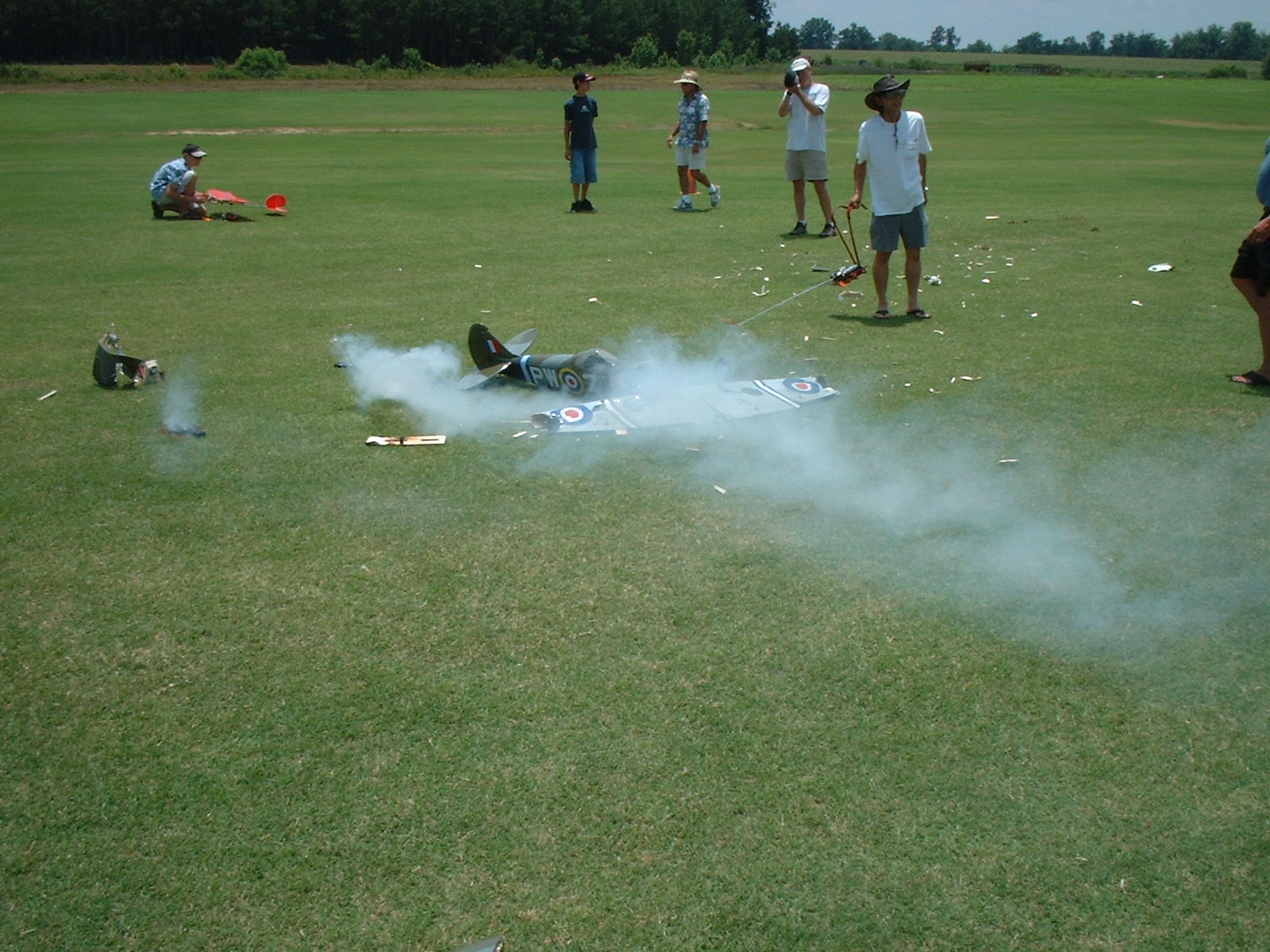
If they had been powered by Lipo packs, there could have been a fire. Here is an example.
Not exactly a raging inferno, but a fire just the same:
Much smaller fire than the turbine crash caused that I saw the last time I was in Houston.
Pat MacKenzie
Iskandar Taib · Jul 22, 2004 12:47 AM
RE: Electric Revolution at the NATS? FAI's Point of View#76 sourceI have been following this thread closely, since I am interested in stunt, and I am now very active in R/C electric. I've gone back to flying some R/C Pattern and this year I've been flying a model called a Partner that is electric powered. I've attached a pic of it. It uses a Hacker C50 14XL brushless motor on a 6.7/1 gear drive, powered by a LiPo pack by Thunderpower. The packs I use are 10S3P packs. This turns a 22-12 prop at 5,800 rpm for a 10 minute flight. The model weighs 11 pounds and has awesome performance.
The cleanliness and lack of vibration with electric really makes it an attractive alternative. But IMO, at least in R/C pattern, it is a competitive advantage. The slower, steady speed in the horizontals yet having excellent vertical makes the package much easier to fly in the aerobatic box. Seems like electric could end up being an actual competitive advantage in Stunt, but of course only time and further development will tell.
BTW, the R/C Pattern Nationals have just concluded. Jason Shulman flying an electric won F3A, the top class. And my good friend Jerry Budd placed 2nd in Masters, the equivalent of PAMPA Advanced, flying my Partner. He did really well considering he only had 30 flights on it before leaving for the Nats.
Electric will certainly not be for everyone, but hang on to your hats, it is coming on strong!
Iskandar Taib · Jul 23, 2004 11:46 PM
RE: Electric Revolution at the NATS? FAI's Point of View#88 sourceIn the old days, electric modelling columnists always said to put a fuse in the circuit, because a stalled motor draws a great amount of current, resulting in melted wires and/or a fire. Might not be necessary these days with the newer speed controllers and with brushless motors.
Minnesotamodeler · Jul 21, 2004 10:06 PM
RE: Electric Revolution at the NATS? FAI's Point of View#72 source>>over: You can't have "one" insulated line, due to creating
>>uneven line drag. Works electrically, of course, but you'll
>>end up with some *serious* control problems: Imagine the
>>drag-related arc of one line being a foot or two (or more)
>>behind the other, and consequences of effective
>>length...perhaps varying as the lines twist from maneuvers,
>>as well as plane speed and changing line tension. Anyone
>>for an instantly-adjustable handle to compensate in flight?
>>Bottom line: Both lines insulated, or none. If I'm wrong,
>>"someone stop me!" (Jim Carey, "The Mask")
>>--Ray
>huh? where did "one" insulated line come from? I think
>you're absolutely correct: one insulated and one uninsulated
>would be a bad plan... none insulated would be a bad plan
>
See posts #48 and 60. Or maybe these were jokes I took seriously?
My "or none" option meant, of course, not using electric power at all.
--Ray
Trostle · Jul 22, 2004 12:44 AM
RE: Electric Revolution at the NATS? An FAI Point of View a#75 sourceI also want to make reference to Peter Germann's post #40 above that gives the words in the rules changes that are to be adopted by the FAI for the CL Aeorbatics (F2B) event in 2005.
Unless there has been some editing of the proposal that was made to change the AMA rules during this current cycle, the wording from the FAI rules change to increase the size of the I.C. moters to 15cc also included provisions to allow electrics and turbines has been proposed and accepted by the AMA CL Aerobatics Contest Board to become effective with the 2005 Rulebook. Line sizes and pull test for the electrics defined in the change proposal are to be those currently listed in the AMA Rulebook for Electric Control Line Precision Aerobatics, event #608.
I guess it is not too surprising that many competitors in CL Precision Aerobatics are not familiar that there already is an electric CL Precision Aerobatics event in the current rulebook. The proposed and I believe the approved changes to the current PA events (Events 322,323, 324, 325 and 326) will incorporate the provisions for electrics as in the proposed FAI rules changes as outlined by Peter in his post.
Keith
Iskandar Taib · Jul 22, 2004 09:45 PM
RE: Electric Revolution at the NATS? An FAI Point of View a#82 source>Precision Aerobatics are not familiar that there already is
>an electric CL Precision Aerobatics event in the current
>rulebook.
It's interesting what you find when you poke around in rulebooks. I had no idea, for instance, that there was an entire "F6" category in the FAI rules that covers events such as freestyle helicopter aerobatics and synchronized aerobatics to music. It's called "Aerosport Promotion", and I suspect these events are meant to be held together with full-size aerosport events. I've never seen mention of these events being held in any magazine I've ever read. F5 (electric RC) I had heard about, but I didn't realize there were so many events under that category.
dirtydan · Jul 23, 2004 02:47 PM
RE: Electric Revolution at the NATS? An FAI Point of View a#87 sourcebob Z
Splish!
That sound final act in my latest catch-and-release. Sometimes it is just too easy and thus of no interest.
Congratulations to Mike for sticking with what I continue to regard as a flawed concept, putting it to all us naysayers by actually entering a big-time contest and doing well with his model.
I will admit to a fair amount of disappointment in realizing there is some sort of safety hazard involved with these trick batteries, this sometimes leading to actual flames. And yet, by definition, there is no volatile fuel on board, this able to serve quite nicely in elevating a mild annoyance into some serious fun.
Maybe we need a cruel ruel specifying a minimum quantity of something like propylene oxide be carried by all electric CL models. Black powder would be an acceptable substitute.
Dan